
Can Two Separate Runs of the Same Suit Count in Indian Rummy?
A gap between two runs does not make either run invalid. What matters is whether each group stands on its own.
Summary: Two non-overlapping natural runs of the same suit can be counted as two sequences under common 13-card Indian Rummy grouping rules. Check the active table, the required pure sequence and all 13 physical cards before declaring.
Test each run on its own
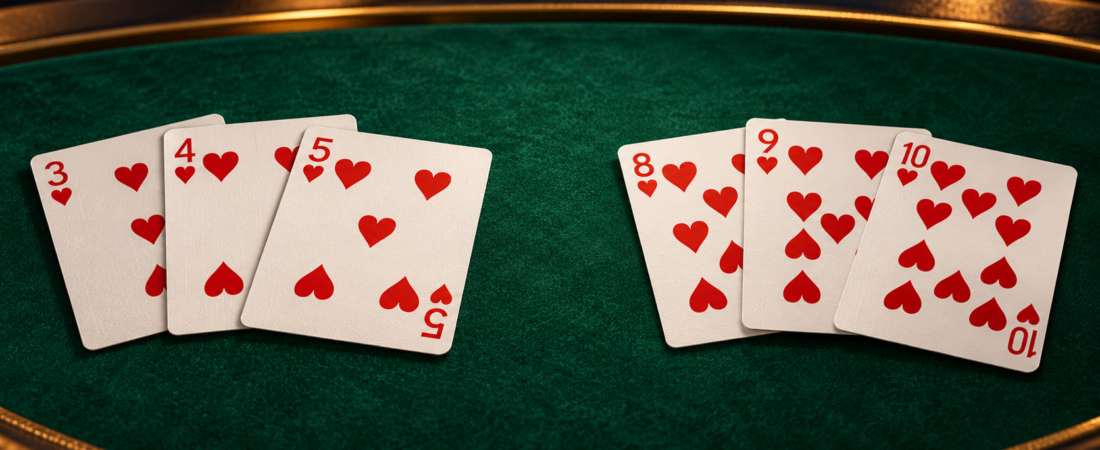
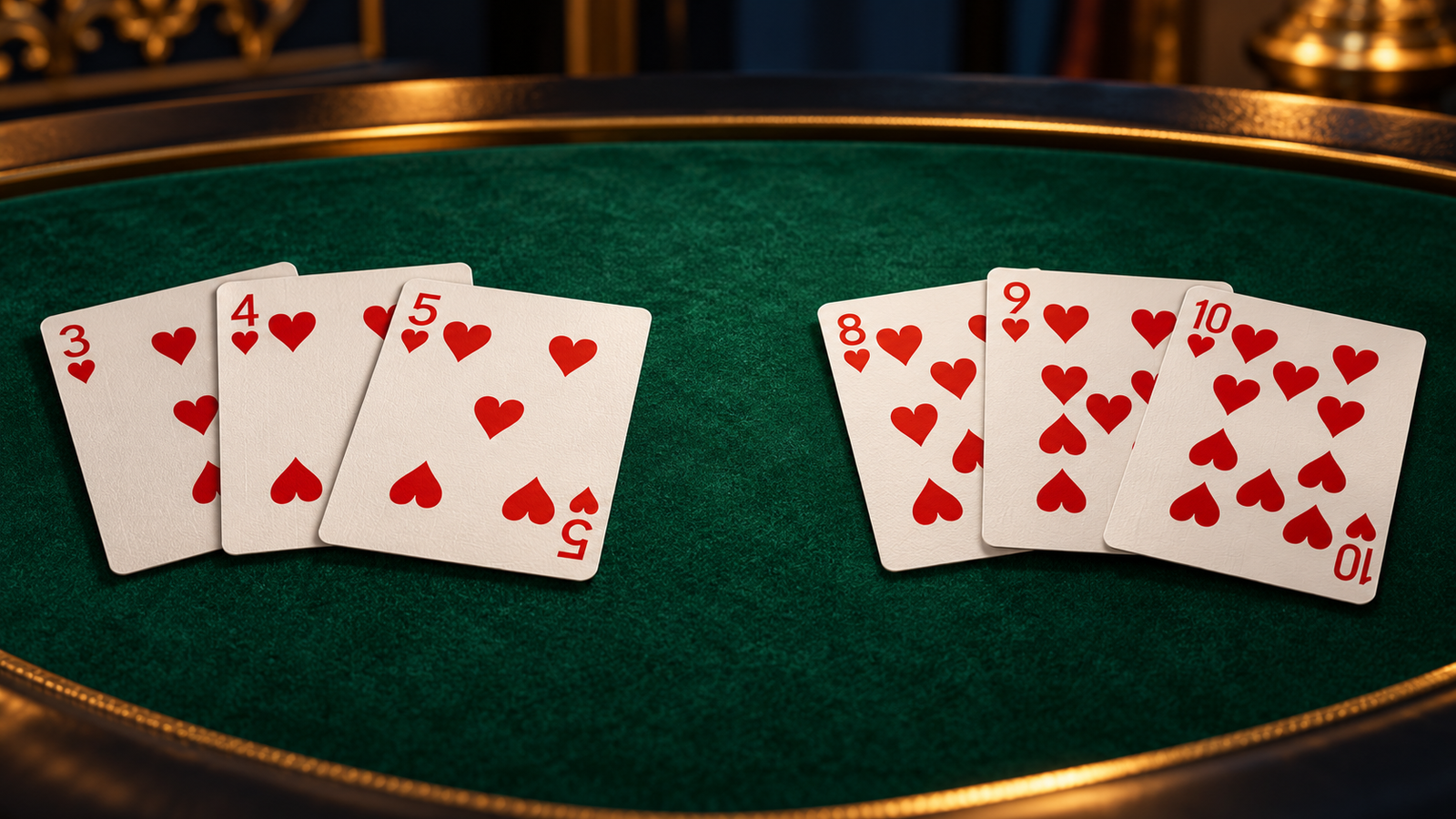
Suppose you hold 3H-4H-5H and 8H-9H-10H, where H means hearts. Each group has three consecutive cards of one suit. They are two separate runs even though 6H and 7H are absent. You do not need to bridge the space between them to count each completed run.
Assume all six are natural cards and none is acting as a Joker. Under common 13-card Indian Rummy grouping rules, each is a pure sequence. The two groups use six different physical cards. If your table has a different rule, follow its current instructions.
A gap is not a shared card
Put a finger on each proposed group and read it from left to right. The first ends at 5H; the second begins at 8H. The absent 6H and 7H do not belong to either group, and neither group borrows a card from the other.
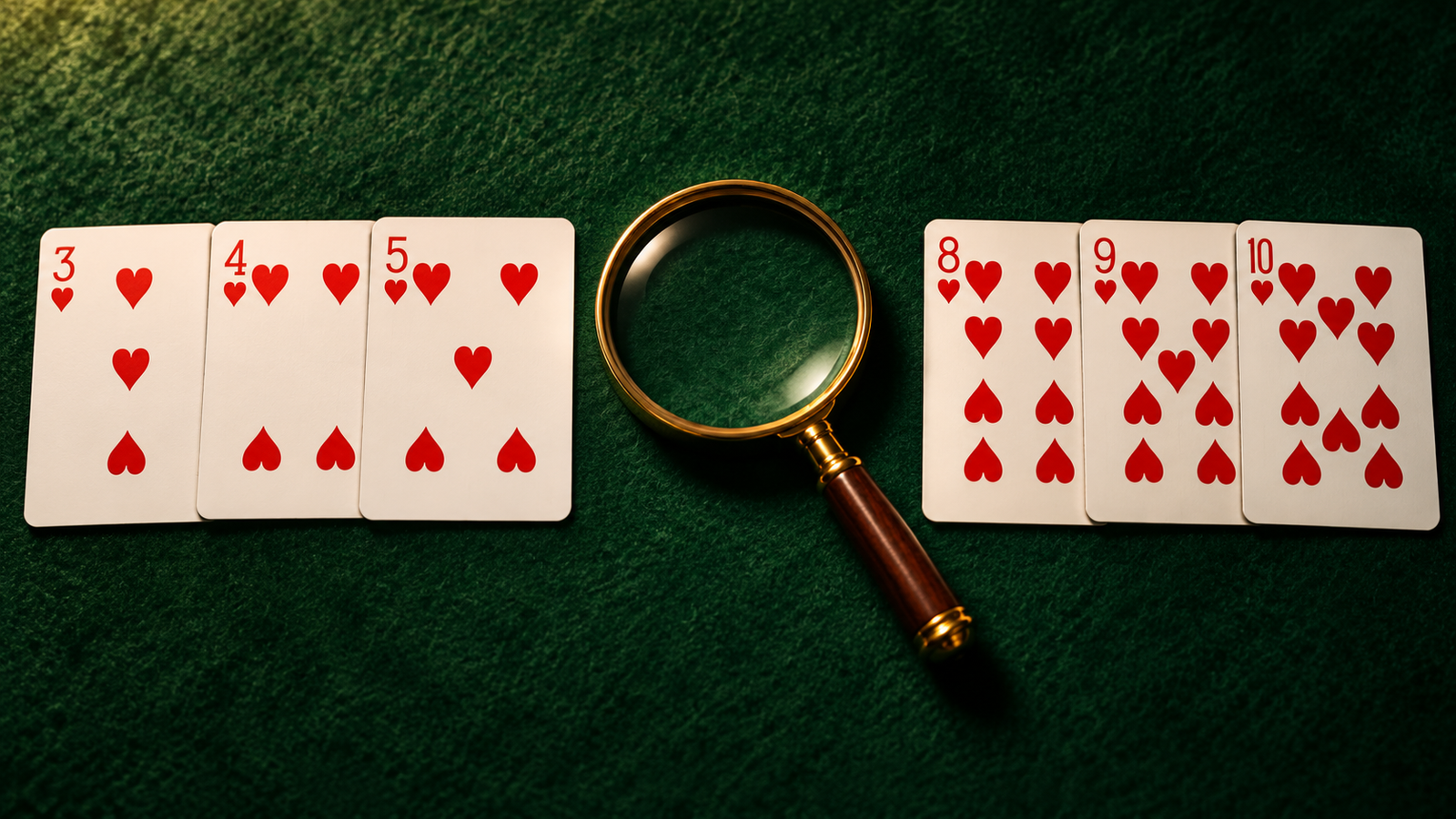
This image shows the six cards used in the two-run check. It does not show a complete declaration hand. Compare the single continuous run split if your cards have no gap, and the one-card, one-group check if a proposed run overlaps another group.
Build the full 13-card check
For a complete teaching example, add 2C-3C-4C-5C and KH-KD-KS to the two heart runs. Here C means clubs, while KH, KD and KS are kings of hearts, diamonds and spades. The groups contain 3 + 3 + 4 + 3 = 13 different physical cards. Assume the pictured ranks are not designated as wild Jokers, and check the active table’s grouping requirements. The first heart run supplies a pure sequence; the second heart run and the club run also have no Joker substitutions.
The example shows why a separate set is not the answer to the same-suit question. It does not say that any six-card fragment alone is ready to declare. Read the Indian Rummy rules and verify the entire hand, including the second sequence, before using a declaration control.
A short decision checklist
- Check that each proposed run has at least three consecutive cards of one suit.
- Identify any Joker substitution; do not label a substituted run pure.
- Count each physical card in one group only.
- Check the remaining cards and the active table’s declaration rules.
- Pause before declaring if any card or table condition is unclear.
18+ only. Practise responsible play, keep time and budget limits, take breaks and do not chase losses. Follow local laws and the active table rules. See the responsible gaming guide.
FAQ
Do both sequences have to be different suits?
Under common Indian Rummy grouping rules, no. Two separate same-suit runs can count if each is valid, uses different physical cards and the complete hand meets the active table rules.
Must I have 6H and 7H between these runs?
No. The 3H-4H-5H and 8H-9H-10H groups are separate completed runs; a gap between them is not a gap inside either run.
Are the six heart cards a valid declaration by themselves?
No. A declaration requires checking the complete hand and the active table rules, including the required pure sequence and second sequence.
Glossary
Responsible play note
Indian Rummy is a skill-based card game, but no article, checklist, or tournament routine can guarantee results. Use these guides to improve decisions, keep time and budget limits, and follow the laws and table rules that apply in your location.