
One Card, One Group: Avoid Double Counting in Rummy
A seven can complete a run or a set in your plan. If you own only one copy, it cannot complete both at once.
Summary: Check the physical cards behind your written groups. Two possible uses for one card are alternative plans, not two completed groups.
Separate a possible group from a completed group
A card can suggest several useful arrangements. A written plan can make those alternatives look like completed groups. Move each physical card into one group before judging the whole hand.
This check complements the 13-card coverage check. A correct sum does not prove that the entries represent different cards. Check the actual cards against the active Indian Rummy rules.
Example: one seven claimed twice
Take these five physical cards: 5H, 6H, 7H, 7C and 7D. H means hearts, C clubs and D diamonds. Assume these are natural cards and none of their ranks is the designated wild Joker.
You can write 5H-6H-7H as a pure sequence, or 7H-7C-7D as a set. Each proposed group has three cards, but the two written groups share the same 7H. You have five cards, not six. With 7H in the hearts run, 7C-7D is only a pair. With 7H in the set, 5H-6H is only a two-card fragment.
This is a five-card illustration within a larger hand. Neither arrangement establishes that a complete 13-card declaration is valid. The remaining cards and the table requirements still matter.
Move the card, then inspect what you left behind
When moving 7H from the run to the set, inspect the run immediately. Do not keep calling it complete from memory. Compare the resulting whole-hand arrangements, including whether a pure sequence remains and which cards are still ungrouped.
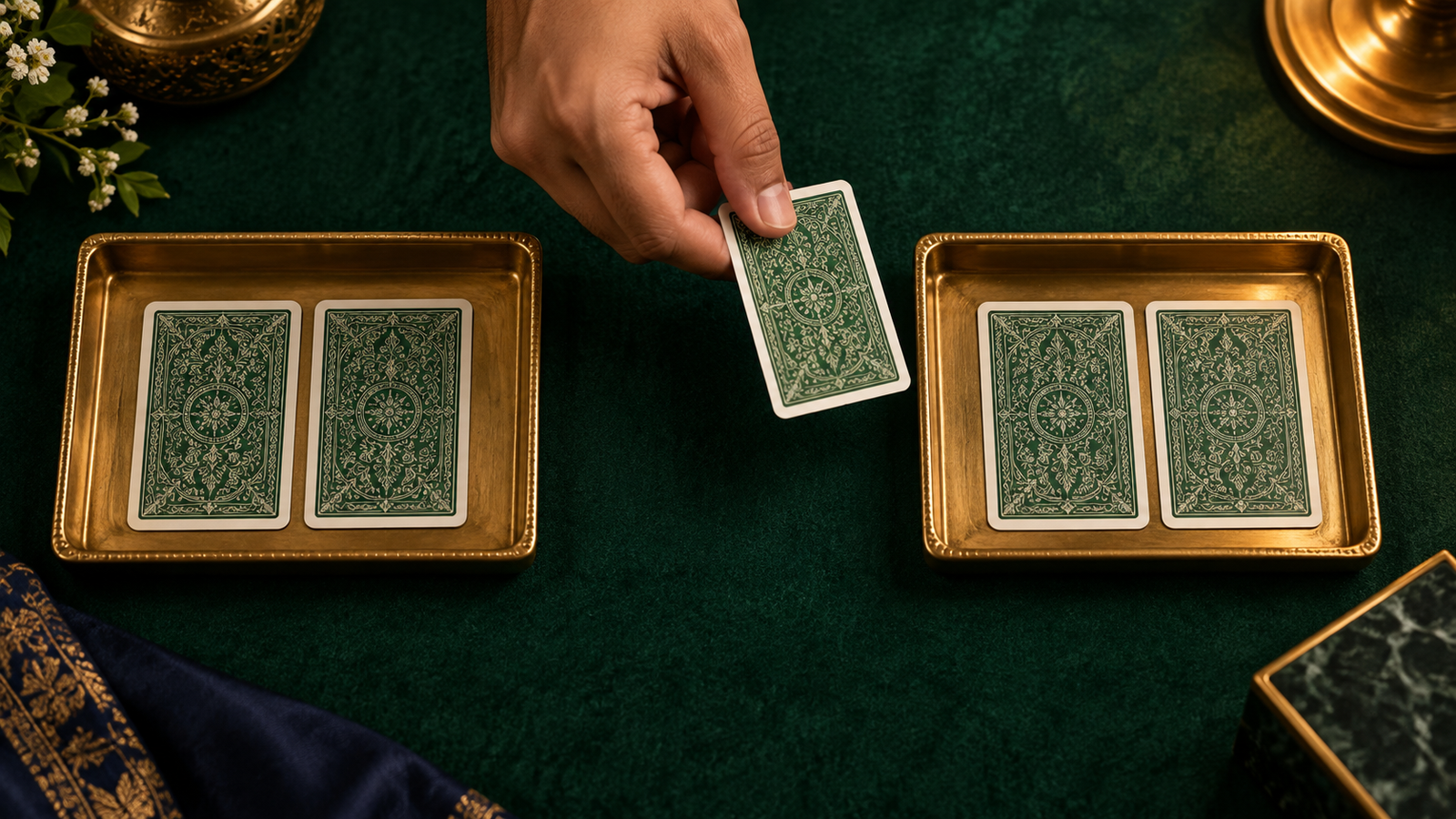
The face-down illustration shows allocation only. Hidden ranks and suits cannot demonstrate a valid sequence or set.
A Joker may change an arrangement if its use is permitted, but imagining one does not supply a card you hold. The Joker allocation guide addresses that separate decision.
Distinguish another copy from another use
In a game using multiple decks, a second physical 7H is a separate card. If you actually hold it, you can examine a plan that places one copy in the hearts run and the other in the set with 7C and 7D. Check the real copies and the active rules; the notation alone cannot establish your holdings.
This does not make two identical 7H cards a valid same-rank set together. Card identity and the different-suit requirement are separate checks. Review the same-suit duplicate check before treating a duplicate as a useful set card.
Checklist before declaring
- Use the final 13-card arrangement, accounting for the required discard.
- Place every physical card in exactly one group.
- Check whether any written card represents the same physical copy twice.
- After moving a card, recheck both the receiving group and the group it left.
- Check every sequence, set, Joker use and the full declaration requirements.
For practice, lay out the five-card example and try both allocations. Name the unfinished fragment each time. This makes the cost of a move visible without predicting a draw or promising a result.
18+ only. Practise responsible play, set time and budget limits, take breaks and do not chase losses. Follow local laws and the active table rules. Read the responsible gaming guide.
FAQ
Can one card belong to a sequence and a set at the same time?
One physical card cannot be allocated to both groups in the same final arrangement. Those are alternative uses.
Does writing six card names prove I have six cards?
No. In 5H-6H-7H and 7H-7C-7D, the repeated 7H may refer to the same physical card.
Is a second identical copy always useless?
No. A distinct copy may support a different group. Check the complete arrangement and the active rules.
Glossary
Responsible play note
Indian Rummy is a skill-based card game, but no article, checklist, or tournament routine can guarantee results. Use these guides to improve decisions, keep time and budget limits, and follow the laws and table rules that apply in your location.