
Joker Allocation: Fill a Sequence Gap or Save It for a Set?
A Joker is most valuable where it removes the hand’s hardest valid-group bottleneck, not automatically in the first visible gap.
Summary: Protect the pure sequence first, then compare the sequence gap and set by declaration need, natural outs, completion distance, and point exposure. Assign the Joker provisionally and move it when a natural card improves the hand. Joker management can reduce mistakes but cannot guarantee results.
Protect purity
A Joker substitute cannot make the mandatory pure sequence.
Count natural outs
Prefer natural completion when several useful cards can still extend a group.
Find the bottleneck
Use the Joker where one missing card blocks the most important valid group.
Reassign freely
Move the Joker when a natural draw completes its current group.
Declaration need comes before convenience
In common 13-card Indian Rummy, a valid declaration needs at least two sequences, including one pure sequence. A Joker may substitute in an impure sequence or, subject to table rules, help complete a valid set, but it cannot replace the natural-card requirement of the pure sequence. If the hand lacks its second sequence, that structural need usually matters more than completing an optional set.
Joker allocation checklist
- Confirm a natural pure-sequence route before using any Joker elsewhere.
- Check whether the hand still needs a second sequence.
- List the natural cards that can complete each candidate group.
- Compare one-card gaps with open-ended routes that have multiple natural outs.
- Use the Joker on the group with the greatest declaration value and fewest realistic outs.
- Reassign it immediately when a natural completion arrives.
- Reduce loose high-card points and keep session and budget limits.
Example: sequence bottleneck versus king set
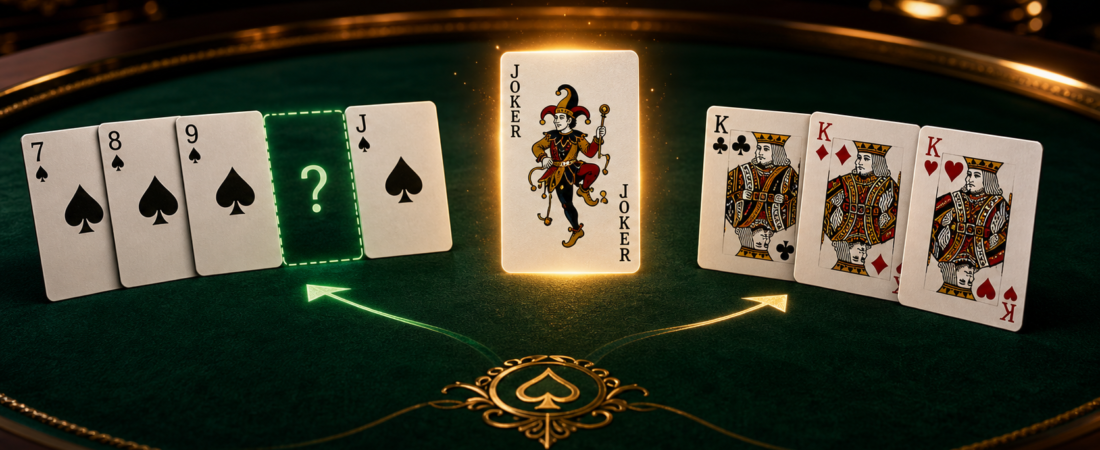
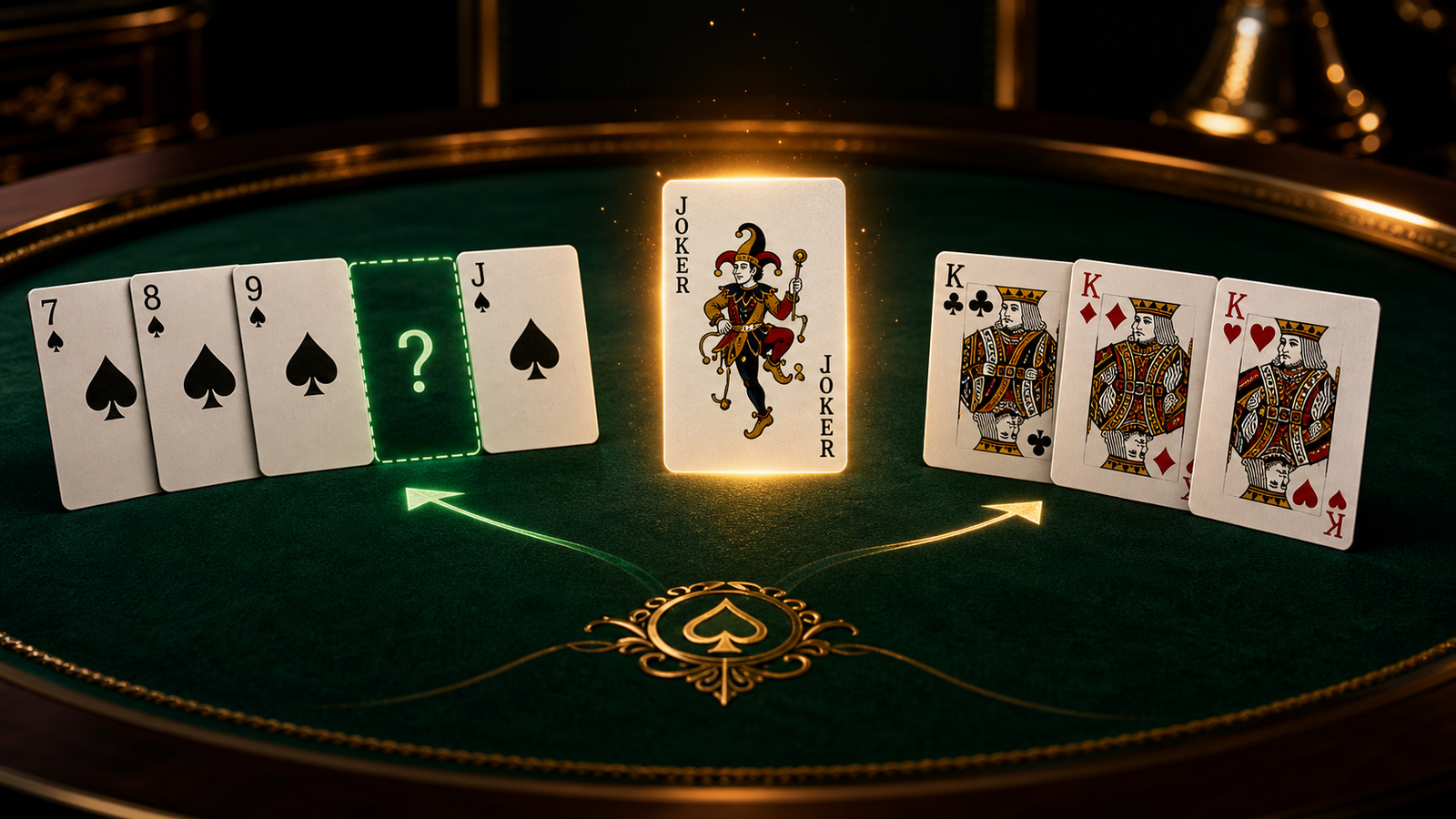
Suppose 4D-5D-6D is your pure sequence. You hold 7S-8S-10S, KC-KD, a Joker, and other cards. The spade group has a one-card gap at 9S and may be your only clear second-sequence route. The king pair needs one of the remaining kings to form a set. Placing the Joker as 9S creates an impure second sequence and meets a declaration-critical need; using it with the kings completes a set but leaves the required second sequence unresolved. If 9S arrives later, move the Joker to the kings or another bottleneck.
Stable rules and platform differences
Indian Rummy platforms can differ in deck count, wild-Joker selection, printed-Joker treatment, duplicate-card rules, scoring caps, and how sets with Jokers are validated. Always check the active table rules. Gin Rummy normally uses no Joker and relies on knocking and deadwood scoring, so its meld decisions are not interchangeable with 13-card Indian Rummy Joker strategy.
FAQ
Should a Joker fill a sequence gap or complete a set?
Protect the pure sequence first, then prioritise the group needed for a valid declaration, especially the second sequence, while comparing natural outs.
Can I move a Joker after assigning it to a group in my hand?
Yes, hand organisation is provisional before declaration; move it when a natural card creates a better valid arrangement, subject to the active table interface.
Does better Joker allocation guarantee a win?
No. It can reduce structural mistakes but cannot control draws, opponents, or declaration timing.
Glossary
- Printed Joker: A dedicated Joker card that may substitute within permitted impure groups under the active rules.
- Wild Joker: A selected rank whose matching cards act as Jokers for that deal, subject to platform rules.
- Natural out: A specific non-Joker card that can complete or validly extend a candidate group.
Responsible play note
Indian Rummy is a skill-based card game, but no article, checklist, or tournament routine can guarantee results. Use these guides to improve decisions, keep time and budget limits, and follow the laws and table rules that apply in your location.