
Can a Joker Sequence Count as Your Second Sequence in Indian Rummy?
A Joker can make a second sequence flexible. It does not remove the need to protect a natural pure sequence first.
Summary: Under common 13-card Indian Rummy grouping rules, a Joker-supported run can count as a second sequence when the hand also has the required natural pure sequence. Check the active table rule, the cards represented by the Joker and every group in the full hand before declaring.
Separate the two sequence checks
Start by locating the natural pure sequence. It must use consecutive cards of one suit without a Joker substitution. Keep that group separate while you assess the rest of the hand.
Then inspect the proposed second sequence. For example, 4S, a Joker and 6S may represent a run with 5S supplied by the Joker under common rules. That makes it an impure sequence, not a pure sequence. The active table rule still decides whether the hand can be declared.
Read the Joker as a missing card, not a free pass
Name the card the Joker is standing for before you count the group. If the surrounding cards do not form one consecutive same-suit route, the Joker does not repair every gap. A Joker in a set or in a different run cannot be counted twice.
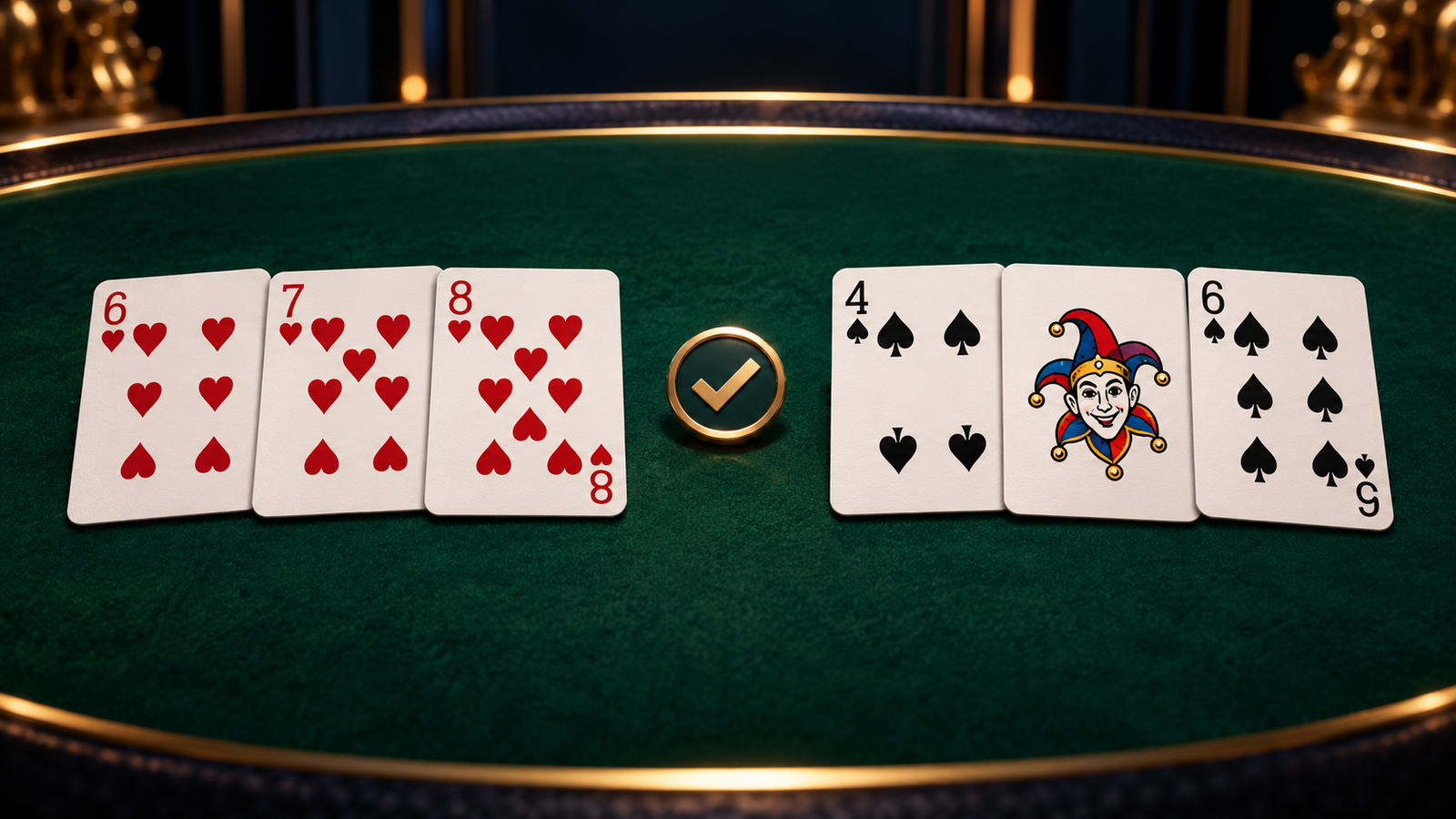
The image is a grouping example, not a complete declaration hand. Compare the pure-sequence recheck after drawing a Joker if the Joker changes your plan, and the one-card, one-group check if two groups appear to use the same card.
Use a complete-hand declaration audit
Suppose a 13-card teaching hand contains 6H-7H-8H as a natural pure sequence, 4S-Joker-6S as a second sequence, 9C-10C-JC and QD-QH-QS-QC. The groups account for 3 + 3 + 3 + 4 = 13 cards. The natural heart run is the pure sequence. The spade group remains Joker-supported.
This example does not set a universal rule for every room, scoring format or Joker designation. Check the Indian Rummy rules, the table’s current declaration instruction and all physical cards before using a declaration control.
A declaration pause checklist
- Identify one natural pure sequence with no Joker substitution.
- Name the rank and suit represented by each Joker.
- Check that the second sequence is consecutive and uses one suit.
- Count every physical card in one group only.
- Pause if the active table rule or any group is unclear.
18+ only. Practise responsible play, keep time and budget limits, take breaks and do not chase losses. Follow local laws and the active table rules. See the responsible gaming guide.
FAQ
Can a Joker sequence be the required pure sequence?
No. A pure sequence uses consecutive cards of one suit without a Joker substitution. A Joker-supported run is an impure sequence under common Indian Rummy grouping rules.
Can the same Joker support two groups?
No. Count each physical card in one group only. Choose the group that best fits the complete hand and active table rules.
Does a Joker-supported second sequence guarantee a valid declaration?
No. You must check the entire 13-card hand, the required pure sequence and the current table rules before declaring.
Glossary
Responsible play note
Indian Rummy is a skill-based card game, but no article, checklist, or tournament routine can guarantee results. Use these guides to improve decisions, keep time and budget limits, and follow the laws and table rules that apply in your location.