Wild Joker vs Printed Joker in Indian Rummy: What Changes in Your Strategy?
Jokers make Indian Rummy hands more flexible, but wild Jokers and printed Jokers can also confuse beginners who place them before the hand structure is ready.
Summary: A printed Joker is the Joker card in the deck, while a wild Joker is usually selected for the round. Both can support impure sequences or sets in many Indian Rummy formats, but neither should be counted as the required pure sequence; use this as responsible play education, not a promise of results.
Printed Joker
A fixed Joker card from the deck that can support many impure groups.
Wild Joker
A round-specific Joker rank or card, depending on table rules.
Pure sequence
Must stay natural; do not use either Joker as a substitute.
Rule caveat
Exact Joker handling can differ by platform, so read the table rules.
What is the difference?
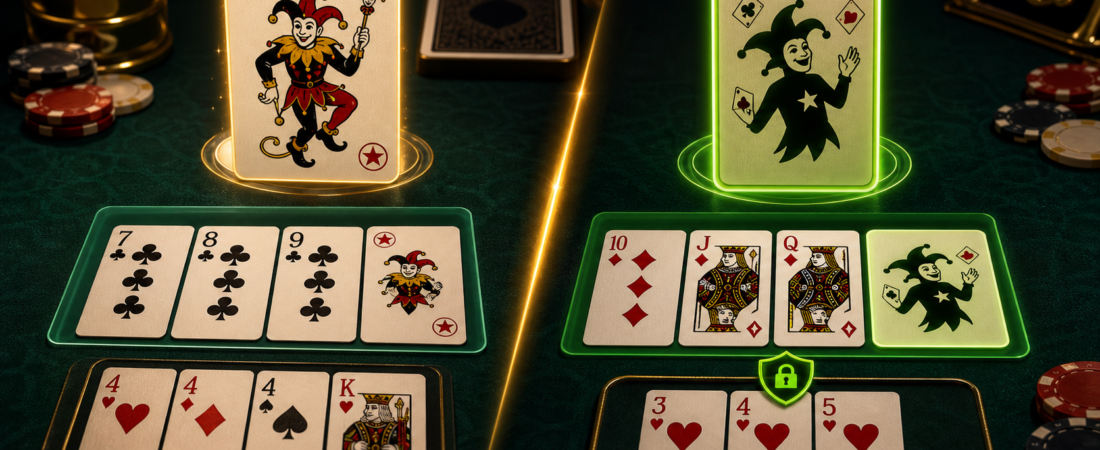
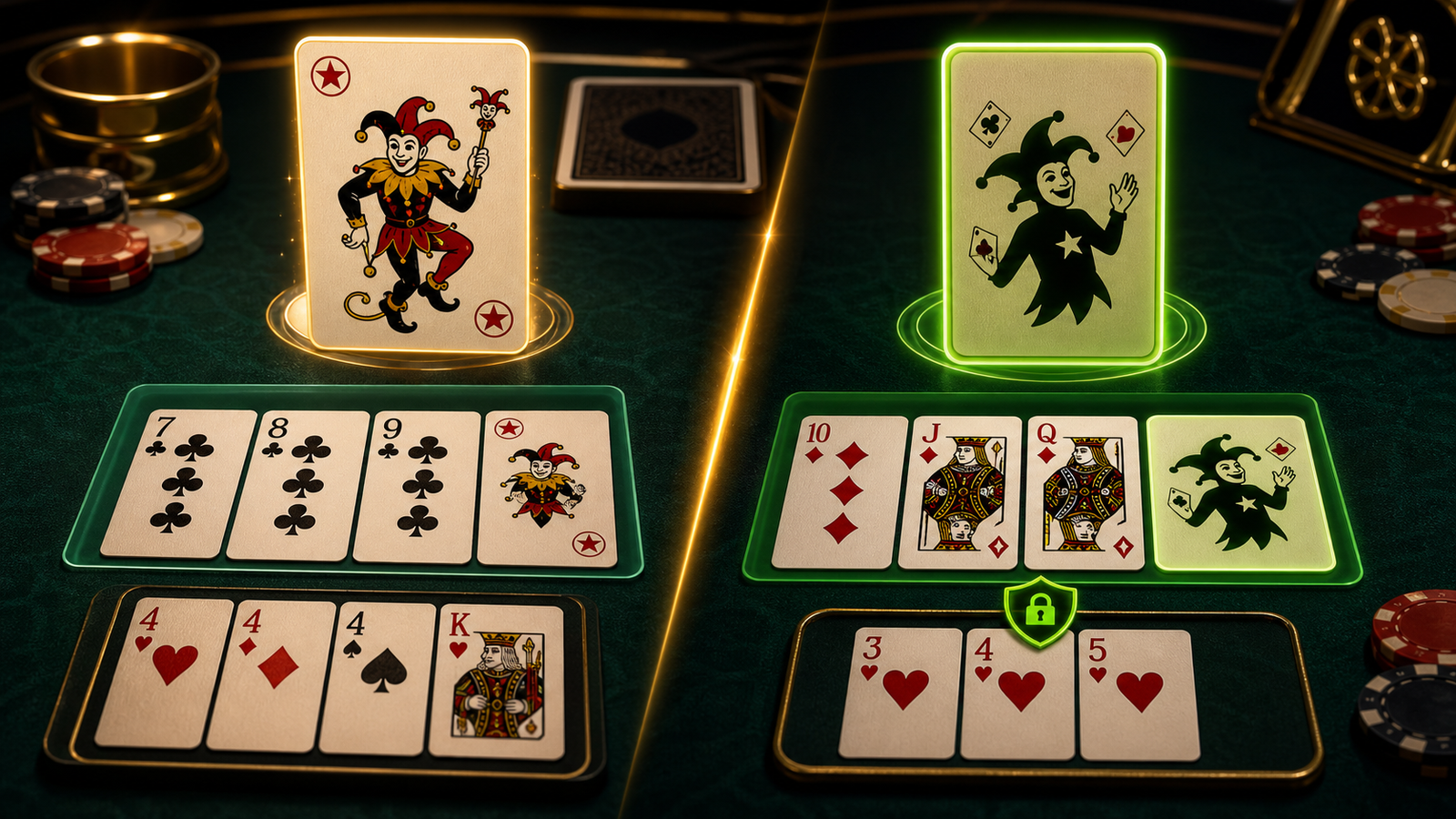
The printed Joker is the Joker card printed in the deck. A wild Joker is usually chosen for that round, often by revealing a card whose rank then acts as Joker support. In 13-card Indian Rummy, both are useful because they can complete difficult impure sequences or sets.
Where Jokers help most
Jokers help when they finish a near-ready group. For example, 7♣ 8♣ printed Joker can act as an impure sequence if it follows the table rules. Q♥ Q♠ wild Joker may also become a valid set support. The strongest use is usually the one that removes the biggest gap while preserving your natural pure sequence.
Joker checklist before declaring
- Confirm one pure sequence exists without printed or wild Joker substitution.
- Check whether each Joker is placed in a legal impure sequence or set.
- Make sure one card is not being counted in two groups.
- Review loose high cards before committing to declaration.
- Check platform-specific Joker and scoring rules before high-stakes play.
Example hand decision
If you hold 5♦ 6♦ 7♦, 10♣ J♣, K♥ K♠, printed Joker, and the wild Joker rank is 9, your diamond run is already pure. Now the printed Joker can support 10♣ J♣ printed Joker as an impure sequence, while a wild 9 may support another weak group. The key is not which Joker looks stronger; it is which placement completes the cleanest legal hand.
FAQ
Can a wild Joker make a pure sequence?
No. If it is used as a substitute, it creates an impure sequence. A pure sequence must be natural.
Is printed Joker better than wild Joker?
Not always. The better Joker depends on your current hand, missing cards, and platform rules.
Are Joker rules identical on every platform?
No. The broad concept is stable, but exact selection, scoring, and table settings can vary by platform.
Glossary
- Printed Joker: The Joker card printed in the deck and used as flexible support in many Indian Rummy formats.
- Wild Joker: A rank or card selected for a round that can act as a Joker under that table’s rules.
- Impure sequence: A same-suit sequence completed with help from a Joker substitute.
Responsible play note
Indian Rummy is a skill-based card game, but no checklist, Joker, or strategy can guarantee results. Use these guides to improve decisions, keep time and budget limits, and follow the rules and laws that apply in your location.