


Wild Joker Revealed: Recheck Your Indian Rummy Hand in Four Steps
The wild Joker changes the role of matching-rank cards, but it does not remove the need for a natural pure sequence.
Summary: After the wild Joker rank is known, separate natural sequence cards from substitutes, protect at least one pure sequence, use Jokers on the hardest declaration bottleneck and review loose points. Joker selection and validation can vary by table, so confirm the active rules. No arrangement guarantees an outcome.
Protect purity
Keep one same-suit natural run free of Joker substitution.
Mark Jokers
Identify every card that acts as a wild Joker under the active deal rules.
Rebuild routes
Assign substitutes to the second sequence or another declaration bottleneck.
Review loose points
Compare unused high cards after the new arrangement is visible.
What the wild Joker reveal changes
In common 13-card Indian Rummy, a rank selected for the deal may act as the wild Joker, while printed Jokers may also be available under the active rules. Those substitutes can help form permitted impure groups, but the declaration still needs at least two sequences including one pure sequence made without Joker substitution.
Do not pull a natural card out of a nearly complete pure sequence merely because its rank can act as a Joker elsewhere. Compare the whole hand first.
Four-step hand recheck
- Sort by suit and lock the strongest natural pure-sequence route.
- Mark each printed or wild Joker and remove it temporarily from speculative groups.
- Identify the hardest remaining requirement, usually the second sequence, and place substitutes there provisionally.
- Compare loose cards by realistic connections and unmatched point exposure.
- Recheck after every draw because a natural completion may free a Joker.
- Confirm the platform’s Joker and declaration validator before submitting.
- Use fixed time and budget limits and never chase a result.
Example: keep the natural run intact
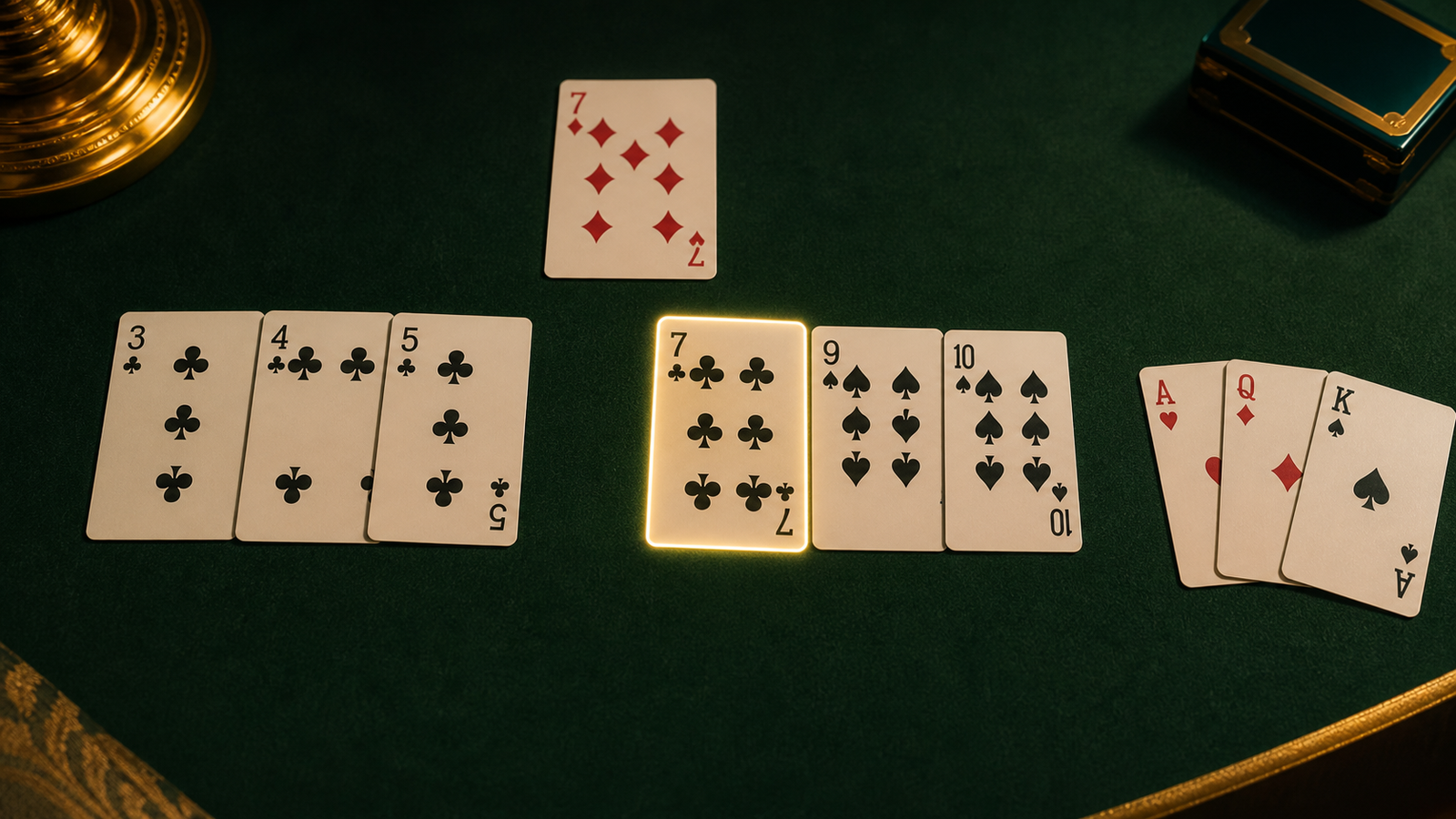
Suppose 5H-6H-7H forms a natural pure sequence and sevens are the wild Joker rank. You also hold 9S-10S, a 7C and two kings. The 7H may technically share the selected rank, but moving it breaks the ready pure sequence. Keep 5H-6H-7H intact and consider using 7C as the substitute for 9S-10S if the table validator permits that arrangement.
If JS arrives, the spade route becomes natural and the Joker can be reassigned to another incomplete group. Treat every placement as provisional until declaration.
Platform differences and responsible limits
Wild-Joker selection, printed-Joker treatment, duplicate-card handling and valid group checks can differ by platform. Always follow the active table rules. Gin Rummy commonly uses different meld and deadwood rules, so its end-hand logic should not be mixed with Indian Rummy declarations. Better organisation can reduce mistakes but cannot control the draw or guarantee results.
FAQ
Can a wild Joker be used in the mandatory pure sequence?
A pure sequence must be formed naturally without Joker substitution; confirm how the active validator treats the selected-rank card in its natural position.
Where should I place a wild Joker first?
After protecting the pure sequence, place it provisionally in the group that removes the most important declaration bottleneck.
Should I keep a Joker fixed after arranging the hand?
No. Reassign it when a natural draw completes its current group or creates a stronger route.
Does holding more Jokers guarantee a win?
No. Jokers add flexibility, but draws, opponent actions, timing and valid grouping still matter.
Glossary
- Wild Joker: A selected rank whose matching cards act as substitutes for that deal under the active rules.
- Pure sequence: Three or more consecutive cards of one suit formed without Joker substitution.
- Declaration bottleneck: The missing valid group that most directly prevents the hand from meeting declaration requirements.
Responsible play note
Indian Rummy is a skill-based card game, but no article, checklist, or tournament routine can guarantee results. Use these guides to improve decisions, keep time and budget limits, and follow the laws and table rules that apply in your location.