

Saw the Card You Need? Count Copies Before Abandoning a Rummy Run
Seeing one six of hearts does not settle whether another copy exists. Start with the table rules, then separate known cards from unknown ones.
Summary: A visible card is evidence about that physical copy. Use the confirmed deck count and reliable observations to review a route, without turning incomplete information into draw odds.
Separate a card identity from a physical copy
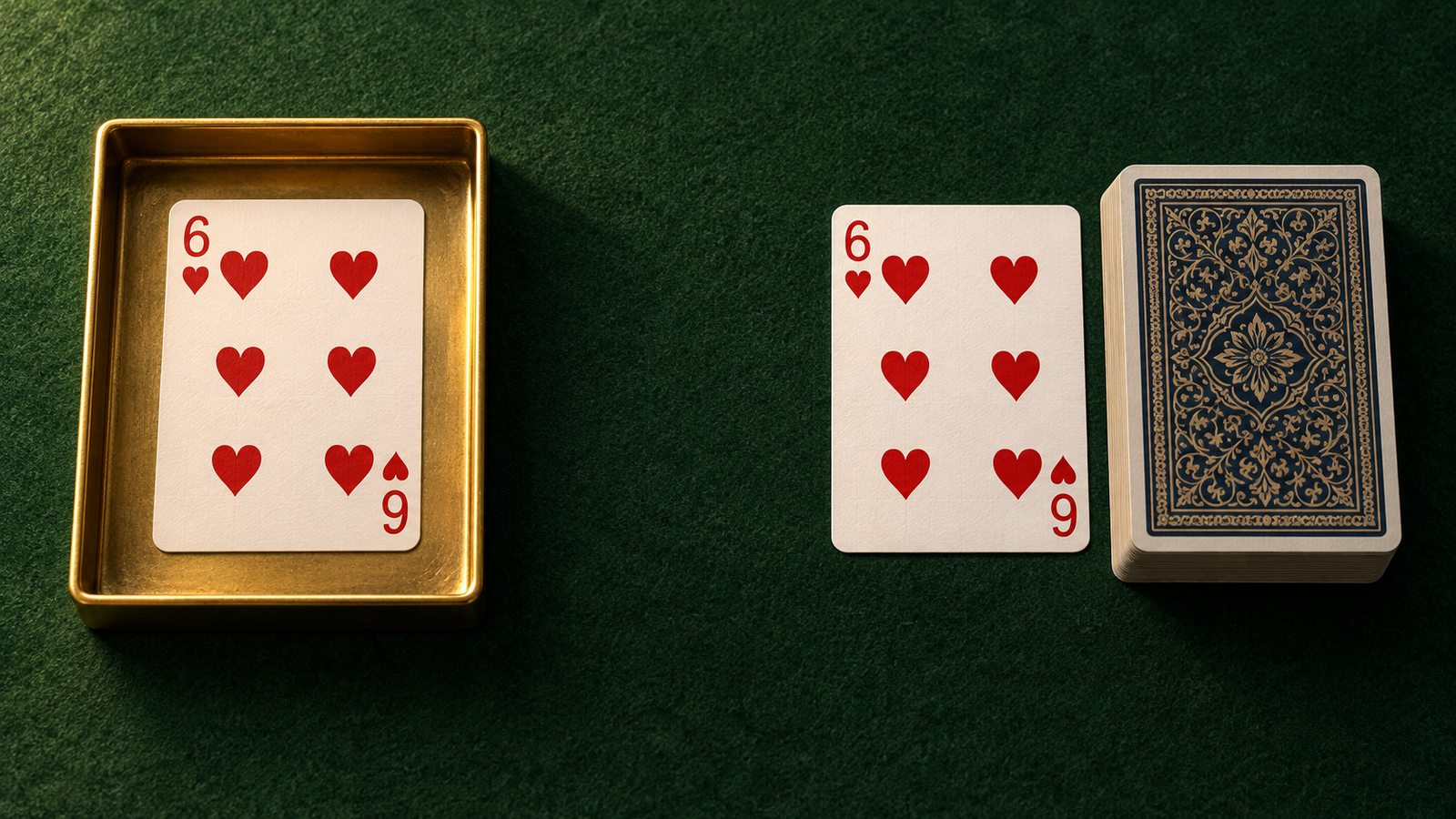
The name 6H means six of hearts. In a game using two complete standard decks, there are two physical copies of that card before dealing. Seeing one copy does not tell you where the other is. Check the active table rules for the actual deck count; do not assume every Indian Rummy table uses the same number.
This distinction matters when you hold 5H-7H and want a natural 6H to close the gap. Seeing a six tells you about that copy. It does not prove that the unseen copy is in the draw pile or available on your next turn.
Use a known, unknown and accessible checklist
- Confirm the number of decks and any rules that change the card supply.
- Name the exact card needed, including its suit.
- Count only distinct physical copies you can reliably account for.
- Keep location separate from existence: an unseen copy may be in another hand.
- Check whether any visible copy is currently available to pick up under the table rules.
- Compare another route and your loose points before choosing a discard.
A card seen in two different turns may be the same physical card moving between locations. Do not count it twice merely because you remember two sightings. If you cannot distinguish the copies reliably, record that uncertainty.
Example: one visible six in a two-deck game
Assume a table uses exactly two complete decks, and none of 5H, 6H or 7H is a designated wild Joker. You hold 5H-7H and have reliably identified one 6H in a location you cannot currently pick from. At most one other physical 6H remains unaccounted for. Its location is unknown. That is a supply limit, not a forecast of your next draw.
If you can account for both distinct copies in inaccessible locations, there is no unaccounted-for natural 6H under these assumptions. Reconsider waiting on that exact gap now. Future availability can change if a card later becomes legally accessible. Do not generalise this example to a different deck count or a platform with different card-handling rules.
Compare routes without inventing percentages
The useful question is whether to keep allocating cards to the gap. Compare the gap with another unfinished route, the need for a pure sequence, and the cost of retaining loose cards. A Joker substitution cannot provide the required pure sequence. Read the Indian Rummy rules before assigning a Joker to this role.
The gap versus open-ended run guide compares route shapes. This copy check adds a different constraint: which physical completion cards can you actually account for? Without reliable information about the hidden cards and draw mechanism, do not attach a percentage to the next draw.
Keep observation within a bounded session
Use only information the game makes available to you. Follow the platform rules on assistance and recording; this exercise needs no tracking software or another player’s private cards. If you lose track, narrow the claim instead of guessing.
18+ only. Practise responsible play, set time and budget limits, take breaks and do not chase losses. Card observation cannot guarantee a win. See the responsible gaming guide.
FAQ
Does seeing one needed card make my sequence impossible?
Not by itself. Confirm the deck count and account for distinct physical copies. Another copy may exist, but its location and availability remain unknown.
Can I count two sightings as two copies?
Only if you can reliably distinguish two physical copies. The same card may move between visible locations.
Does one unaccounted-for copy mean it is in the closed deck?
No. It may be in another hand or elsewhere under the table rules. Unaccounted for does not mean drawable.
Glossary
Responsible play note
Indian Rummy is a skill-based card game, but no article, checklist, or tournament routine can guarantee results. Use these guides to improve decisions, keep time and budget limits, and follow the laws and table rules that apply in your location.