
Two Draws, No Progress? Reset Your Indian Rummy Hand Plan
A promising opening route can become expensive when two draws add nothing useful. The answer is not to rebuild the whole hand on a timer. It is to check whether the route still deserves its cards.
Summary: After two unhelpful draws, protect the natural pure sequence first. Then compare each unfinished group by completion routes, loose-card points and overlap with other plans. Keep a route that still has several useful natural cards; retire one that depends on a single narrow card while trapping high points. The review improves discipline, not the certainty of a result.
What the two-draw rule means
Two draws are a review cue, not an automatic order to break a group. Separate the cards already forming your natural pure sequence from provisional groups. For every unfinished route, ask which natural cards complete it and whether those cards also improve another group.
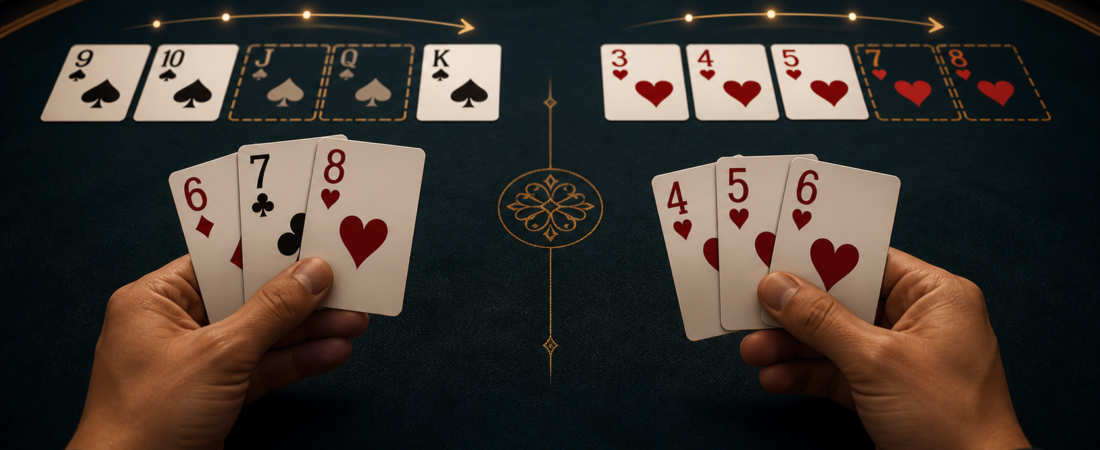
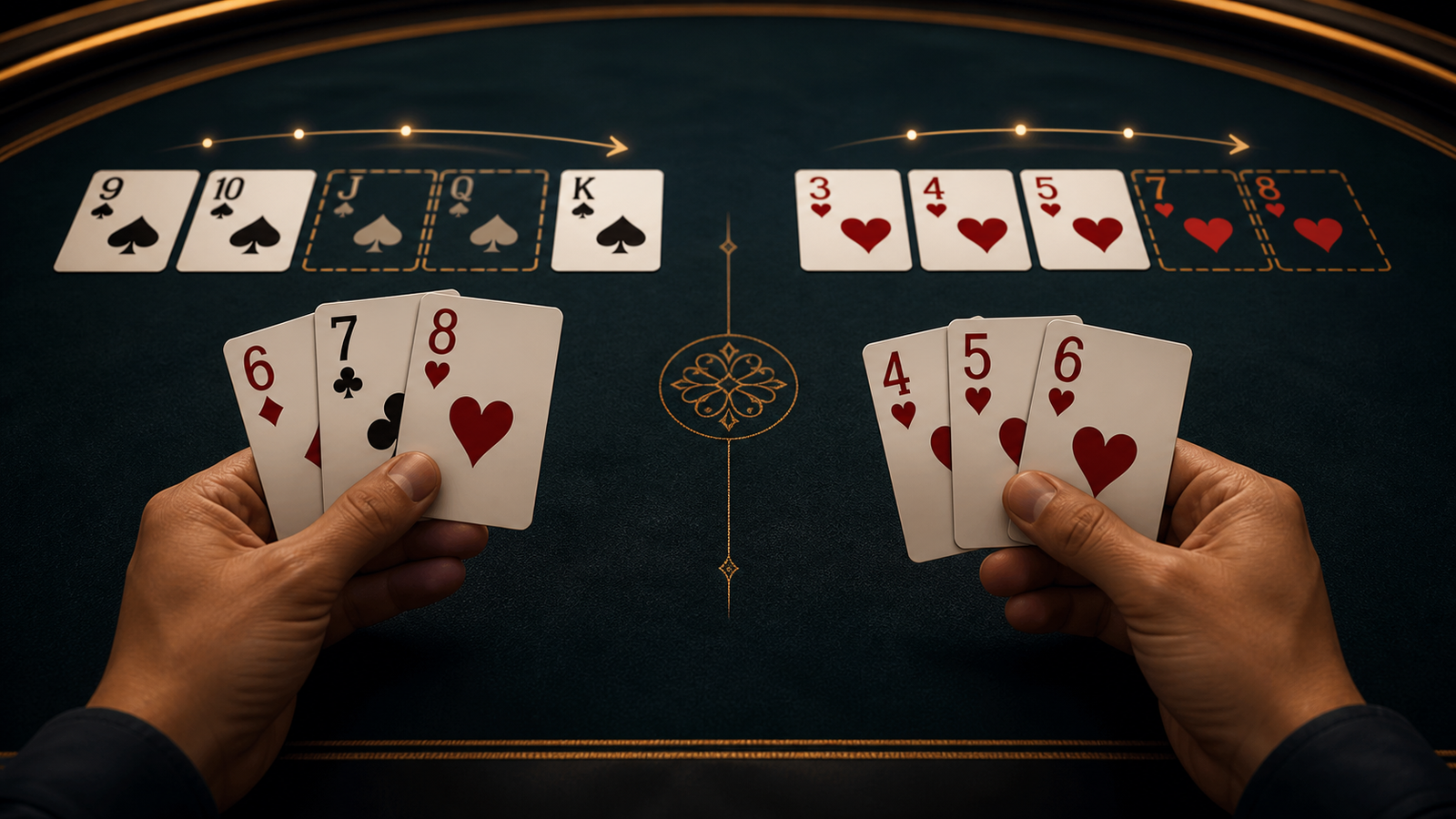
A route such as 6-7 of hearts has two open ends, subject to cards already visible and the active deck. A route such as 6-8 of clubs needs the 7 of clubs for a natural three-card sequence. That difference does not predict the next draw, but it shows which plan is more flexible.
A practical reset checklist
- Lock the natural pure sequence before moving anything else.
- Count the useful natural completions for each unfinished route.
- Mark high cards that are not part of a strong sequence or set route.
- Check whether one physical card appears in two provisional groups.
- Choose one route to keep and one loose card to release after the draw.
Use the opening-hand evaluation guide for the first layout and the high-card reduction guide when loose points start to dominate the choice.
Example: retire the narrower route
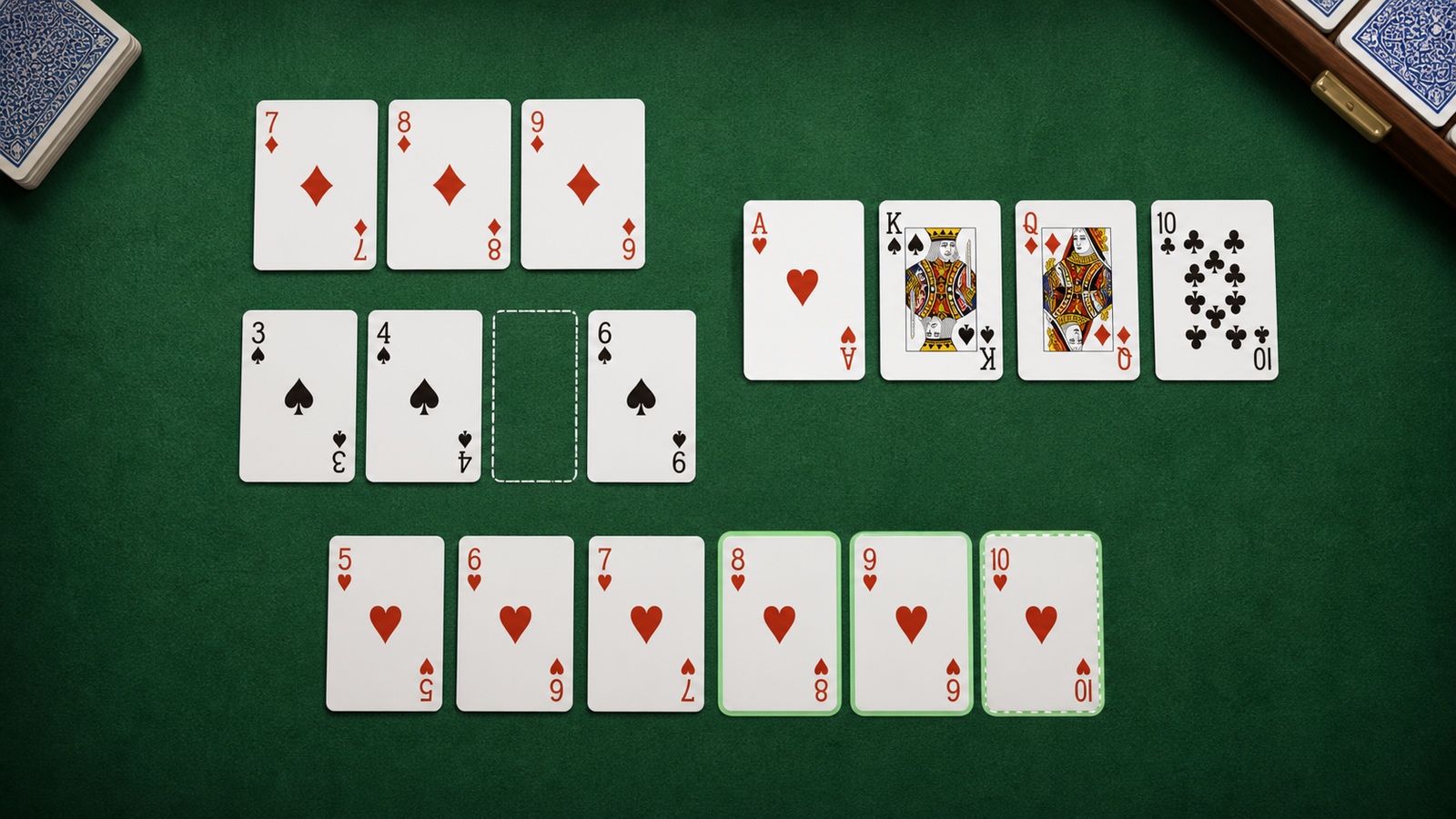
Suppose the hand already has 3-4-5 of spades as a pure sequence. It also holds 6-8 of clubs, 6-7 of hearts, a loose queen and other grouped cards. Two draws fail to help either route.
Keep the pure sequence untouched. If the 6-7 hearts still has useful open ends while the club route depends only on the 7 of clubs, the narrower club route is a reasonable reset candidate. The exact discard still depends on the full hand, visible cards and current table rules. Do not treat two turns as proof that a card cannot arrive.
Decision framework after every later draw
Recheck three facts: what is already valid, what changed, and which loose card now carries the most points with the fewest useful routes. A natural completion may free a Joker or turn a former discard candidate into a connector.
For related planning, see completion distance and two-route hand planning. Play only if you are 18+ and permitted in your location. Set time and spending limits; strategy cannot guarantee a win or income.
FAQ
Must I break a sequence route after two missed draws?
No. Two draws are only a review point. Keep the route if it remains flexible and does not trap costly loose cards.
Should the pure sequence ever be sacrificed during the reset?
Protect a completed natural pure sequence because it is required for a valid declaration under common Indian Rummy rules.
Does the reset rule predict which card will come next?
No. It organizes current choices and visible information; it does not predict random draws.
Glossary
- Reset cue: A chosen point for reviewing whether an unfinished card route still deserves space in the hand.
- Open-ended route: A same-suit consecutive pair that may be extended naturally at either end, subject to rank boundaries.
- Inside-gap route: Two same-suit cards separated by one missing rank.
Responsible play note
Indian Rummy is a skill-based card game, but no article, checklist, or tournament routine can guarantee results. Use these guides to improve decisions, keep time and budget limits, and follow the laws and table rules that apply in your location.