
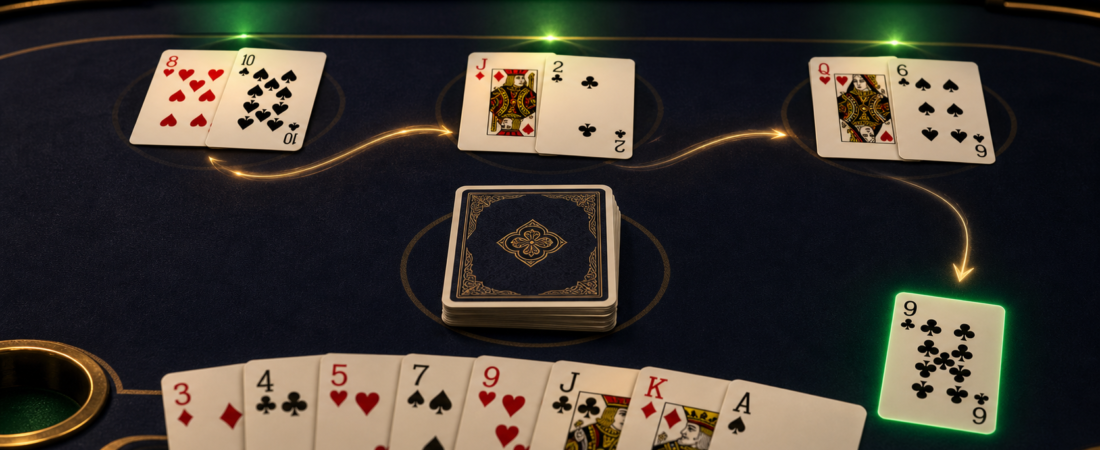
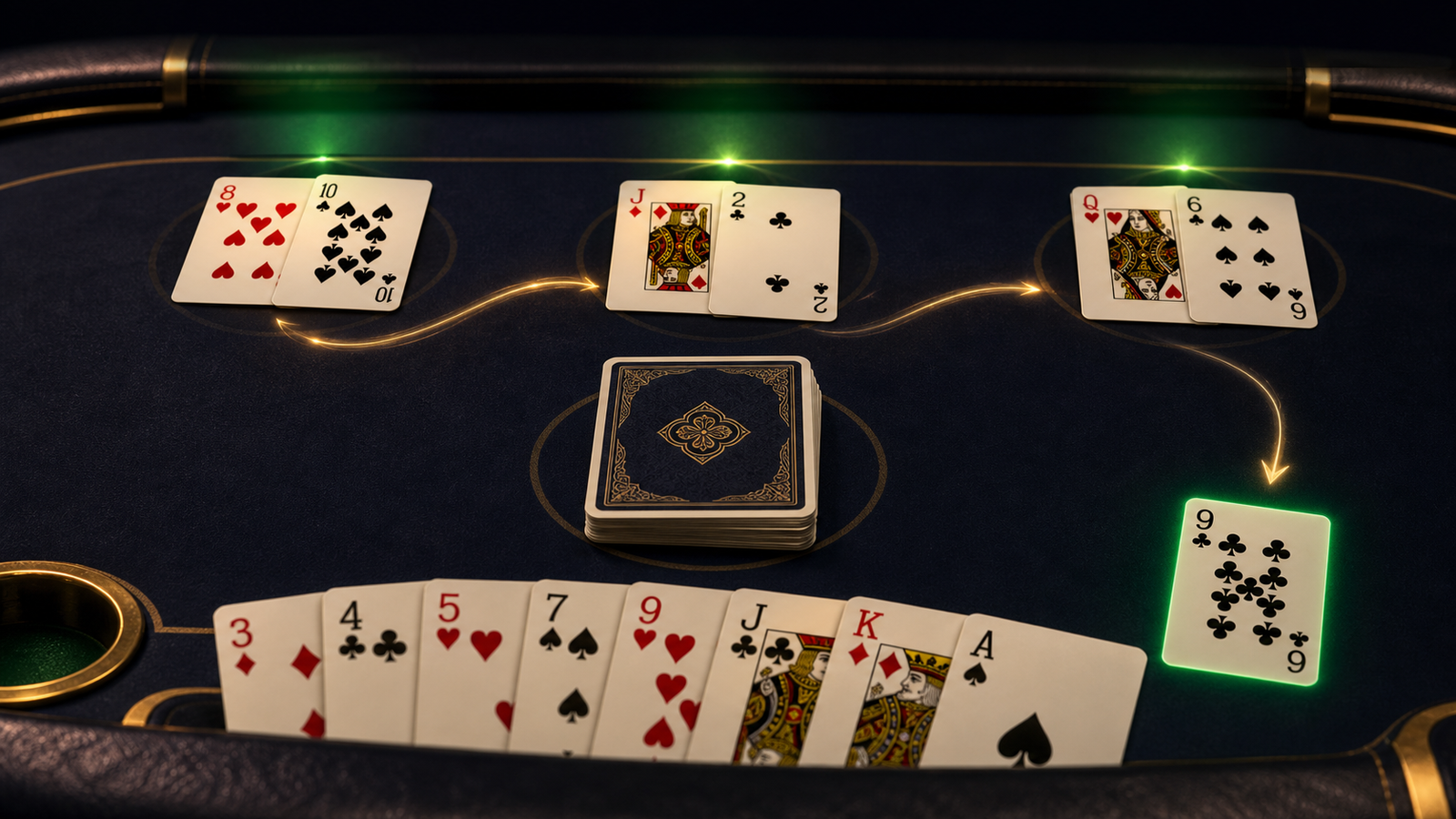
A Three-Turn Opponent Observation Framework for Indian Rummy
One visible pickup is a clue, not proof; a short sequence of actions is more useful than a single dramatic guess.
Summary: Observe an opponent’s visible pickups and discards for three turns, record only facts, and form a cautious working hypothesis about suits or ranks they may value. Use that hypothesis as one discard-safety input while protecting your own pure sequence and reducing points. No observation method guarantees an outcome.
Record the fact
Note the exact visible pickup or discard without guessing its purpose.
Look for repetition
A second related action can make a suit or rank pattern more meaningful.
Test the pattern
Use the third turn to strengthen, weaken, or discard your hypothesis.
Keep safety first
Never damage your own pure sequence only to avoid a speculative feed.
Observation is evidence, not certainty
Online Indian Rummy exposes limited public information: face-up pickups, discards, timing, and sometimes declared groups at the end. A pickup can serve a sequence, a set, a temporary hold, or a point-reduction move. Treat each action as evidence with several possible explanations, not as proof of an opponent’s hidden hand.
The three-turn observation checklist
- Turn one: record the exact visible pickup and following discard.
- Turn two: check for the same suit, a neighboring rank, or a repeated rank; do not force a connection.
- Turn three: label the pattern stronger, weaker, or unresolved.
- Before discarding, compare the possible feed risk with your own hand structure and points.
- Protect a completed pure sequence and avoid holding a dangerous high card indefinitely.
- Reset the hypothesis when later actions contradict it.
- Keep session and budget limits regardless of the table read.
Example: update, do not anchor
Suppose an opponent visibly picks 8H, later discards 4C, then picks 10H. A cautious hypothesis is that hearts near 8H-10H may be useful to that player, but the missing 9H and their hidden cards remain unknown. If you hold 9H as a loose high-risk card, compare the possible feed risk with your own chance to use it. If it anchors your only pure-sequence route, keep the structure; if it is isolated, reduce risk when a safer discard exists.
Stable rules and platform differences
Indian Rummy commonly uses draw-and-discard turns and requires valid sequences and sets, including at least one pure sequence for a valid declaration. The visibility of earlier discards, turn timers, auto-discard behavior, deck count, Joker rules, and scoring caps can differ by platform. Gin Rummy uses knocking and deadwood scoring, so its observation tactics and end conditions are not interchangeable.
FAQ
How many turns should I observe before changing a discard plan?
There is no fixed rule, but three turns provide a simple review window; act sooner only when your own hand structure and point risk justify it.
Does picking two cards of one suit prove an opponent needs that suit?
No. It makes the hypothesis more relevant, but hidden cards and later discards can change the interpretation.
Can opponent observation guarantee safer discards?
No. It can improve awareness but cannot reveal a hidden hand or control the result.
Glossary
- Visible pickup: A face-up card taken from the discard pile under the active table rules.
- Working hypothesis: A temporary explanation for observed actions that must be revised when new evidence appears.
- Feed risk: The possibility that your discard helps an opponent complete or improve a group.
Responsible play note
Indian Rummy is a skill-based card game, but no article, checklist, or tournament routine can guarantee results. Use these guides to improve decisions, keep time and budget limits, and follow the laws and table rules that apply in your location.