
Three Pairs Are Not Two Sequences: A Rummy Grouping Check
Three promising pairs may look like a tidy six-card block. Count completed groups separately from cards that still need help.
Summary: Six cards can form two three-card sequences only when the actual ranks and suits allow it. Adding three two-card fragments does not establish that either sequence exists.
Count finished groups separately from fragments
For this exercise, a pair means any two cards you have placed together while planning. It might be a same-suit connection or two cards of one rank. That planning label does not make a valid group. Under the common rules used here, a sequence needs at least three consecutive cards of one suit; a set needs three or four cards of one rank in different suits.
Six cards do not automatically become two completed sequences. The arithmetic describes quantity, while ranks and suits determine the groups. Start with the sets and sequences guide if those checks are unfamiliar.
Example: six cards but no completed sequence
Lay out 3H-4H, 7C-8C and QD-QS. H means hearts, C clubs, D diamonds and S spades. Assume these are natural cards and none of their ranks is the designated wild Joker. You have six distinct cards, arranged as three pairs.
3H-4H lacks a third card for a sequence. So does 7C-8C. QD-QS shares a rank but has only two cards, so it is not a completed set. Rearranging these six particular cards does not create a three-card natural sequence. None of the three displayed pairs is a finished group.
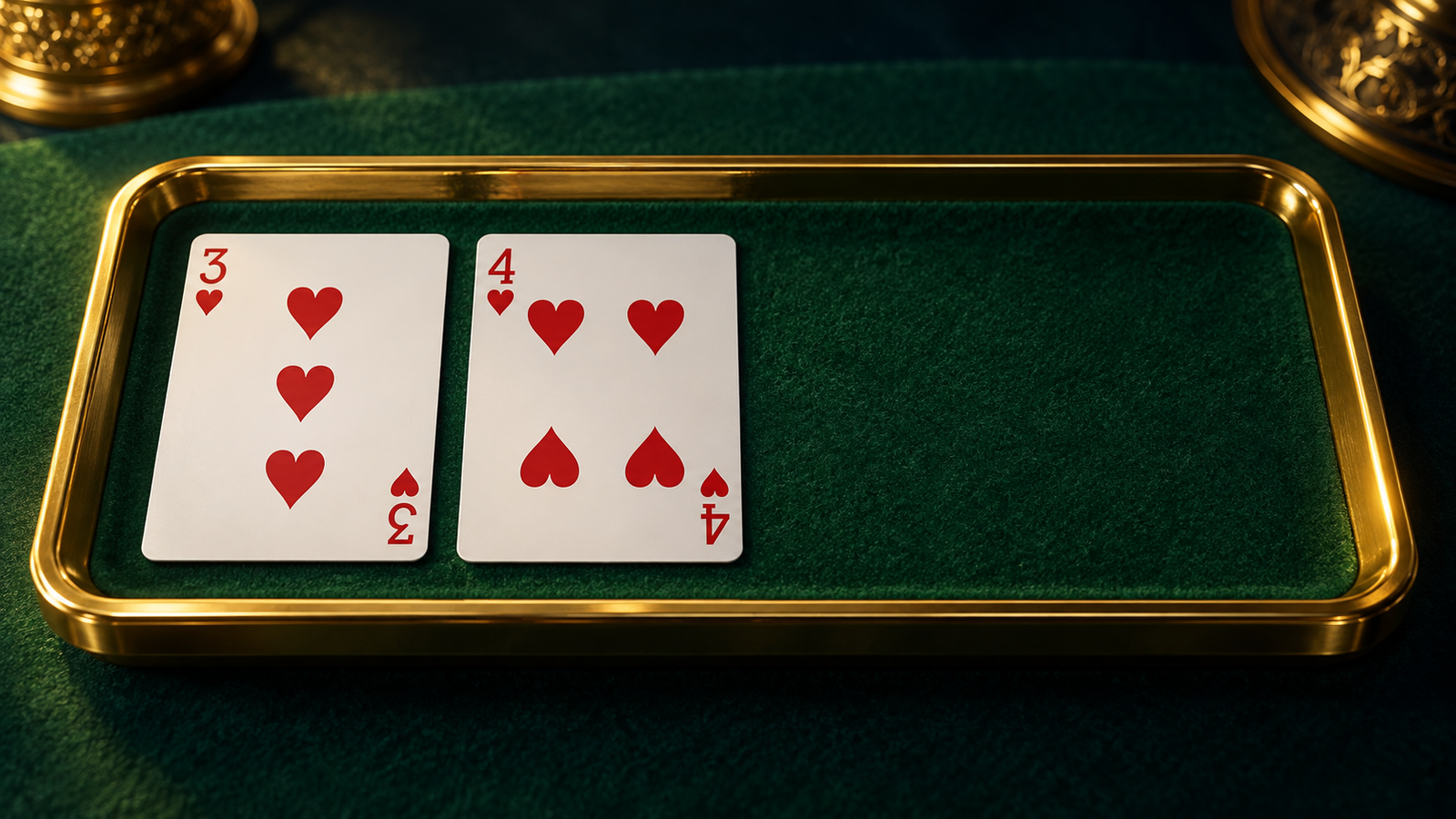
The body image shows the unfinished hearts pair. The face-down cover illustrates three pairs by count only; hidden suits and ranks cannot prove validity.
Compare with six cards that really can make two runs
Now compare 3H-4H-5H and 7C-8C-9C under the same natural-card assumptions. These are two separate three-card pure sequences. Both examples contain six cards; only this second example has the ranks and suits needed for those two runs.
These are alternative six-card illustrations, not successive turns and not full 13-card hands. The example does not say you can exchange cards freely or predict the next draw. The remaining seven cards would still need valid grouping for a full declaration.
Use a missing-card note without assuming a draw
For 3H-4H, a natural 2H or 5H could complete a three-card run. Write those as possible completions, not cards you own. Their existence in a deck does not prove they remain available or will be drawn. A Joker substitution, where permitted, changes the group check and does not supply a pure sequence by substitution.
Keep a separate tally for completed groups and unfinished routes. Recheck it when the hand changes. For choosing between unfinished routes, see the set-pair versus sequence-pair guide; that strategy question comes after recognising what is already complete.
A short practice checklist
- Read the actual rank and suit of every card.
- Label each displayed group complete or unfinished under the active rules.
- For an unfinished route, name the missing card without adding it to your holdings.
- Count completed sequences and confirm the required pure sequence separately.
- Check the entire final hand before declaring.
Do the exercise away from live play with the six cards written above. Explain why the first arrangement has no completed group and why the second has two runs. A neat layout is useful for inspection, but it cannot replace that explanation. Review the active rules whenever a group condition is unclear.
18+ only. Practise responsible play, set time and budget limits, take breaks and do not chase losses. Follow local laws and the active table rules. Read the responsible gaming guide.
FAQ
Do three pairs count as two sequences?
Not automatically. The actual six cards must form two valid separate sequences; the first example cannot.
Is a two-card same-rank pair a set?
Under the common rules described here, a set needs three or four cards in different suits. Two cards alone are incomplete.
Are all two-card fragments useless?
No. A fragment may support a future group, but potential should not be counted as a completed group.
Glossary
Responsible play note
Indian Rummy is a skill-based card game, but no article, checklist, or tournament routine can guarantee results. Use these guides to improve decisions, keep time and budget limits, and follow the laws and table rules that apply in your location.