
One Joker, Two Gaps: Why the Whole Rummy Run Is Still Incomplete
Three cards of one suit can contain two missing ranks. Assign your Joker to one exact position before calling the group complete.
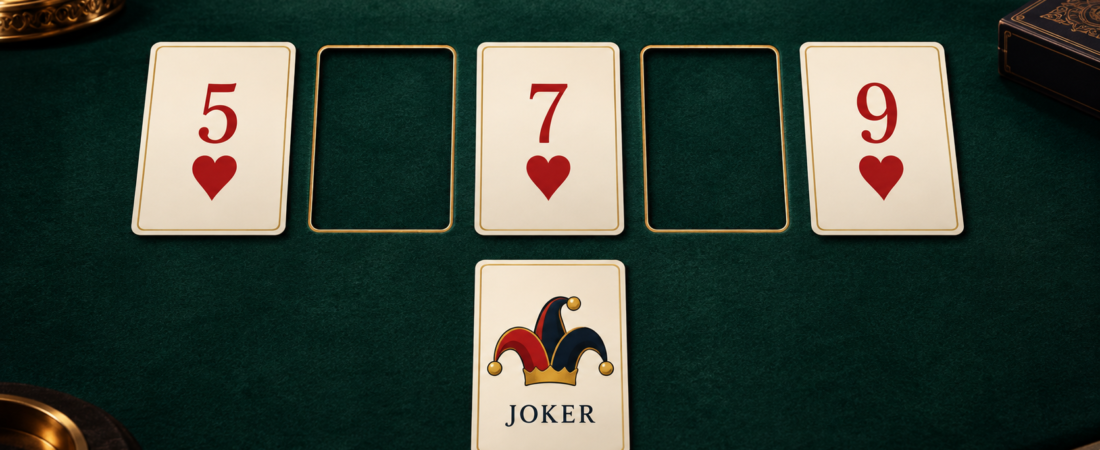
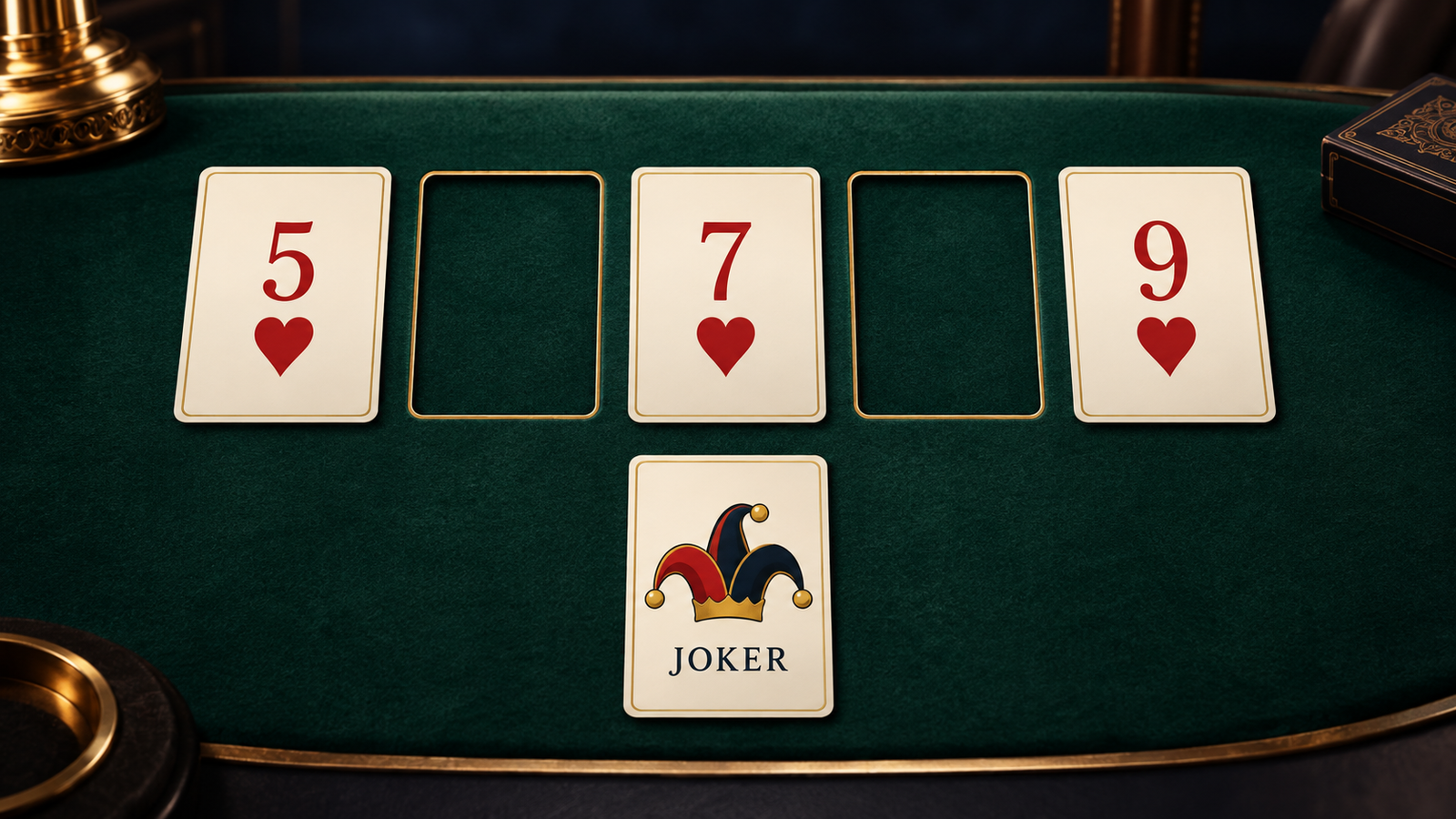
Summary: A single Joker represents one missing card in a group. With 5H-7H-9H, completing the full five-rank run needs both 6H and 8H; one substitute leaves a gap.
Name each missing rank before placing the Joker
Matching suits can make a group look closer to finished than it is. Sort the ranks first. A sequence needs consecutive ranks in one suit, and a substitute Joker occupies one missing card position. It cannot stand for two different ranks at once.
For the example below, use common 13-card Indian Rummy rules and assume 5H, 7H and 9H are natural cards, not designated wild Jokers. H means hearts. The separate printed Joker may substitute in an impure sequence. It does not replace the required pure sequence elsewhere in the hand. Review the Indian Rummy rules if these group types are unfamiliar.
Example: five, seven and nine of hearts
The full run from 5H to 9H is 5H-6H-7H-8H-9H. Holding 5H-7H-9H leaves two missing ranks: 6H and 8H. If the Joker stands for 6H, 8H is still missing. If it stands for 8H, 6H is still missing. Rearranging the four physical cards does not remove either requirement.
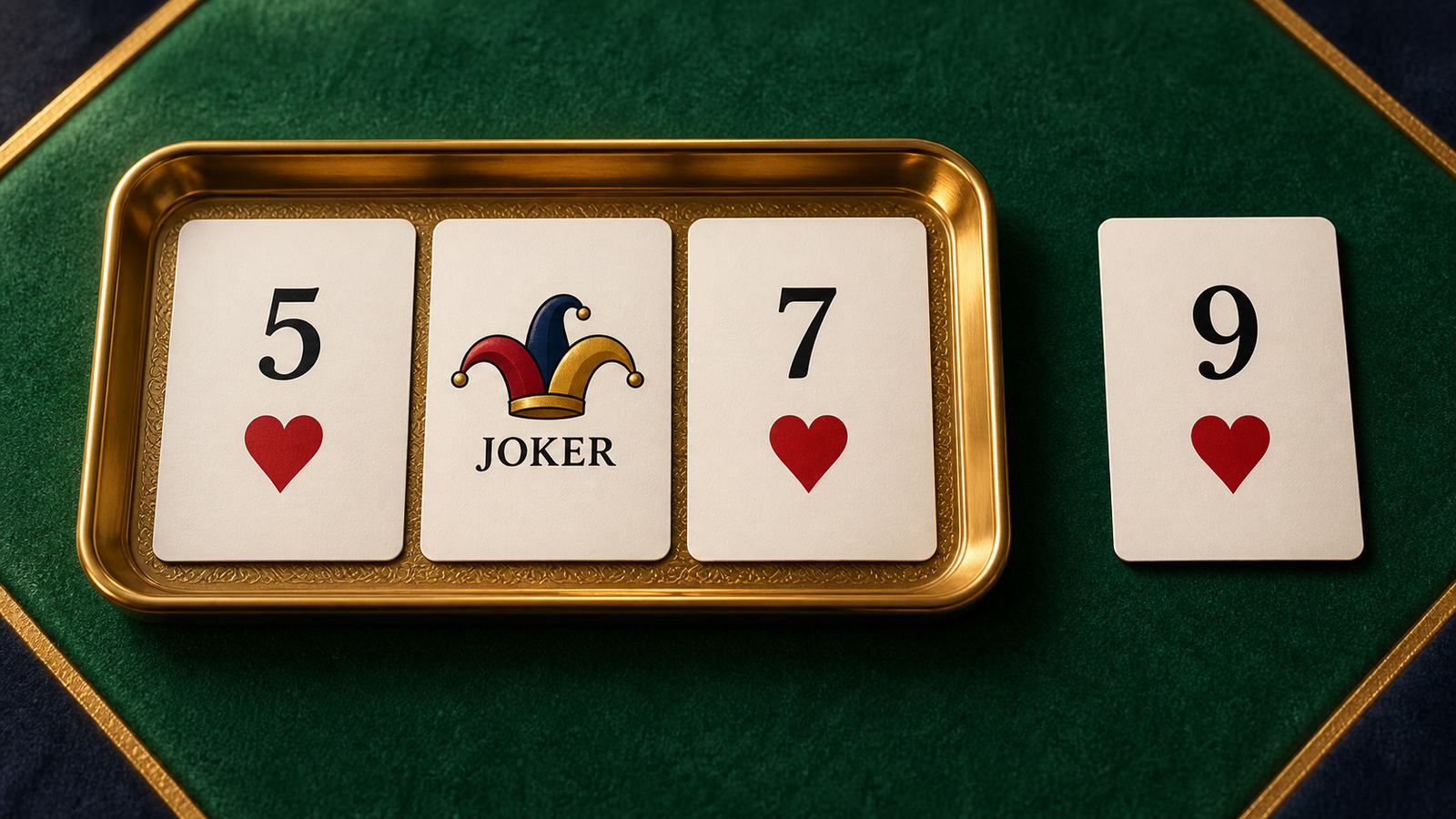
So 5H-Joker-7H-9H is not a complete sequence. Neither is 5H-7H-Joker-9H. The mistake is counting the Joker twice in your plan, even if the card appears only once on screen. Do not treat this four-card collection as a finished group.
A smaller group can work, but leaves a card outside
You can instead form 5H-Joker-7H, with the Joker representing 6H. That is a three-card impure sequence under the example rules. The 9H remains outside it. Alternatively, 7H-Joker-9H uses the Joker as 8H and leaves 5H outside. These are alternative arrangements; the same Joker and 7H cannot be used in both at once.
Compare the card left over with the rest of your hand before choosing a route. A smaller valid group is useful only if you still account for the unmatched card and the other declaration requirements. This example does not make 9H or 5H an automatic discard.
Check one substitution at a time
- Write the intended first and last rank of the run.
- List every rank between them in order.
- Mark which physical cards you actually hold.
- Assign the Joker to one exact missing position.
- Check whether another gap remains.
- If you shorten the group, identify every card left outside.
- Preserve a separate pure sequence and audit the whole hand before declaring.
When a natural 6H later arrives, 5H-6H-7H-Joker-9H can use the Joker as 8H under these assumptions. That describes a possible future arrangement, not a reason to expect that draw. The final hand audit still applies.
Practise with the missing ranks written down
In a practice hand, place a note marked 6H and another marked 8H beside the collection. Move the Joker onto one note and observe the other gap. Then test the smaller three-card group. This makes it harder to overlook the unmatched card when sorting quickly.
18+ only. Practise responsible play, set time and budget limits, take breaks and do not chase losses. Joker management cannot guarantee a win. See the responsible gaming guide.
FAQ
Can one printed Joker fill both gaps?
No. Within a group it substitutes for one missing card, so the other missing rank remains unfilled.
Is 5H-Joker-7H a pure sequence?
No. The Joker substitutes for 6H, making it an impure sequence under the example rules.
Should I discard the nine after making the smaller group?
Not automatically. Check its use elsewhere, the rest of your hand and the available actions under the active table rules.
Glossary
Responsible play note
Indian Rummy is a skill-based card game, but no article, checklist, or tournament routine can guarantee results. Use these guides to improve decisions, keep time and budget limits, and follow the laws and table rules that apply in your location.