
Rummy Scoring System: Points Calculation Guide
Scoring in Indian Rummy is not only about the final number. It shapes every discard, every Joker decision, and every late-hand risk choice.
Summary: In most 13-card Indian Rummy formats, ungrouped cards and invalid declarations can create penalty points. Face cards usually carry high point value, while a valid declaration depends on proper sequences and sets, including at least one pure sequence.
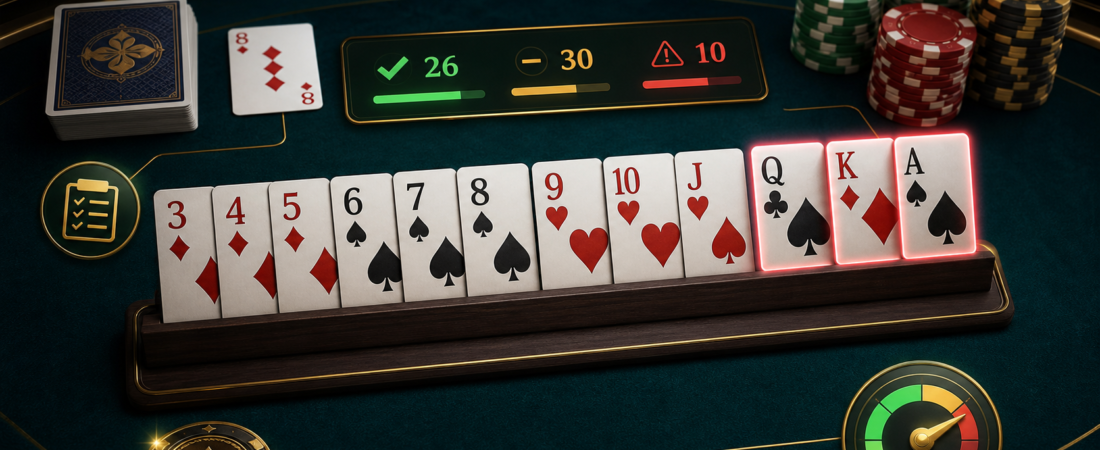
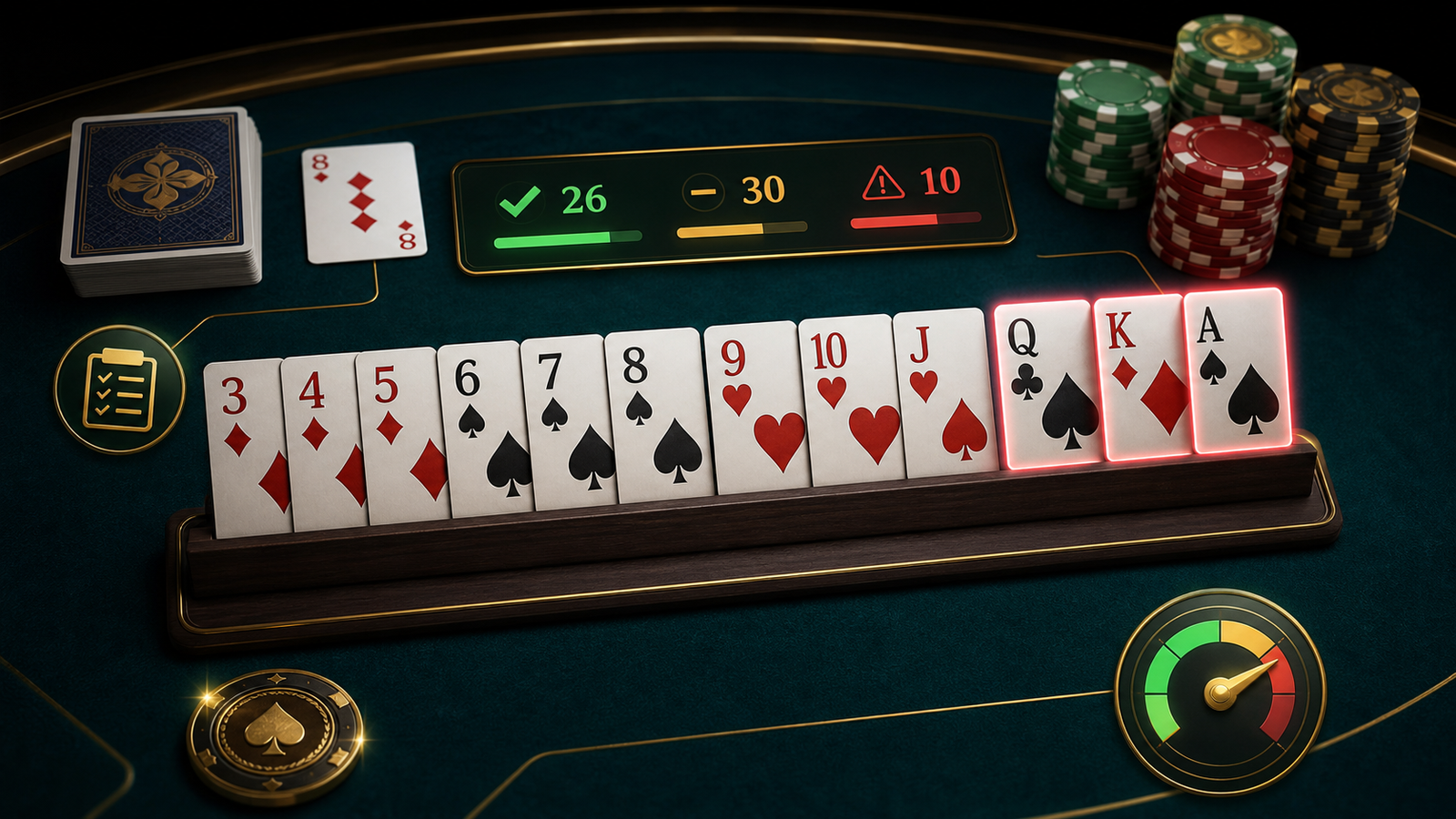
High cards carry risk
A, K, Q, J and 10 can quickly raise penalty exposure when they stay loose outside useful groups.
Pure sequence comes first
A pure sequence is still the foundation. Score reduction should not break your best natural run.
Jokers reduce pressure
Use Jokers to complete weak groups, but never count a Joker-made group as your required pure sequence.
Drop is a risk tool
Some tables allow drop options with fixed penalties. Rules differ by platform, so check the table rules before playing.
How points are usually counted
Indian Rummy scoring is generally based on cards that remain unmatched or incorrectly grouped when a hand ends. Number cards often carry face value, while face cards and aces commonly count as 10 points each. Exact caps, drop values, and table formats can vary by platform, so treat the table rule panel as the final source.
A simple penalty-control checklist
- First, protect or build a pure sequence without a Joker.
- Second, group connected cards before chasing distant sets.
- Third, review every loose high card and decide whether it is still useful.
- Fourth, use Jokers to complete high-risk groups only after the pure sequence is safe.
- Finally, before declaration, check that every card belongs to a valid sequence or set.
Example hand decision
Suppose your hand has 5♥-6♥-7♥, Q♠, K♦, 10♣, 8♣-9♣ and a Joker. The 5♥-6♥-7♥ run is already a pure sequence, so do not disturb it. The Joker can support 8♣-9♣ as an impure sequence, while Q♠ and K♦ need attention because they may add heavy points if they remain loose.
Responsible play note
A scoring system helps you make calmer responsible play decisions, but it cannot guarantee outcomes. Avoid chasing losses, set limits before a session, and treat rummy as skill-based entertainment rather than income.
FAQ
What is the rummy scoring system?
It is the method used to count penalty points from ungrouped or invalidly grouped cards after a hand ends. Exact values can vary by platform format.
How are face cards counted in Indian Rummy?
Face cards and aces are commonly treated as high-value cards, often 10 points each, but players should confirm the platform rule panel.
Does a pure sequence reduce points?
A pure sequence helps make a valid declaration. It does not automatically remove every risk, but it prevents the biggest structural mistake in many hands.
Glossary
- Penalty points: Points counted from ungrouped cards or an invalid declaration.
- Pure sequence: Three or more consecutive cards of the same suit without a Joker.
- Drop: A platform-specific option to leave a hand early for a fixed penalty where supported.