
How to Rebuild Sequences After Each Draw in Indian Rummy
Every draw changes the value of your groups. The key is to rebuild around the pure sequence requirement without chasing every tempting card.
Summary: After each draw in Indian Rummy, re-check the pure sequence path, compare natural connectors against Joker-supported groups, decide which branch has the clearest future, and discard the card that weakens your structure the least. This responsible play framework supports time and budget limits; it is not a guaranteed outcome.
Pure path
Natural same-suit connectors remain the first priority after every draw.
Branch choice
Compare two possible runs and keep the one with more outs.
Joker support
Use Jokers for impure groups after natural sequence needs are protected.
Discard cleanup
Release cards that no longer support the chosen sequence branch.
Why sequence rebuilding matters
Indian Rummy hands are not static. A card that looked weak before the draw may become a useful connector, while an old plan may become too slow. The stable priority is to create at least one pure sequence without Joker substitution, then use sets and impure sequences to organize the rest of the hand.
Draw-by-draw rebuild framework
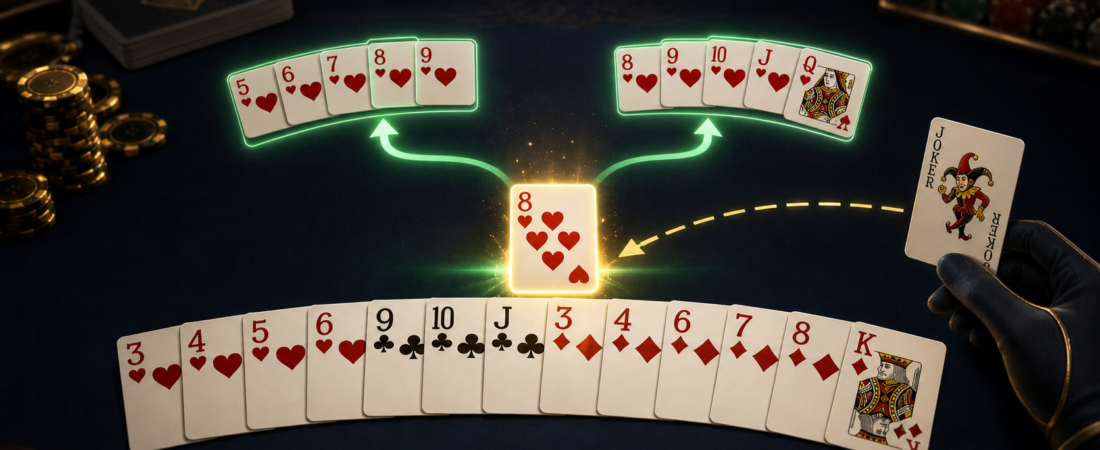
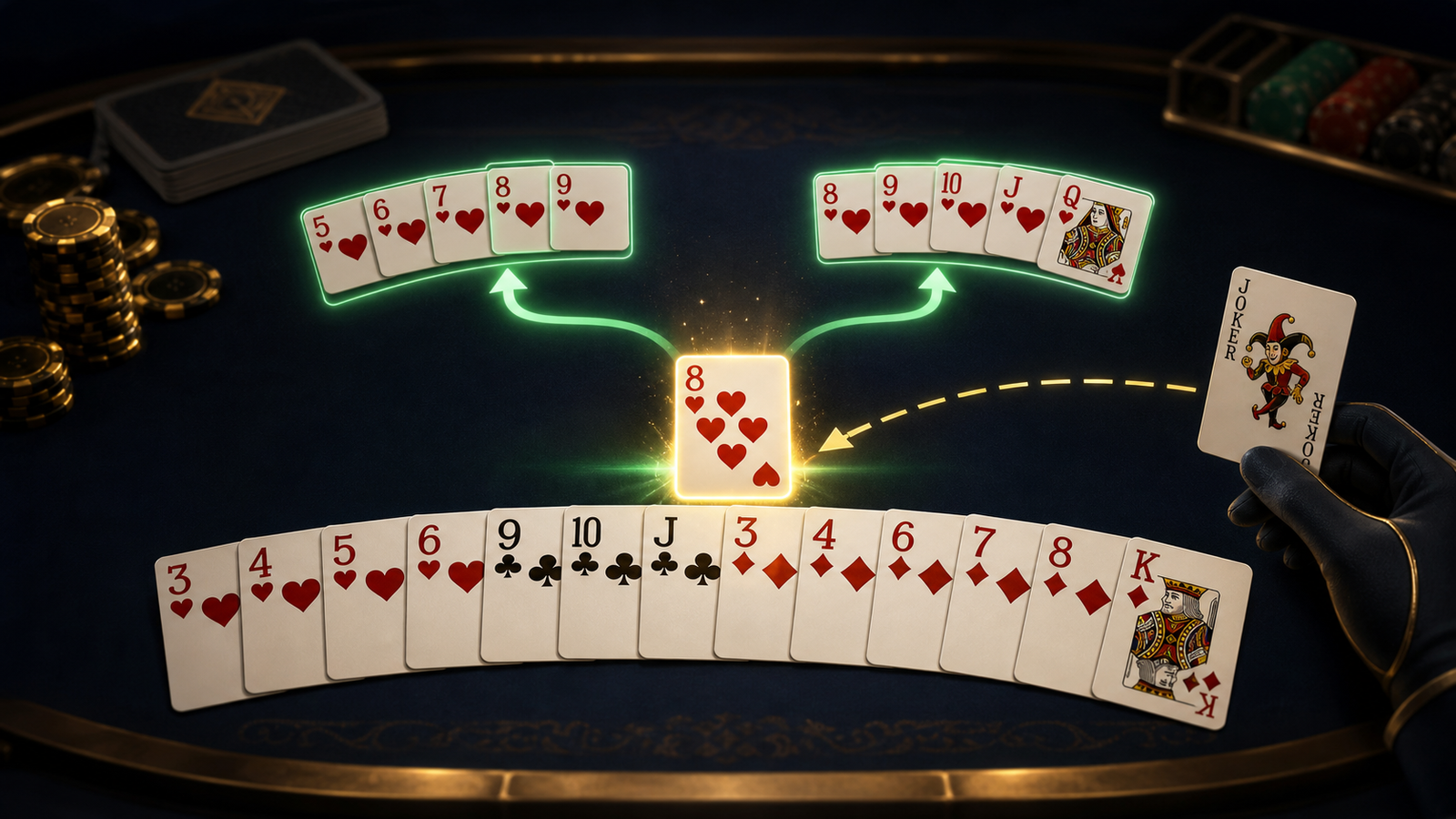
- Place the new card next to every same-suit connector it can support.
- Mark the pure sequence candidate before using any Joker.
- Count outs: a middle connector may grow in two directions, while an edge card may have fewer paths.
- Compare natural sequence potential against set potential.
- Move the weakest unsupported card into the discard-candidate zone.
- Check table-specific timing, scoring, and declaration rules before making rushed choices.
Example hand: choose the cleaner branch
Imagine your hand includes 5H 6H, 8H, 8S 8C, 10D JD, printed Joker, 3C, 4C, QS, and 2D. If you draw 7H, the heart group becomes 5H-6H-7H-8H, a strong natural sequence path. The 8S-8C pair can wait as a set option, while the printed Joker may support 10D-JD if needed. The rebuild decision is to protect the heart pure sequence first, then discard the card with the least connection to the new structure.
Do not mix Indian Rummy and Gin Rummy logic
Indian Rummy sequence building focuses on valid sequences and sets, with pure sequence protection as a central declaration requirement. Gin Rummy uses concepts such as melds, knocks, and deadwood under a different ruleset. If you compare formats, label the difference clearly instead of applying Gin Rummy scoring directly to 13-card Indian Rummy.
FAQ
What is a pure sequence in rummy?
In Indian Rummy, a pure sequence is a same-suit consecutive run made without using a Joker as a substitute.
Should I rebuild my hand after every draw?
Yes, but keep it disciplined. Re-check the pure sequence path, compare useful connectors, and avoid changing plans for a card that does not improve structure.
Can a sequence framework make me win every time?
No. It can reduce mistakes and improve structure, but it cannot control future draws or opponents’ decisions.
Glossary
- Pure sequence: A natural same-suit run that does not use a Joker as a replacement card.
- Impure sequence: A sequence that uses a Joker or wild card to stand in for a missing card, subject to table rules.
- Outs: Cards that can improve a group if drawn later, such as ranks that extend a sequence branch.
Responsible play note
Indian Rummy is a skill-based card game, but no article, checklist, or tournament routine can guarantee results. Use these guides to improve decisions, keep time and budget limits, and follow the laws and table rules that apply in your location.