
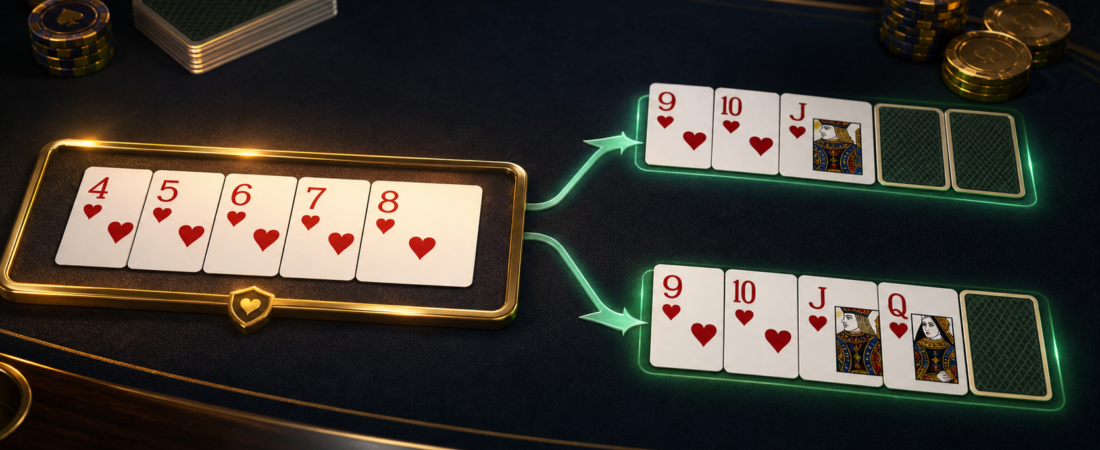
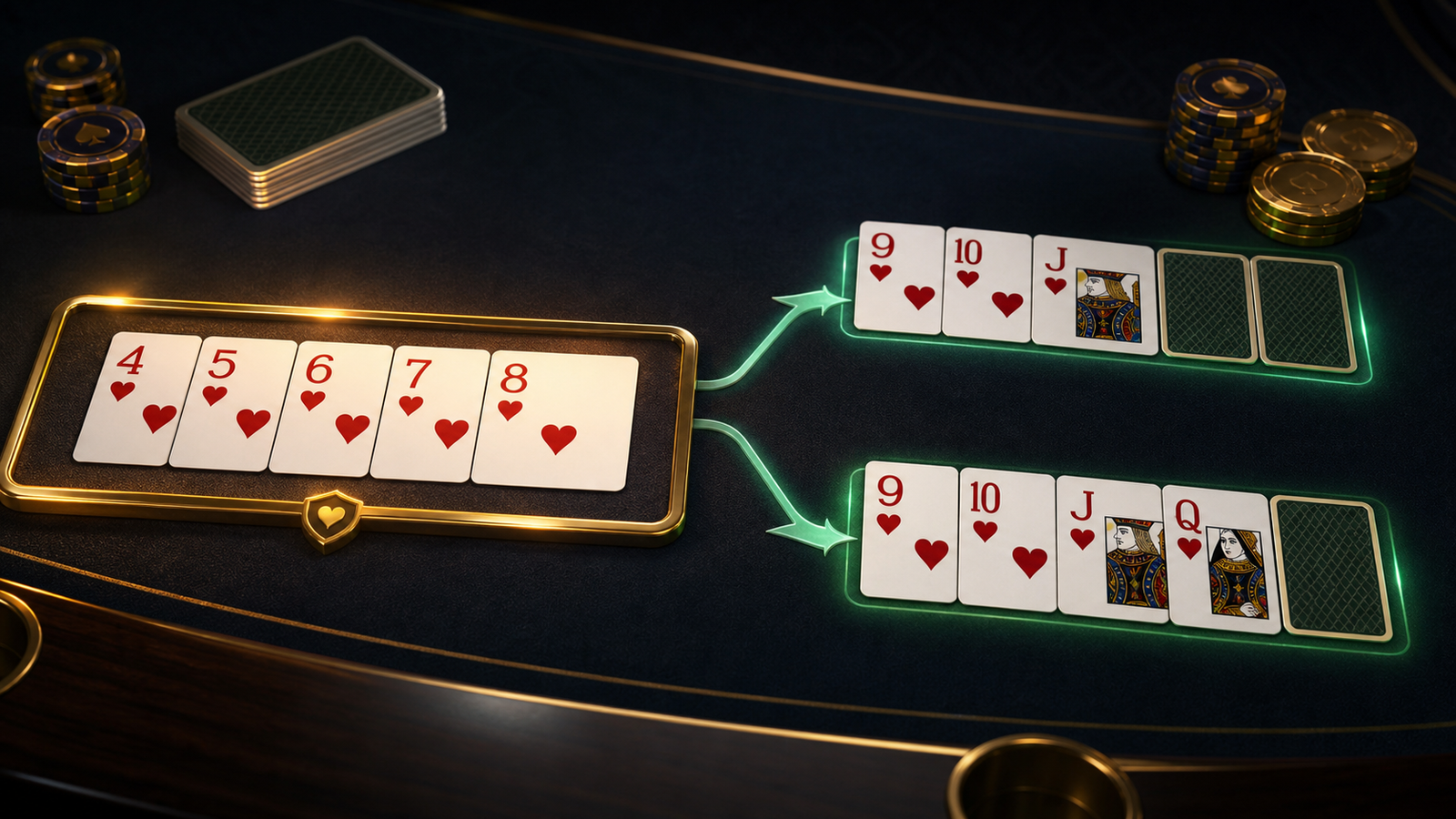
Protect Two Sequence Routes After Your Pure Sequence in Indian Rummy
Once your pure sequence is secure, keeping two realistic routes can prevent one blocked draw from collapsing the rest of your hand.
Summary: Lock the natural pure sequence, then compare two candidate sequence routes by missing cards, natural outs, Joker dependence, visible discards, and loose-card points. Keep both only while each remains realistic; prune the weaker route when it becomes narrow or expensive. This framework improves decision quality but cannot guarantee results.
Lock the pure sequence
Do not break the mandatory natural run to chase a speculative alternative.
Keep two routes
Preserve two realistic same-suit paths until new information separates them.
Count natural outs
Prefer routes that several unseen cards can complete or extend.
Prune point risk
Release a weak route when its loose cards become costly or too exact.
Why a second route matters after the pure sequence
In common 13-card Indian Rummy, a valid declaration needs at least two sequences, including at least one pure sequence. Finishing the pure sequence removes the first structural bottleneck, but the hand still needs another valid sequence. A two-route plan keeps two plausible same-suit builds alive briefly instead of depending on one exact card.
This is not a reason to hoard every connector. The aim is controlled flexibility: two routes with real natural outs, not several unrelated fragments.
Two-route decision checklist
- Freeze the completed natural pure sequence unless a clearly stronger valid arrangement appears.
- Sort the remaining cards by suit and mark every consecutive pair or one-card gap.
- Count the natural cards that can complete or extend each candidate route.
- Check whether visible discards have already weakened one route.
- Note which route requires a Joker and whether that Joker is needed elsewhere.
- Compare the points carried by loose cards in both routes.
- After every draw, keep the stronger two routes or prune the weakest one.
- Use session and budget limits and never treat the framework as a guaranteed result.
Example hand: open-ended clubs versus an inside heart gap
Suppose 4D-5D-6D is your pure sequence. Your remaining cards include 7C-8C, 10H-QH, 3S-3H, a printed Joker, and loose cards. The clubs can grow with 6C or 9C, while the hearts need the exact JH unless a Joker is assigned. Keep both routes provisionally if the points remain manageable, but treat the clubs as the more flexible natural route. If JH appears, the heart route becomes strong; if opponents discard several useful clubs, re-score instead of following the opening plan blindly.
Stable Indian Rummy rules and platform differences
The stable teaching point is that 13-card Indian Rummy commonly requires at least two sequences and at least one pure sequence. Deck count, wild-Joker selection, duplicate-card handling, scoring caps, and declaration controls can vary by platform, so check the active table rules. Gin Rummy uses melds, knocking, and deadwood scoring; its strategy should not be mixed into this Indian Rummy sequence guide.
FAQ
Should I always keep two sequence routes after making a pure sequence?
No. Keep two only while both have realistic natural outs and acceptable point exposure; prune the weaker route when the evidence changes.
Is an open-ended sequence route always better than an inside gap?
Not always. Open-ended routes often have more natural outs, but visible discards, Joker availability, and the rest of the hand can change the comparison.
Can a two-route plan guarantee a win?
No. It is a decision framework for reducing fragile plans, not a promise about draws, opponents, or outcomes.
Glossary
- Sequence route: A group of same-suit cards with a realistic path to a consecutive valid sequence.
- Natural out: A non-Joker card that can validly complete or extend a candidate group.
- Route pruning: Releasing the weaker candidate plan when its completion chance or point value deteriorates.
Responsible play note
Indian Rummy is a skill-based card game, but no article, checklist, or tournament routine can guarantee results. Use these guides to improve decisions, keep time and budget limits, and follow the laws and table rules that apply in your location.