Printed Joker in Rummy: How to Use It Without Breaking Your Hand
A printed Joker in rummy gives flexibility, but it also creates confusion for beginners who use it too early or in the wrong group. Strong players treat the Joker as support, not as an excuse to skip structure.
Summary: In Indian Rummy, the printed Joker can improve your hand by completing an impure sequence or a set. It does not replace the need for a pure sequence, and it should usually be placed only after your main structure is clear.
What is a printed Joker in rummy?
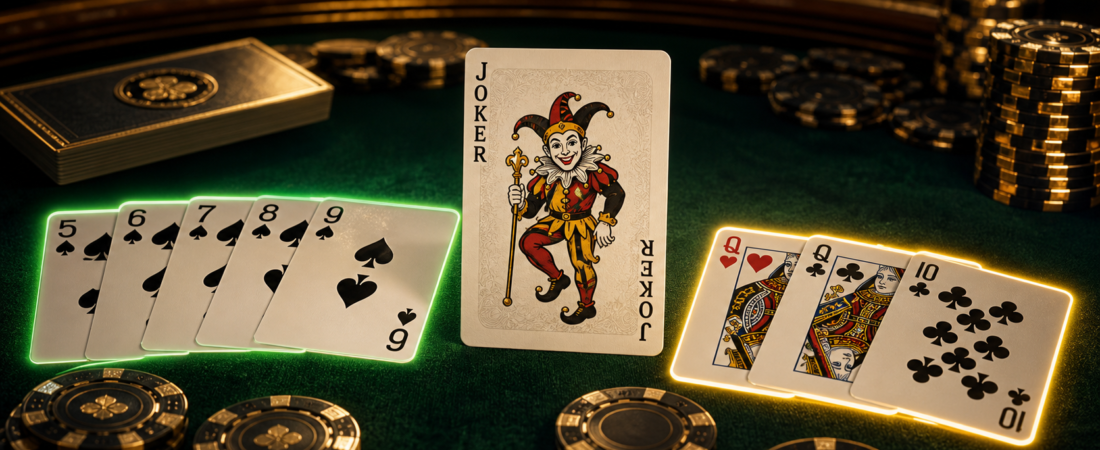
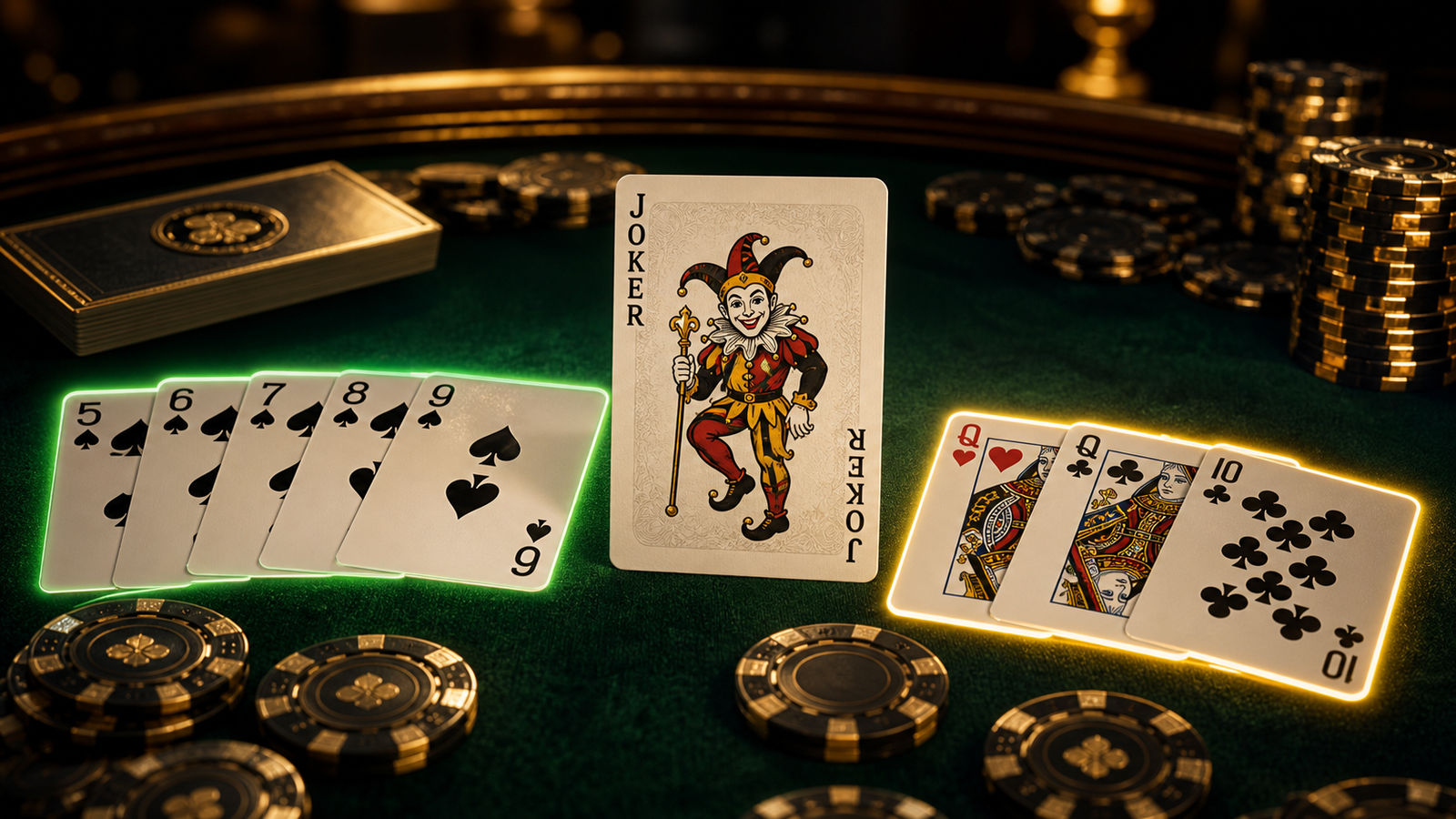
A printed Joker is the Joker card already printed in the deck, unlike the wild Joker that changes from round to round. In Indian Rummy, it is usually treated as a flexible substitute for missing cards in an impure sequence or a set.
That flexibility matters, but it does not change the core hand-building order. The best rummy strategy for beginners is still to secure a pure sequence first and assign the Joker later.
Where the printed Joker helps most
The printed Joker is strongest when it completes a nearly ready group. If you already hold 9♣ 10♣ and need J♣ for an impure sequence, or if you hold two 7s and need a third card for a set, the Joker can reduce waiting time and lower point risk.
It is less efficient when dropped into a vague, half-planned grouping. A Joker placed too early often hides the real weakness of the hand and delays better decisions.
Where the printed Joker does not help
The printed Joker does not turn an impure sequence into a pure sequence. If your only run depends on the Joker, your declaration is still not safe. This matters for players searching how to win rummy game every time, because disciplined structure reduces mistakes more reliably than flashy Joker usage.
The Joker also does not solve a bad hand if your card grouping remains messy. If the rest of the cards are disconnected, even a powerful Joker can only repair one weakness at a time.
Decision framework for mid-game Joker use
Ask three questions before placing the printed Joker. First, do I already have a pure sequence? Second, does the Joker complete a real group immediately? Third, does saving the Joker create more flexibility than spending it now?
If the answer to the first question is no, avoid locking the Joker into decorative use. If the answer to the second is no, the Joker may be better kept as a reserve card while you improve the main structure.
Printed Joker checklist
- Build or confirm a pure sequence before assigning the printed Joker.
- Use the Joker where it completes a near-finished sequence or set immediately.
- Avoid using the Joker to hide a weak opening hand with no natural structure.
- Re-check whether the Joker is serving a better role elsewhere after each draw.
- Do not confuse printed Joker value with guaranteed results; it only improves options.
- If points are rising, use the Joker to stabilize the hand instead of chasing a fancy rebuild.
Example hand decision
Imagine you hold 3♠ 4♠ 5♠, 7♦ 8♦, Q♣ Q♥, printed Joker, A♣, K♣, 10♥, 10♣, 2♦, and 6♣. Your pure sequence already exists as 3♠ 4♠ 5♠. That means the printed Joker is free to support your next-best group.
In this hand, using the printed Joker as 9♦ to complete 7♦ 8♦ printed Joker is often cleaner than forcing it into a Q♣ Q♥ set immediately. The reason is flexibility: the queens may still improve naturally, while the diamond run removes uncertainty faster and can reduce future deadwood.
FAQ
Is the printed Joker better used in a set or in a sequence?
It depends on hand structure. Use it where it completes the stronger group right now, especially after your pure sequence is already secure. Sequences often deserve priority because they support a legal declaration more consistently.
Can the printed Joker replace a missing card in a pure sequence?
No. A pure sequence must be natural. The printed Joker can only help create an impure sequence or support a set.
Does getting a printed Joker early mean the hand is automatically strong?
No. The Joker increases flexibility, but it cannot fix every weakness. Opening-hand quality, sequence paths, discard reading, and point control still decide the strength of the hand.
Glossary
Printed Joker: The Joker card already printed in the deck and used as a flexible substitute in many Indian Rummy formats.
Wild Joker: A rank or card selected for that round which can act as a Joker, depending on platform rules.
Deadwood: Cards that are not yet part of a useful set or sequence and may increase your points.
Responsible play note
Indian Rummy is a skill-based card game, but outcomes still vary from hand to hand. Use guides like this to improve decisions, not to expect guaranteed wins. Play only if permitted in your location, keep time and budget limits, and stop if the game stops feeling controlled.