
After the Draw: A Three-Question Indian Rummy Discard Audit
The best discard is not always the highest card; it is the card with the weakest role after the new draw changes your hand.
Summary: After each draw, ask three questions: which card least supports a valid sequence or set, which choice leaves the lowest loose-point exposure, and which discard appears least useful to opponents from visible evidence. Protect the pure sequence first and reassess every turn.
Check structure
Protect the pure sequence and compare each card’s realistic natural connections.
Count points
Use point exposure as a tie-breaker after structural value is understood.
Read the table
Recent visible pickups and discards can change the safety of a candidate.
Decide once
Complete the audit before releasing a card instead of reacting to rank alone.
Why every draw requires a fresh discard decision
A newly drawn card can complete a sequence, create a second route, duplicate an existing role or make another card expendable. Reusing the previous turn’s discard plan ignores this change. In common 13-card Indian Rummy, protect at least one pure sequence and build a second valid sequence before treating optional sets as the only priority.
The three-question discard audit
- Structure: which card has the fewest realistic same-suit sequence links or same-rank set links?
- Points: among similarly weak cards, which one leaves the highest unmatched exposure?
- Safety: has an opponent visibly picked a nearby card or rank that makes this discard an obvious feed?
- Keep any completed natural pure sequence intact.
- Do not count speculative unseen cards as guaranteed outs.
- Confirm the remaining hand still has at least two plausible sequence routes.
- Use time and budget limits and stop when play no longer feels controlled.
Example: structure before face-card points
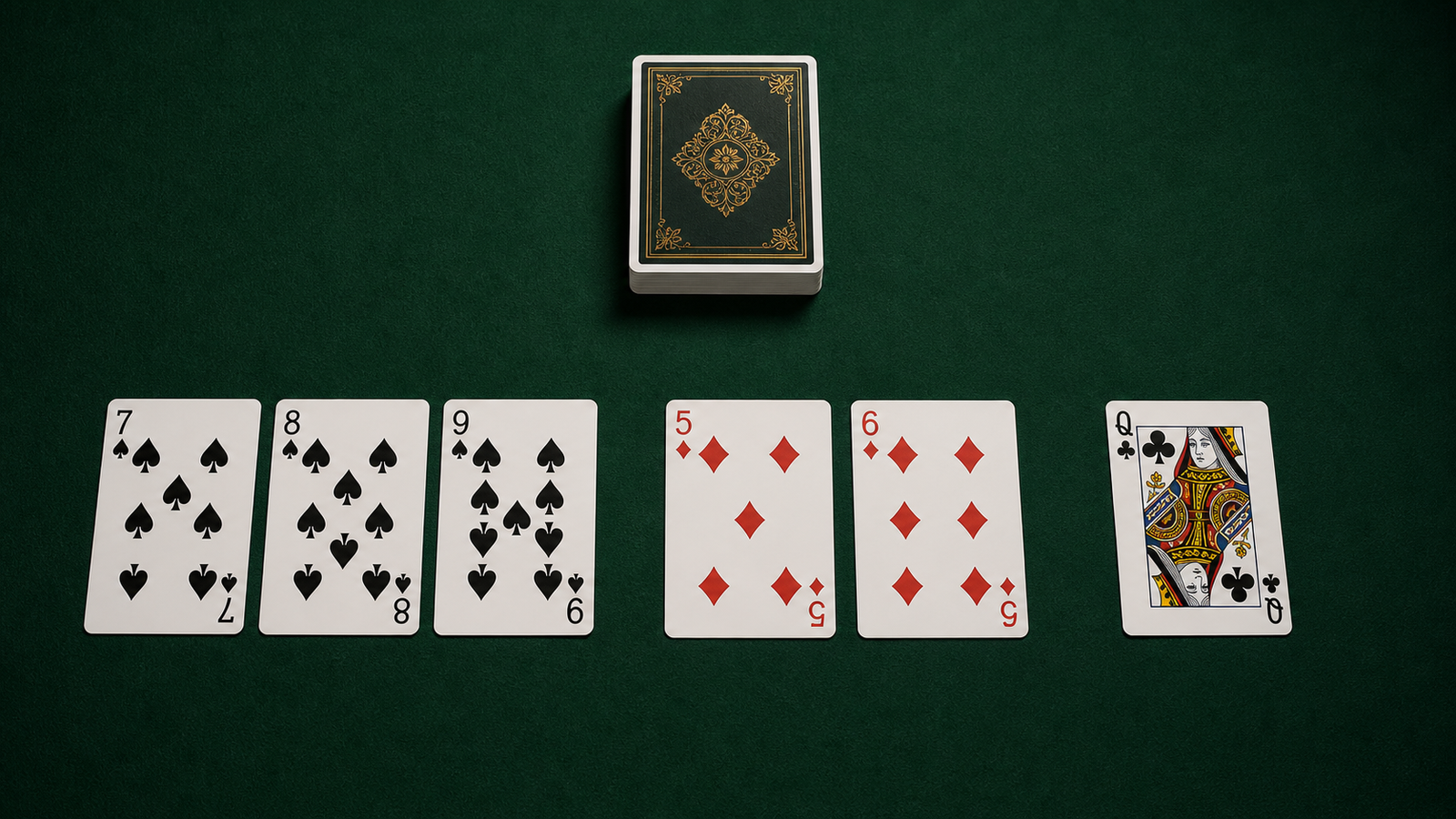
Suppose 7S-8S-9S is your pure sequence, 5D-6D is a connected route, and QC is isolated. If the new draw does not connect QC or create a queen set, the queen carries high loose-point exposure and has weaker structure than the diamond pair. QC becomes a reasonable discard candidate unless visible pickups strongly suggest it would feed an opponent.
If instead you hold JC-QC and draw KC, the queen now belongs to a natural sequence. The audit must change: a lower isolated card may be the weaker discard despite carrying fewer points.
Rules, evidence and responsible limits
Aces and face cards commonly count as ten unmatched points, while number cards commonly count face value, but scoring caps, drop values and duplicate-card treatment vary by platform. Table observation provides clues rather than certainty. Gin Rummy uses knocking and deadwood scoring, so do not import its end-hand decisions into Indian Rummy.
FAQ
Should the highest card always be discarded first?
No. A high card may anchor a strong natural sequence; compare structure before points.
What should I check immediately after drawing?
Re-sort the hand, protect the pure sequence, identify changed connections and compare the weakest discard candidates.
Can visible discards reveal an opponent’s exact hand?
No. They offer limited signals only and should never be treated as certainty.
Does this discard audit guarantee lower points?
No. It supports disciplined decisions but cannot control future cards or opponents.
Glossary
- Discard candidate: A card being evaluated for release after the draw.
- Point exposure: The value likely to remain unmatched if the hand ends before completion.
- Natural connection: A same-suit sequence link formed without Joker substitution.
Responsible play note
Indian Rummy is a skill-based card game, but no article, checklist, or tournament routine can guarantee results. Use these guides to improve decisions, keep time and budget limits, and follow the laws and table rules that apply in your location.