


Count Your Routes Before Choosing an Opening-Hand Plan
An opening hand often contains several attractive pairs, but not every pair creates an equally useful route. Count the natural paths before deciding what to protect.
Summary: Sort all 13 cards by suit, mark natural runs and one-card gaps, then count how many cards can complete each route. Protect the best pure-sequence path and compare the remaining routes with loose-card point exposure. The method supports disciplined choices but cannot predict the draw.
A route is more than a nearby rank
A natural sequence route needs consecutive cards of the same suit. The 4H-5H pair can extend with 3H or 6H, while 4H beside 5C is not a route. A completed 8C-9C-10C run is stronger evidence than two unrelated high cards that might eventually form a set.
Opening-hand route-count checklist
- Sort all 13 cards by suit and then by rank.
- Mark completed natural runs and protect the strongest pure-sequence route.
- Count one-card gaps and open-ended pairs that can extend naturally.
- Keep one primary route and one credible backup instead of chasing every possibility.
- Compare loose high-card points and review the plan after each draw.
Example: compare two clear routes
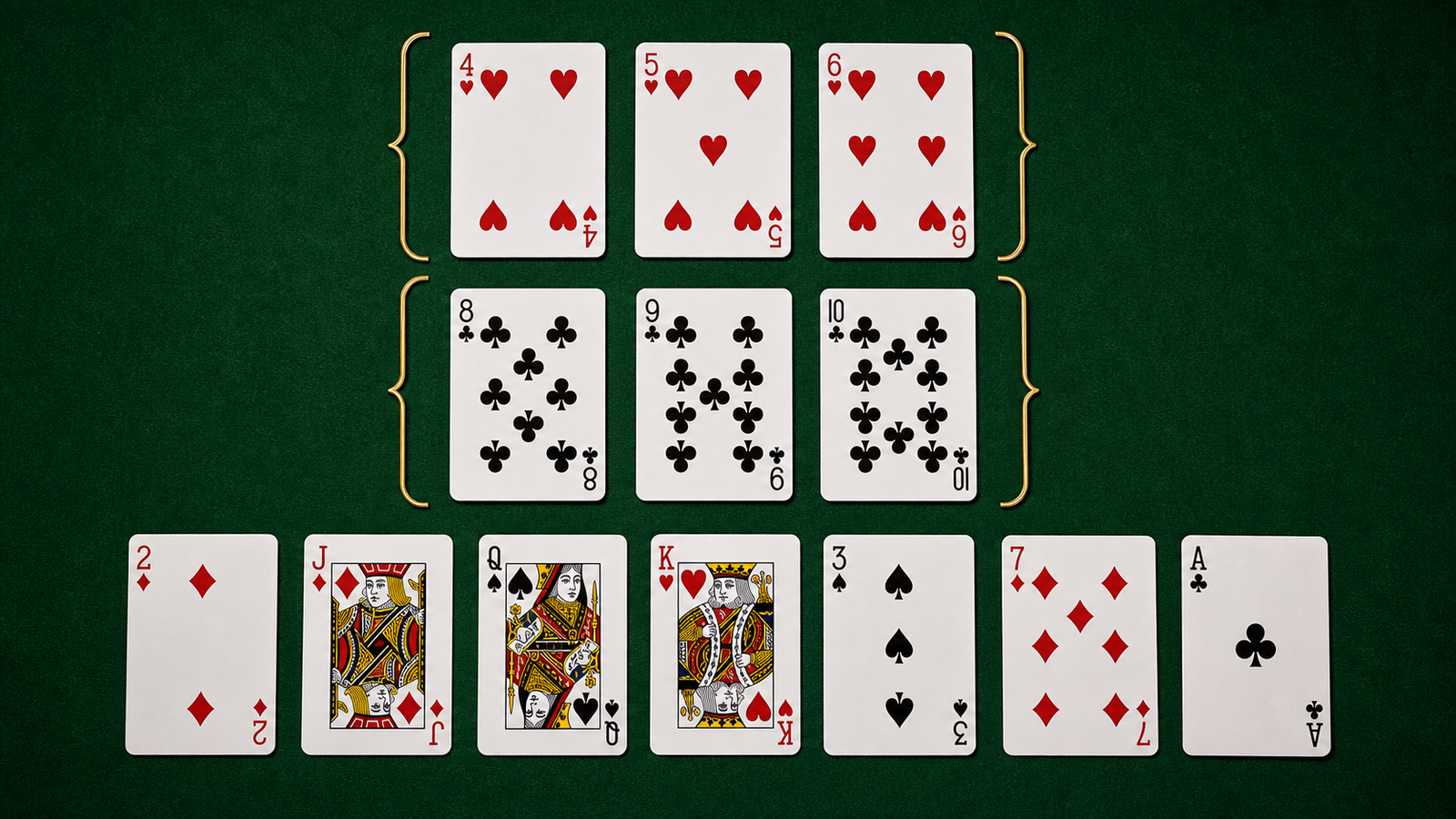
Consider 4H-5H-6H and 8C-9C-10C within the same opening hand. Both are completed natural sequences, so one can satisfy the pure-sequence condition and the other can serve as the required second sequence. The seven remaining cards still need valid grouping. Their suits, ranks and point exposure should decide the next plan rather than changing a completed run without a specific gain.
Do not turn route count into certainty
Visible discards can reduce the practical value of a route, but they do not reveal every hidden card. Multiple decks, Jokers and platform-specific rules also affect availability. Recount after each draw, separate public evidence from guesses about opponents, and use the rules guide to confirm declaration requirements.
Adults should use session and budget limits and never chase losses. Read the responsible gaming guide for practical controls. Route counting can reduce avoidable mistakes, but it does not guarantee winning or income.
FAQ
What counts as a natural sequence route?
Two or more same-suit cards that are already consecutive or have a specific natural card that can connect them.
How many opening-hand routes should a beginner keep?
Keep the strongest pure-sequence route and one credible backup, then reassess as cards are drawn and discarded.
Does having more routes guarantee a win?
No. Route count improves planning but cannot control draws, opponents or declaration timing.
Glossary
- Natural route: A same-suit path that can form a consecutive run without Joker substitution.
- Open-ended pair: Two consecutive same-suit cards that may extend naturally at either end.
- Point exposure: The scoring risk carried by cards that remain outside valid groups.
Responsible play note
Indian Rummy is a skill-based card game, but no article, checklist, or tournament routine can guarantee results. Use these guides to improve decisions, keep time and budget limits, and follow the laws and table rules that apply in your location.