How to Play Rummy: 13-Card Beginner Guide
New players do not need to memorize every advanced tactic first. Start by understanding the hand structure, the pure sequence rule, and the final declaration check.
Summary: In 13-card Indian Rummy, each player organizes cards into valid sequences and sets. A pure sequence without a Joker is the foundation for a valid declaration, while Jokers and sets help complete the remaining hand.
Start with 13 cards
Sort cards by suit and rank so natural runs become easier to see.
Protect pure sequence
Build at least one same-suit consecutive run without a Joker before chasing fancy groups.
Use Jokers after structure
Jokers are support cards for impure sequences or sets, not replacements for the pure sequence.
Check before declare
A calm final scan prevents invalid declaration mistakes and supports responsible play.
Basic flow of a hand
A typical Indian Rummy turn asks you to pick a card from the closed deck or open discard pile, then discard one card. The goal is to arrange all 13 cards into valid sequences and sets. Platform rules can vary, so always read the table rules before playing.
Beginner checklist
- Sort by suit first.
- Mark the strongest pure sequence candidate.
- Keep useful middle cards that can connect both directions.
- Use Jokers to complete weak groups after the pure sequence is safe.
- Discard loose high cards when they no longer support a realistic group.
Example hand idea
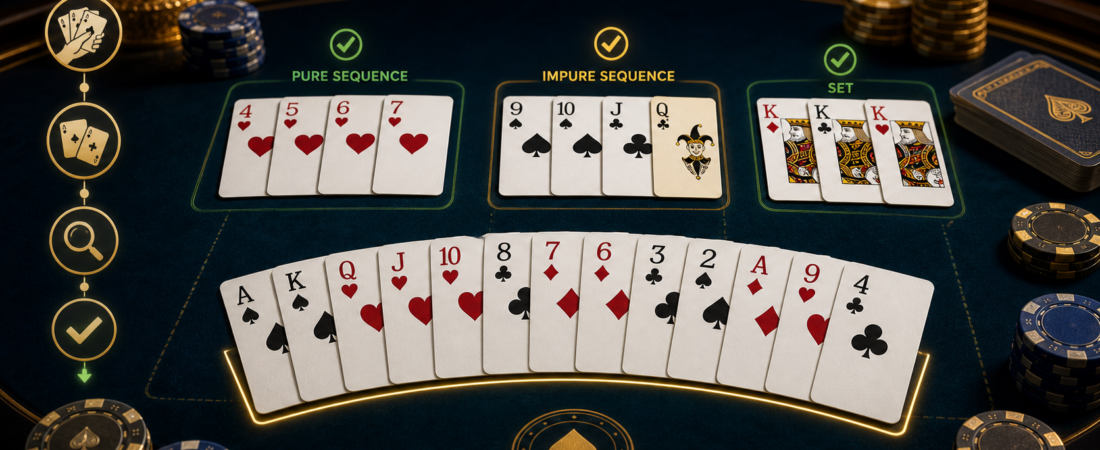
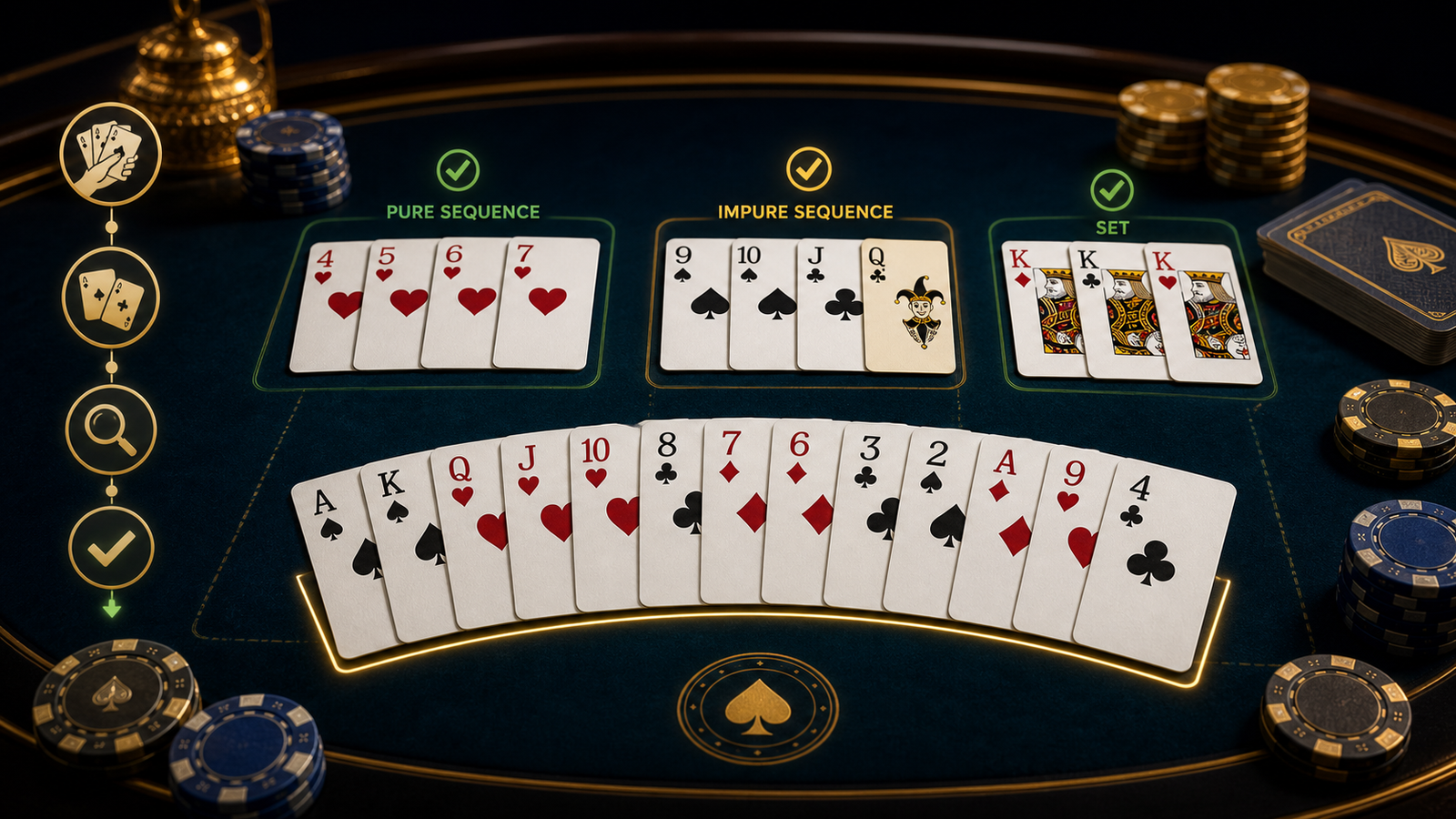
If you hold 4♥-5♥-6♥, that can be your pure sequence. A group like 9♣-10♣-Joker can support an impure sequence, while K♦-K♣-K♥ can form a set. Before declaring, confirm no card is left loose.
Responsible play note
Learning how to play rummy improves decision quality, but it does not guarantee wins. Set time and budget limits, avoid chasing losses, and treat the game as entertainment.
FAQ
How do you play 13-card rummy?
You organize 13 cards into valid sequences and sets, usually with at least one pure sequence required before a valid declaration.
What should a beginner learn first?
Start with sorting cards, identifying pure sequence candidates, and checking every group before declaring.
Can a Joker make a pure sequence?
No. A pure sequence is made without a Joker. Jokers can help with impure sequences or sets depending on table rules.
Glossary
- Pure sequence: A same-suit consecutive run made without a Joker.
- Impure sequence: A sequence completed with Joker support.
- Declaration: Submitting your grouped hand for validation.