
First-Turn Drop Decision in Points Rummy: A Practical Checklist
An early drop is a risk-control option, not an automatic response to an untidy opening hand.
Summary: Sort the hand, identify a pure-sequence route, count completion distance and compare loose-card points before using any early-drop option. Drop timing and penalties are platform-specific, so check the active table rules. This framework supports disciplined decisions but cannot guarantee outcomes.
Find a pure route
Mark the strongest natural same-suit path before judging the hand.
Count distance
Separate one-card gaps from plans that need two or more exact draws.
Price loose points
Notice isolated aces and face cards that carry common ten-point exposure.
Check table terms
Drop availability and penalties differ, so read the active rules first.
What an early drop decision should measure
In common 13-card Indian Rummy, a valid declaration needs at least two sequences, including one pure sequence. An opening hand with a natural pure-sequence route, another flexible run and manageable loose points may justify continued evaluation. A hand with no credible pure route, several exact-card chases and heavy loose points may make an available early drop worth comparing.
Drop penalties, timing and availability are platform-specific. Never assume one table’s points apply everywhere.
First-turn drop checklist
- Sort all 13 cards by suit.
- Mark natural consecutive cards that can become a pure sequence.
- Count how many cards each unfinished route needs.
- Prefer open or one-gap routes over multiple exact-card chases.
- Identify loose high cards and calculate their common point exposure.
- Check Joker flexibility without using it to pretend a pure sequence exists.
- Read the active table’s drop timing and penalty.
- Continue only within preset time and budget limits.
Example opening hand
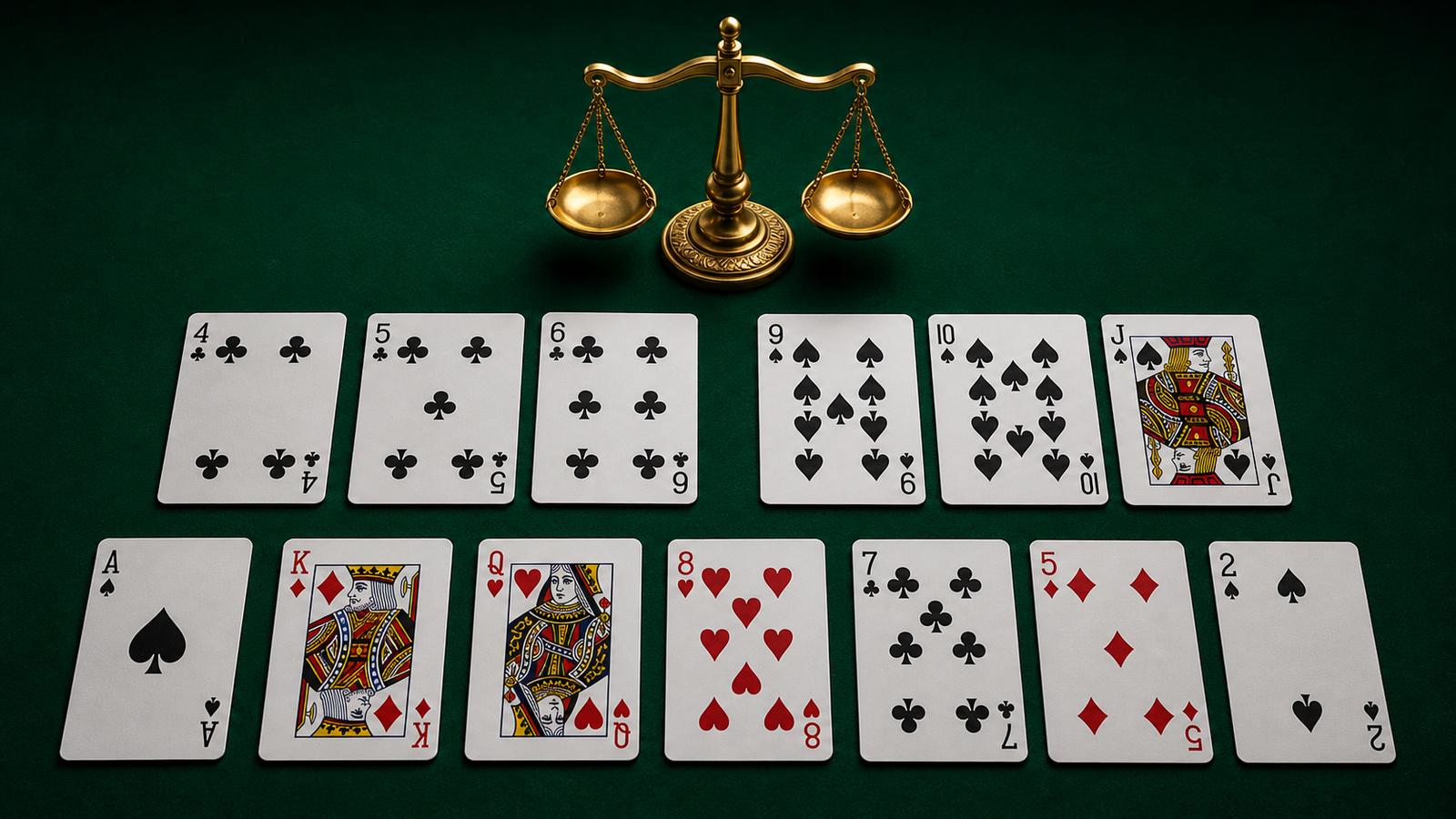
Suppose 4C-5C-6C is already a pure sequence candidate and 9S-10S-JS forms a second natural run. Seven loose cards remain, including an ace, king and queen. The hand has useful structure even though its loose points need attention. By contrast, if both runs were broken two-card chases and the high cards were isolated, an available early drop could deserve more weight. The decision depends on the full hand and table terms, not one bad-looking card.
Stable rules versus platform differences
The stable teaching point is the sequence structure of 13-card Indian Rummy and the need for at least one pure sequence. Deck count, Joker selection, scoring caps, first-drop and middle-drop penalties, and interface timing can vary. Gin Rummy uses knocking and deadwood scoring; it does not use the same drop framework.
FAQ
Should I always drop when my opening hand has high cards?
No. First check whether those cards connect to realistic sequences and compare the whole hand with the active drop penalty.
Is the first-turn drop penalty the same on every platform?
No. Timing, availability and point penalties can differ, so the active table rules are authoritative.
Can a drop checklist guarantee better results?
No. It can reduce impulsive decisions but cannot control draws, opponents or outcomes.
Glossary
- Early drop: A platform-provided option to leave a hand early for a stated penalty under that table’s rules.
- Completion distance: The number of missing cards needed to turn a candidate group into a valid sequence or set.
- Point exposure: The scoring value carried by unmatched cards if the hand ends before a valid declaration.
Responsible play note
Indian Rummy is a skill-based card game, but no article, checklist, or tournament routine can guarantee results. Use these guides to improve decisions, keep time and budget limits, and follow the laws and table rules that apply in your location.