

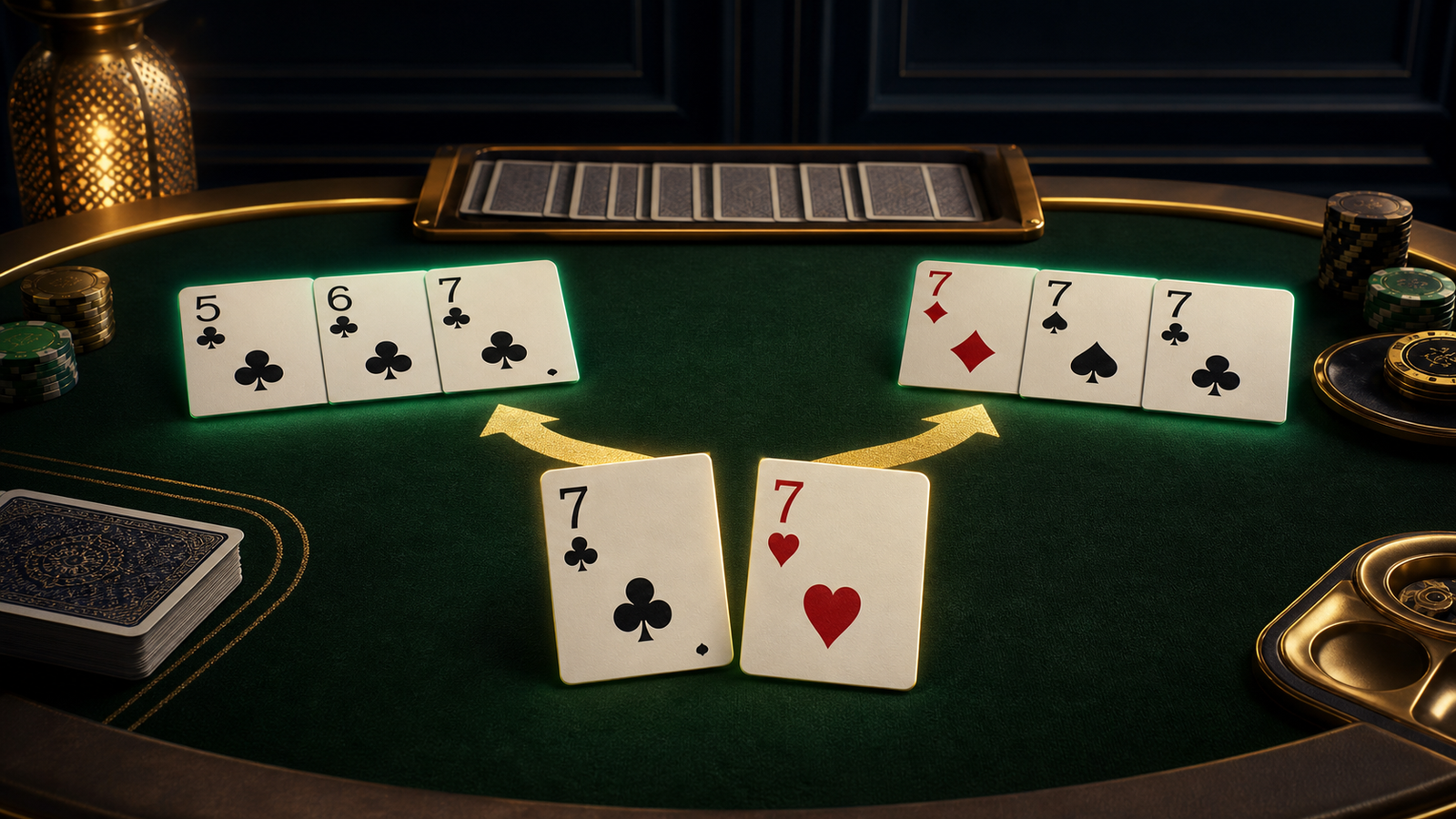
Duplicate Cards in Indian Rummy: Keep, Split, or Discard?
Two cards of the same rank can look redundant, but each may connect to a different suit or future set.
Summary: Treat duplicate-rank cards as separate candidates. Check natural sequence connections first, then same-rank set potential, visible copies, and point exposure. Keep both only while each has a clear role. This decision framework improves structure but never guarantees a result.
Split by suit
Evaluate each duplicate card against its own same-suit sequence connectors.
Test the set
A set route needs another same-rank card in a permitted different suit.
Protect purity
Give priority to the duplicate that strengthens the best natural pure-sequence path.
Plan the exit
When one copy loses its role, compare point cost and discard safety before releasing it.
What duplicate cards mean in Indian Rummy
Here, duplicate cards means cards of the same rank in different suits, such as 7H and 7C. They may work together toward a set, but each can also support a separate same-suit sequence. They are not automatically waste cards. A valid Indian Rummy declaration still depends on complete sequences and sets, including at least one pure sequence.
Duplicate-card decision checklist
- Separate the duplicate cards and mark every same-suit connector around each one.
- Reserve the card that best supports a natural pure-sequence route.
- Check whether a realistic third same-rank, different-suit card can complete a set.
- Use visible discards and pickups as evidence, without assuming unseen cards are available.
- Compare point exposure and discard safety before releasing the weaker copy.
- Reassess after every draw and keep firm time and budget limits.
Example hand: give each seven a role
Suppose you hold 7H, 7C, 5H-6H and 8C-9C. The 7H completes 5H-6H-7H, while 7C extends 7C-8C-9C. Splitting the same-rank cards creates two natural sequences, so chasing a third seven for a set would be unnecessary. If only one copy connected, the other would remain a set candidate or a later discard.
Rules boundary and probability caveat
The pure-sequence requirement and grouping cards into valid sequences or sets are stable Indian Rummy concepts. Deck count, duplicate-card handling within sets, Joker selection, timers and scoring can vary by platform. Check the active table rules before assuming two identical cards from multiple decks can share one set. Gin Rummy uses a different meld and deadwood system.
FAQ
Should I always discard one of two same-rank cards?
No. Each card may support a different same-suit sequence, or both may remain a realistic set route.
Can duplicate cards form a valid set in 13-card Rummy?
Same-rank cards can support a set, but suit and multiple-deck duplicate rules can vary by platform; check the active rules.
Does this duplicate-card framework guarantee a win?
No. It reduces avoidable grouping mistakes but cannot control draws or opponents.
Glossary
- Pure sequence: A same-suit consecutive run made without using a Joker as a substitute.
- Duplicate rank: Two or more held cards sharing a rank, often in different suits.
- Set candidate: An incomplete same-rank group that may become a valid set under the active table rules.
Responsible play note
Indian Rummy is a skill-based card game, but no article, checklist, or tournament routine can guarantee results. Use these guides to improve decisions, keep time and budget limits, and follow the laws and table rules that apply in your location.