
Is a Set Required in Indian Rummy? A Sequence-Only Example
A hand can contain valid sequences without a same-rank set. Check the declaration requirements before breaking a run just to create one.
Summary: Under the common 13-card rules used here, a set is optional. A hand made entirely of valid sequences can meet the grouping requirements; the active table rules still govern declaration.
Separate required sequences from optional sets
The phrase “sequences and sets” names the available group types. It does not mean that every hand must contain both. Under common 13-card Indian Rummy rules, the hand needs at least two sequences, including at least one pure sequence. Other cards may form further sequences or permitted sets.
Check the active Indian Rummy rules before applying this example. A table may have additional conditions or a particular declaration procedure. This article explains group structure; it does not certify a live hand or an unverified table setting.
Example: thirteen cards with no set
Consider this final arrangement: 3C-4C-5C, 6H-7H-8H, 9S-10S-JS, and 10D-JD-QD-KD. C means clubs, H hearts, S spades and D diamonds. Assume all listed cards are natural and none of their ranks is the designated wild Joker.
Each group has consecutive ranks in one suit. The four group sizes are 3, 3, 3 and 4, giving 13 distinct physical cards. All four groups are natural sequences, so the example meets the common sequence requirements without a set. The repeated ranks across different suits do not need to be moved into sets.
Read the 13-card coverage check for the counting step. The 3-3-3-4 layout is one example, not a compulsory pattern for every hand.
Why forcing a set can break a finished hand
In that example, 10S and 10D share a rank but are only two cards. They are not a completed set. Moving them out of their runs would also leave those original groups needing another check. There is no reason to dismantle the example merely because it has no set.
A different hand may benefit from a set. Judge the complete arrangement actually available, including every card left behind. Do not reserve the same physical card for a run and a set at once; use the one-card, one-group check.
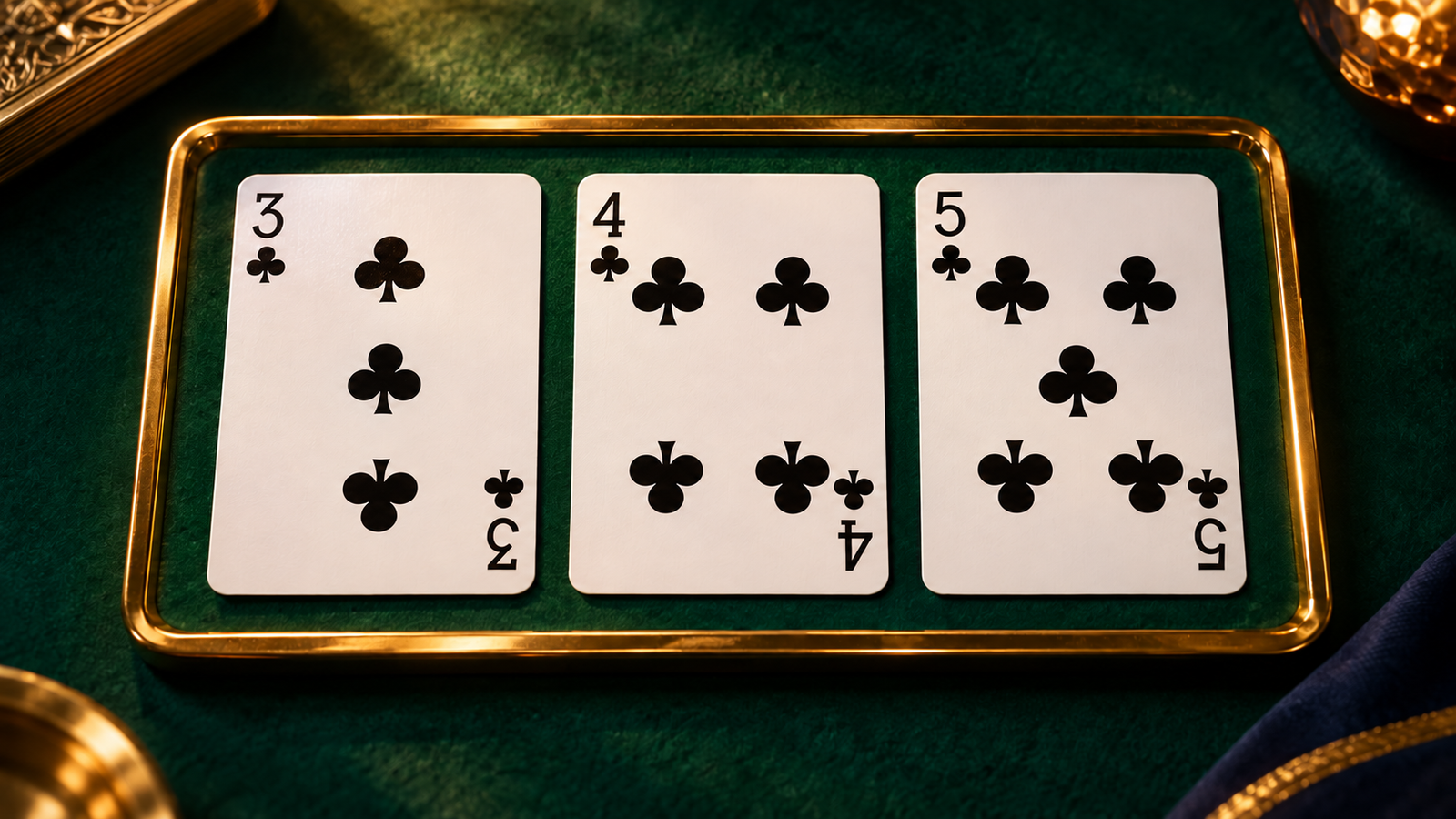
The body image shows the first three-card run only. The cover uses card backs as an organisational illustration; it does not show a valid 13-card hand.
Checklist for a hand with only sequences
- Confirm the table permits the group structure you plan to submit.
- Check the final 13 cards after accounting for the required discard.
- Read each sequence by rank and suit, not by how neatly it is displayed.
- Confirm the required number of separate sequences and the pure sequence.
- Account for each physical card exactly once and follow the declaration procedure.
When practising, read the four example groups aloud and explain why each is a sequence. Then identify the rule that would require a set. Under the common rules described here, there is no such requirement. Do not invent one from the wording of a guide title.
18+ only. Practise responsible play, set time and budget limits, take breaks and do not chase losses. Follow local laws and the active table rules. Read the responsible gaming guide.
FAQ
Must every Indian Rummy hand contain a set?
Under the common 13-card rules described here, no. Valid sequences can cover the whole hand. Confirm the active table requirements.
Can sets replace the required sequences?
No. An optional set does not replace a required sequence or the pure-sequence requirement.
Does the example guarantee a successful live declaration?
No. Check your actual cards, Joker designation, active rules and the required submission procedure.
Glossary
Responsible play note
Indian Rummy is a skill-based card game, but no article, checklist, or tournament routine can guarantee results. Use these guides to improve decisions, keep time and budget limits, and follow the laws and table rules that apply in your location.