
Do Your Rummy Groups Account for All 13 Cards?
Four neat groups can still leave a card outside. Count the cards in each group before checking whether the whole hand is ready.
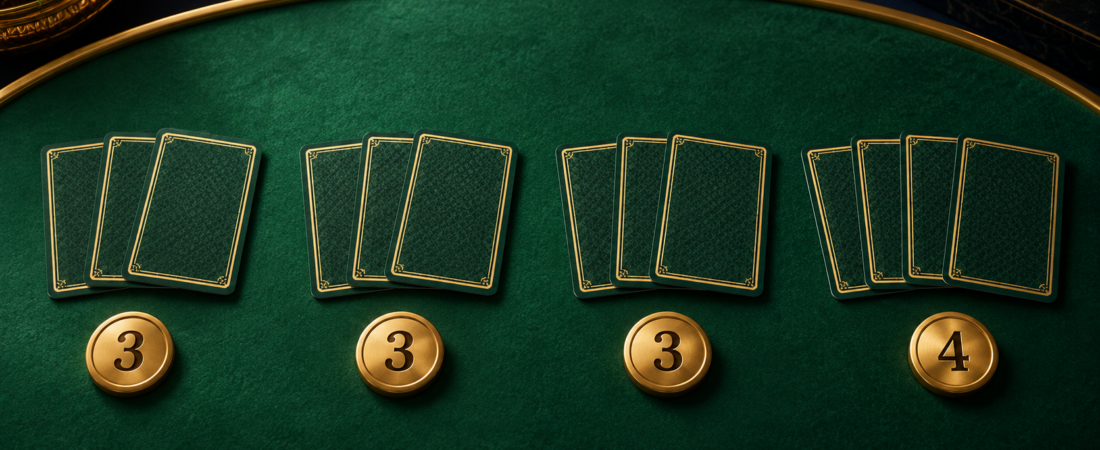
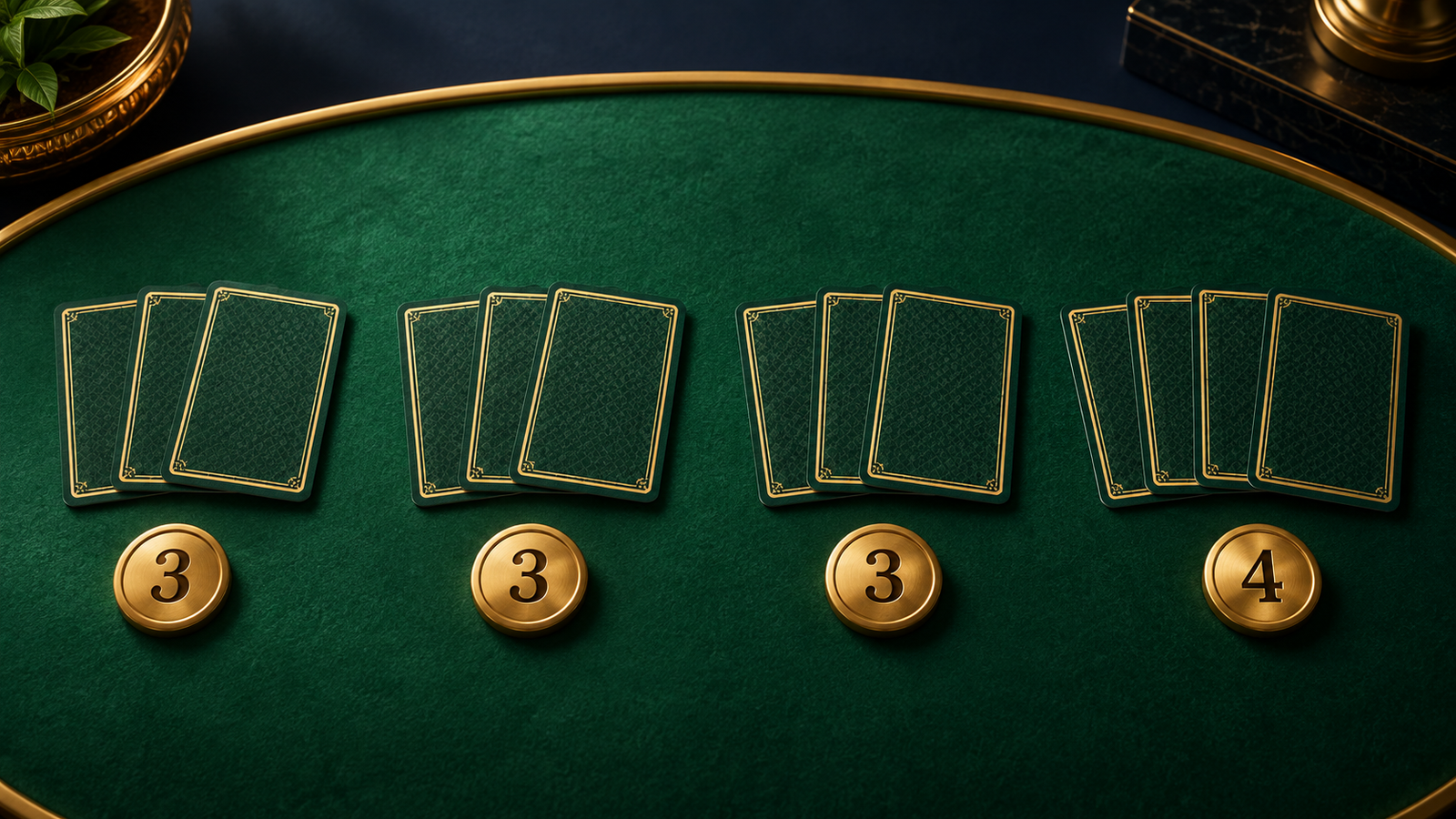
Summary: A 3-3-3-4 layout accounts for 13 cards, but the numbers alone do not make the groups valid. Four groups of three account for only 12, leaving one card to resolve.
Start with the hand you will declare
A tidy layout can hide a card that has no valid group. Count the physical cards assigned to each group, then count anything left outside. For this exercise, check the final 13-card hand after accounting for the required discard. Do not confuse it with the temporary 14-card state after drawing.
Use the turn-by-turn card-count guide if the stage of the turn is unclear. The arithmetic below checks coverage only. You still need the table’s sequence, set, Joker and declaration rules.
Example: three groups of three and one of four
Suppose your final arrangement is 3H-4H-5H, 6C-7C-8C, 9H-9D-9S, and 10D-JD-QD-KD. H means hearts, C clubs, D diamonds and S spades. Assume all listed cards are natural and none of these ranks is the designated wild Joker.
The group sizes are 3, 3, 3 and 4. Their sum is 13. The hearts, clubs and diamond runs are same-suit consecutive sequences; the three nines form a set in different suits. Under the common rules used for this example, the sequence requirement is covered, including pure sequences. Confirm the active table rules and the actual cards before declaring.
The four-card group is a sequence here. Counting four cards does not tell you whether another four-card collection is a sequence, a set or neither. Read each group using the Indian Rummy rules guide.
Find the thirteenth card in a 3-3-3-3 layout
Four groups of three total 12. In a final 13-card hand, one physical card remains outside those groups. It cannot disappear just because the other cards look complete. Do not declare until you have accounted for it in a valid arrangement.
For instance, 10D-JD-QD can extend to 10D-JD-QD-KD when KD is the remaining natural card. If the remaining card is KH instead, placing it beside those diamonds does not create that run. The suit matters as well as the rank. You may need a different valid arrangement or further play; this check does not name an automatic discard.
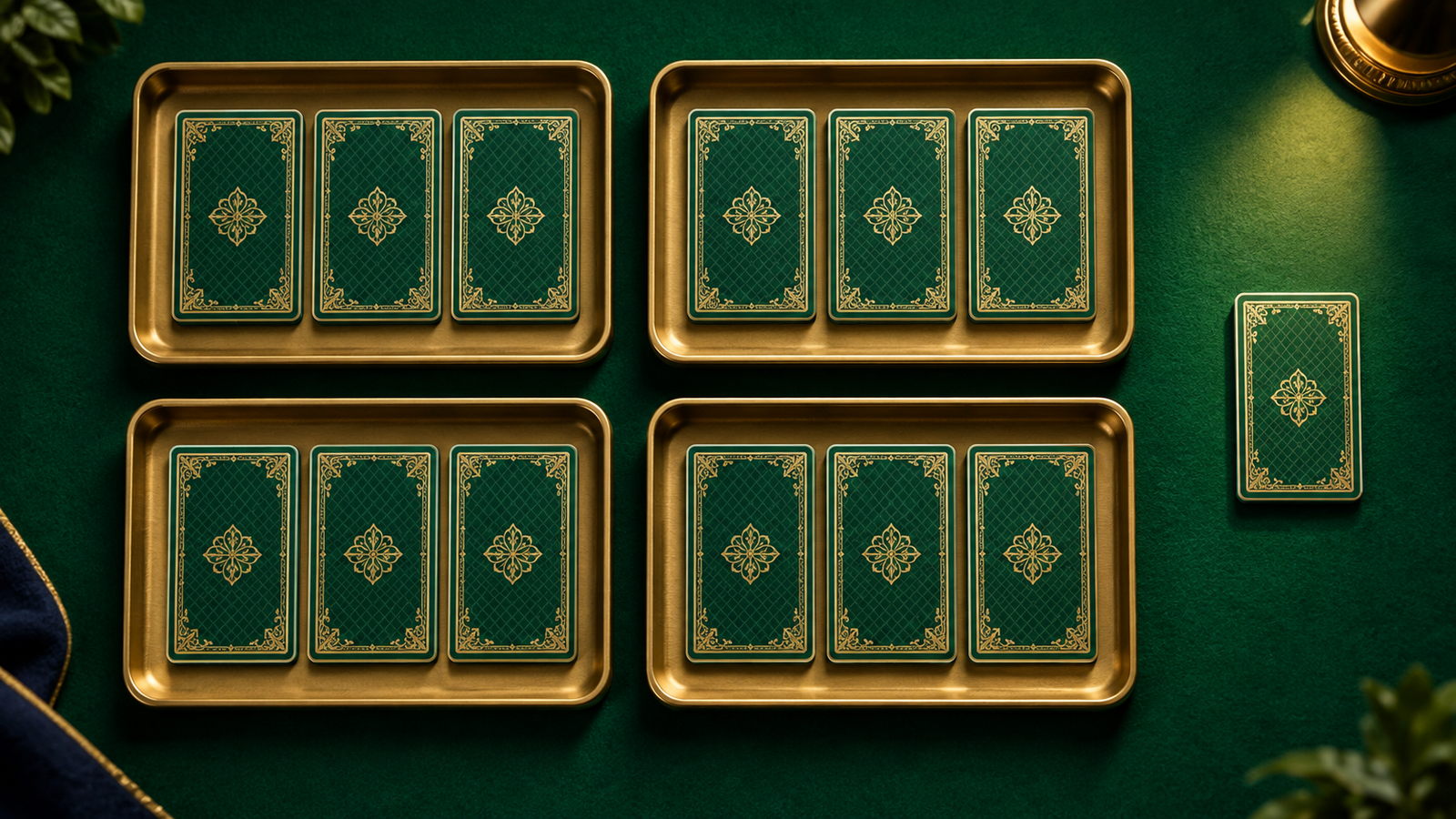
The face-down illustration shows card counts only. It cannot demonstrate valid sequences or sets because the ranks and suits are hidden.
Do not turn 3-3-3-4 into a mandatory rule
The 3-3-3-4 pattern is a convenient counting example, not a requirement to force every hand into four groups. A permitted longer sequence changes the size totals. Judge the real groups against the active rules instead of breaking a valid run merely to match a picture.
Also avoid sharing one physical card between two groups. If you write the same card into two different runs on paper, the totals can appear correct while the arrangement is impossible. The guide to splitting a six-card run shows why separate groups need separate cards.
Use a coverage checklist before the rules check
- Confirm that you are checking the final 13-card arrangement.
- Count the physical cards in each displayed group.
- Add the group sizes and count the cards outside them.
- Ensure every physical card belongs to exactly one group.
- Check ranks, suits and any Joker substitution within each group.
- Check the required sequences, including a pure sequence, and the table’s final-discard procedure.
To practise this check, lay out four groups of three and one loose card. Name the loose card before trying to fit it anywhere. Repeat with a card that extends a sequence and a card that does not. Correct counting is useful, but it cannot predict a draw or guarantee a result.
18+ only. Practise responsible play, set time and budget limits, take breaks and do not chase losses. Follow local laws and the active table rules. Read the responsible gaming guide.
FAQ
Does 3-3-3-4 automatically mean a valid declaration?
No. It accounts for 13 cards. Each group and the whole hand must still satisfy the active rules.
Must every Indian Rummy hand use exactly four groups?
Do not treat this example as a universal requirement. Permitted group lengths and declaration rules determine which arrangements are valid.
Can I ignore one card after making four three-card groups?
No. Those groups cover only 12 cards; the remaining card still needs to be accounted for in the final hand.
Glossary
Responsible play note
Indian Rummy is a skill-based card game, but no article, checklist, or tournament routine can guarantee results. Use these guides to improve decisions, keep time and budget limits, and follow the laws and table rules that apply in your location.