


Two Jokers, Two Jobs: Allocate Them Across an Indian Rummy Hand
Two Jokers create options, but using both on the easiest-looking group can leave the rest of the hand without a workable declaration route.
Summary: Secure a natural pure sequence first. Then list the unfinished groups that still matter for a valid declaration and give each Joker one provisional job. Avoid placing both Jokers in a group that already has several natural completion routes while another required sequence remains blocked. Recheck after every draw. This framework reduces allocation mistakes but cannot guarantee a result.
Protect purity
Keep the mandatory pure sequence free of Joker substitution.
Name two jobs
Assign each Joker to a separate declaration need before chasing optional groups.
Count natural outs
Save flexible natural routes from unnecessary Joker use.
Reassign after draws
Move a Joker when a natural card completes its current group.
Why two Jokers still need a plan
A common 13-card Indian Rummy declaration needs at least two sequences, including at least one pure sequence. A printed Joker or wild Joker may substitute in an impure sequence and may support a valid set under the active table rules, but neither can turn a substituted run into the mandatory pure sequence.
With two Jokers, the temptation is to finish one convenient group immediately. First check what the whole hand lacks. If the second sequence is still missing, completing an optional set with both Jokers can solve the wrong problem.
Two-Joker allocation checklist
- Sort the hand by suit and secure the strongest natural pure-sequence route.
- Confirm whether a second sequence is already complete or still blocked.
- List every one-card gap and unfinished set that can legally use a Joker.
- Count the natural cards that can complete each candidate group.
- Give the first Joker to the most declaration-critical bottleneck.
- Use the second Joker on a separate weak group unless the active rules and final structure justify another arrangement.
- After each draw, rebuild the groups, reduce loose points, and keep fixed time and budget limits.
Example: split the jobs instead of stacking Jokers
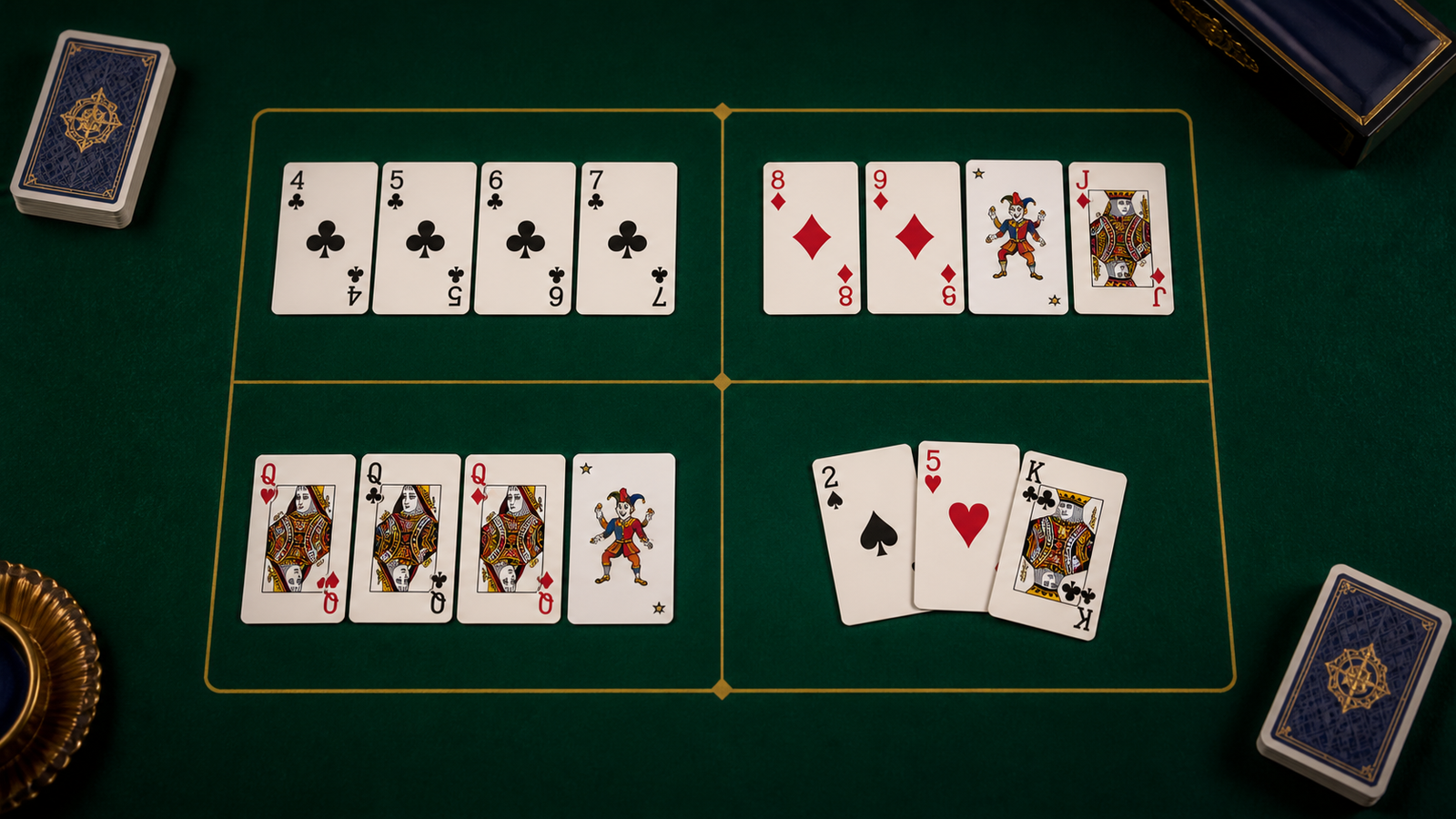
Suppose 4C-5C-6C is your pure sequence. You also hold 8D-9D-JD, QH-QC, a printed Joker and a wild Joker. The diamond cards need 10D for a natural run, while the queens need a third permitted suit card for a natural set.
One provisional arrangement uses a Joker as 10D to complete the required second sequence and the other with the queens, subject to the table’s set rules. Putting both Jokers with the queens would leave the second sequence unresolved. If 10D or another natural completion arrives, move the freed Joker to the next valid bottleneck.
Final checks and related guides
Before declaring, confirm that every physical card appears once, the pure sequence uses only natural cards, the second sequence is valid, and all Joker-assisted sets comply with the active deck and duplicate-card rules. Platform validators and wild-Joker treatment can vary.
Related guides: review printed Joker allocation, wild Joker versus printed Joker and sets and sequences.
FAQ
Should I always place two Jokers in different groups?
No. Treat separate jobs as a useful default, then follow the active table rules and the final declaration structure.
Can either Joker be used in the mandatory pure sequence?
No. The mandatory pure sequence must use natural cards without Joker substitution.
Does having two Jokers guarantee a valid declaration?
No. You still need the required sequences, valid remaining groups, correct card count and a legal final arrangement.
Glossary
- Allocation: The provisional group and role assigned to a Joker while organising the hand.
- Bottleneck: A missing card or group that blocks the hand from meeting declaration requirements.
- Natural out: A non-Joker card that can validly complete or extend a candidate group.
Responsible play note
Indian Rummy is a skill-based card game, but no article, checklist, or tournament routine can guarantee results. Use these guides to improve decisions, keep time and budget limits, and follow the laws and table rules that apply in your location.