
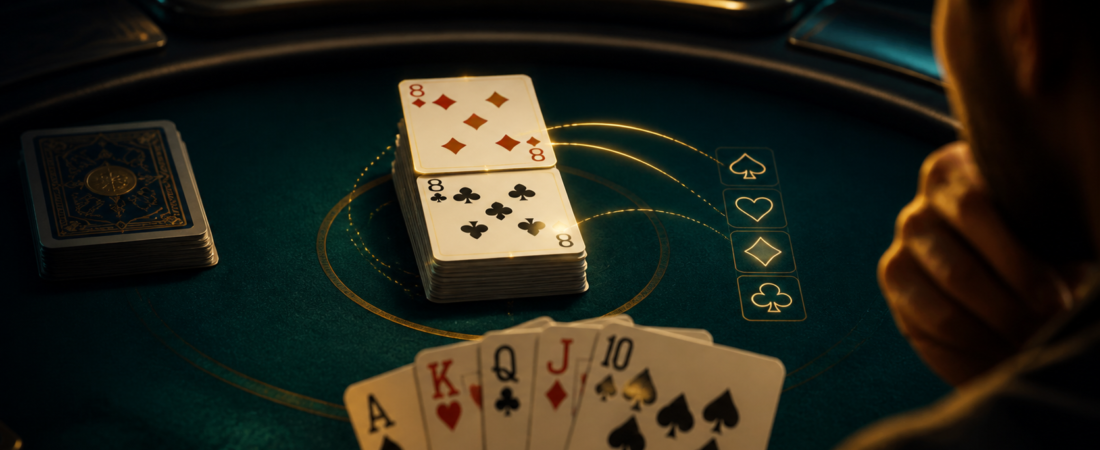

Two Same-Rank Discards: What the Signal Means in Indian Rummy
Two discarded eights tell you what left an opponent’s hand; they do not reveal every card that opponent still holds.
Summary: Treat repeated same-rank discards as a limited observation signal. Record the suits and timing, check visible pickups, and compare any discard adjustment with your own pure-sequence and second-sequence needs. Do not assume the opponent has rejected the entire rank or cannot use nearby cards. Observation can improve discipline, but it cannot guarantee a safe discard or a result.
Record the fact
Note the exact rank, suit and order of each visible discard.
Limit the inference
Two same-rank discards do not reveal the opponent’s full grouping plan.
Protect your hand
Do not break a strong pure-sequence route for an uncertain read.
Review new evidence
A later pickup or discard can strengthen or weaken the original signal.
What two same-rank discards actually show
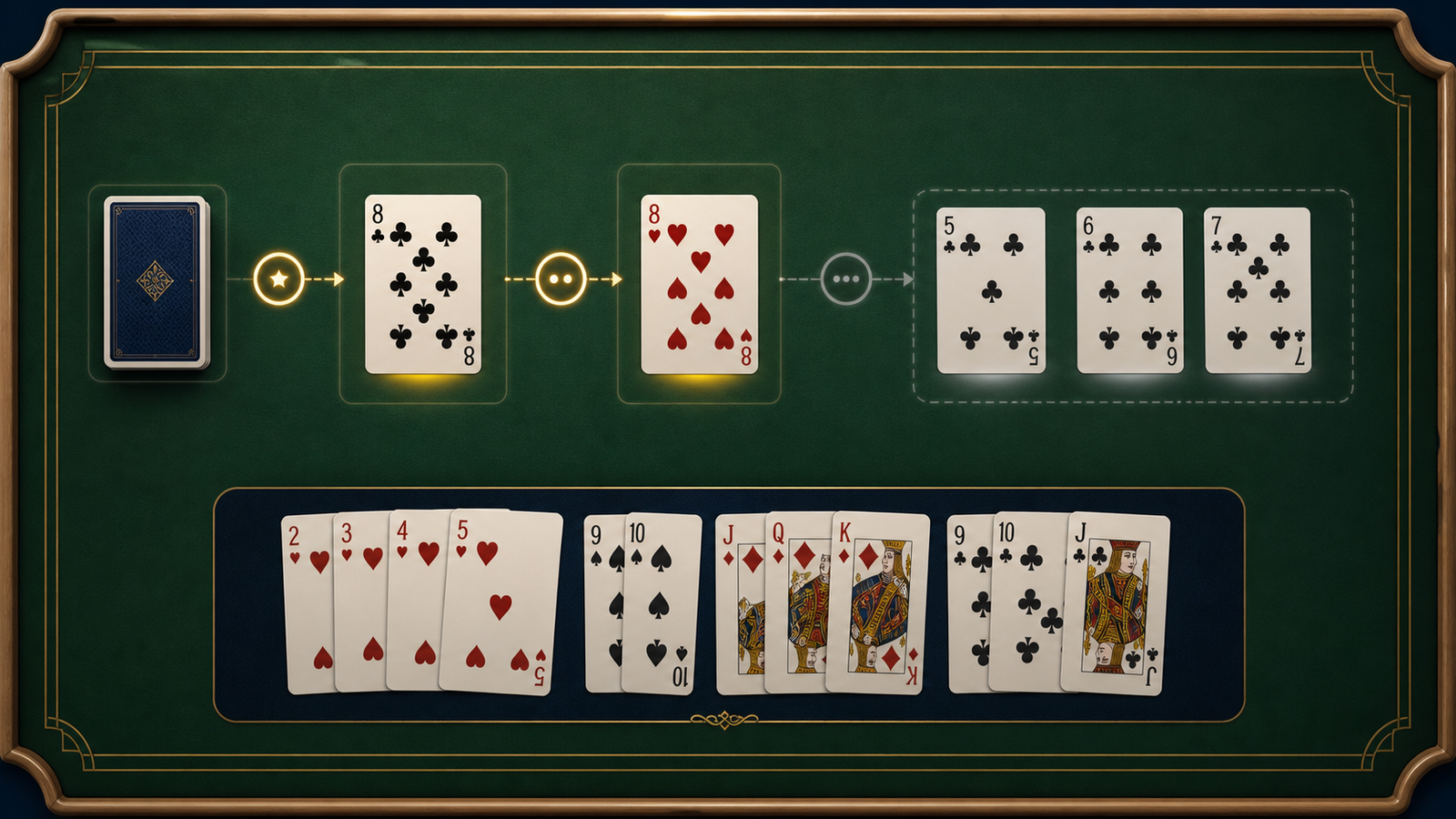
If an opponent discards 8C and later 8H, the visible fact is narrow: those two cards left that player’s hand at those moments. The pattern may suggest that a set of eights was not useful then, or that other groups had higher priority. It does not prove the player holds no other eight.
Suits matter too. Each discarded eight has different same-suit sequence neighbours. The 8C can connect with clubs, while 8H can connect with hearts. A rank-only conclusion misses those separate routes.
Fact-to-decision checklist
- Note the exact rank and suit instead of remembering only the repeated rank.
- Record whether the cards were discarded early or after several turns.
- Check whether the opponent picked a nearby rank or same-suit card from the open pile.
- Separate the observed cards from your inference about the remaining hand.
- Protect your own pure sequence and required second sequence before changing a discard plan.
- Prefer a lower-point loose card when two options carry similar connection risk.
- Update the read when new visible evidence appears and keep fixed time and budget limits.
Example: two eights do not make every eight safe
An opponent discards 8C on an early turn and 8H later. You hold 8S as a loose card and 7D-8D-9D as a natural sequence. The visible pattern does not justify breaking the diamond sequence or assuming 8S is harmless. Keep the completed natural group intact.
If 8S remains loose and competes with another weak card, compare point exposure and nearby visible pickups. Discarding it may be reasonable, but call it a risk-based choice rather than a certainty about the opponent’s hand.
Use signals without weakening valid structure
Your own declaration structure comes first. A common 13-card Indian Rummy hand needs at least two sequences, including one pure sequence. Table observation should help choose between genuinely loose cards, not persuade you to dismantle a valid group on thin evidence.
Related guides: read how to read discards, the three-turn observation framework and safe discard signals.
FAQ
Do two same-rank discards prove an opponent does not want that rank?
No. They show only that two specific cards were discarded at particular times; the rest of the hand remains unknown.
Should I discard the same rank immediately?
Not automatically. Check your own groups, the suits involved, visible pickups and point exposure first.
Can discard reading identify a completely safe card?
No. Visible actions support cautious inferences, not certainty about hidden cards or future draws.
Glossary
- Observed fact: A visible action such as the exact card placed on the open discard pile.
- Inference: A tentative conclusion drawn from visible actions rather than known hidden cards.
- Connection risk: The possibility that a discarded card helps another player’s sequence or set.
Responsible play note
Indian Rummy is a skill-based card game, but no article, checklist, or tournament routine can guarantee results. Use these guides to improve decisions, keep time and budget limits, and follow the laws and table rules that apply in your location.