Printed Joker Allocation in Indian Rummy: A Constraint-First Guide
A printed Joker should solve the hand’s tightest declaration constraint, not simply complete the first group that looks convenient.
Summary: Protect a natural pure sequence first, identify whether a second sequence is still missing, then compare candidate groups by natural outs, completion distance and loose-card points. Printed-Joker treatment and set validation can vary by platform, so check the active rules. This framework improves decisions but cannot guarantee results.
Protect purity
Keep the mandatory natural pure-sequence route free of Joker substitution.
Find the constraint
Ask which missing legal group currently blocks a valid declaration.
Count natural outs
Save the Joker from a route that several unseen natural cards can complete.
Reallocate after draws
Move the Joker when a natural card resolves its current bottleneck.
Printed Joker meaning in 13-card Indian Rummy
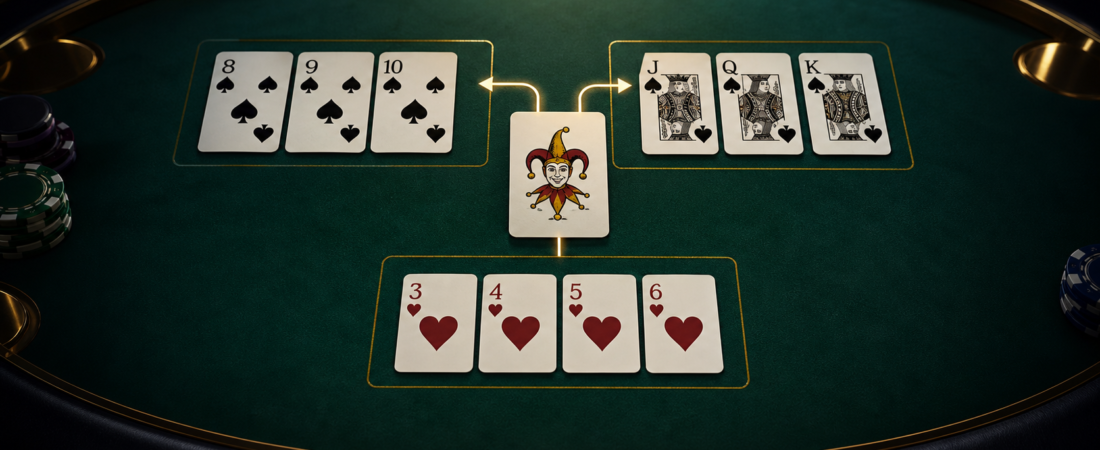
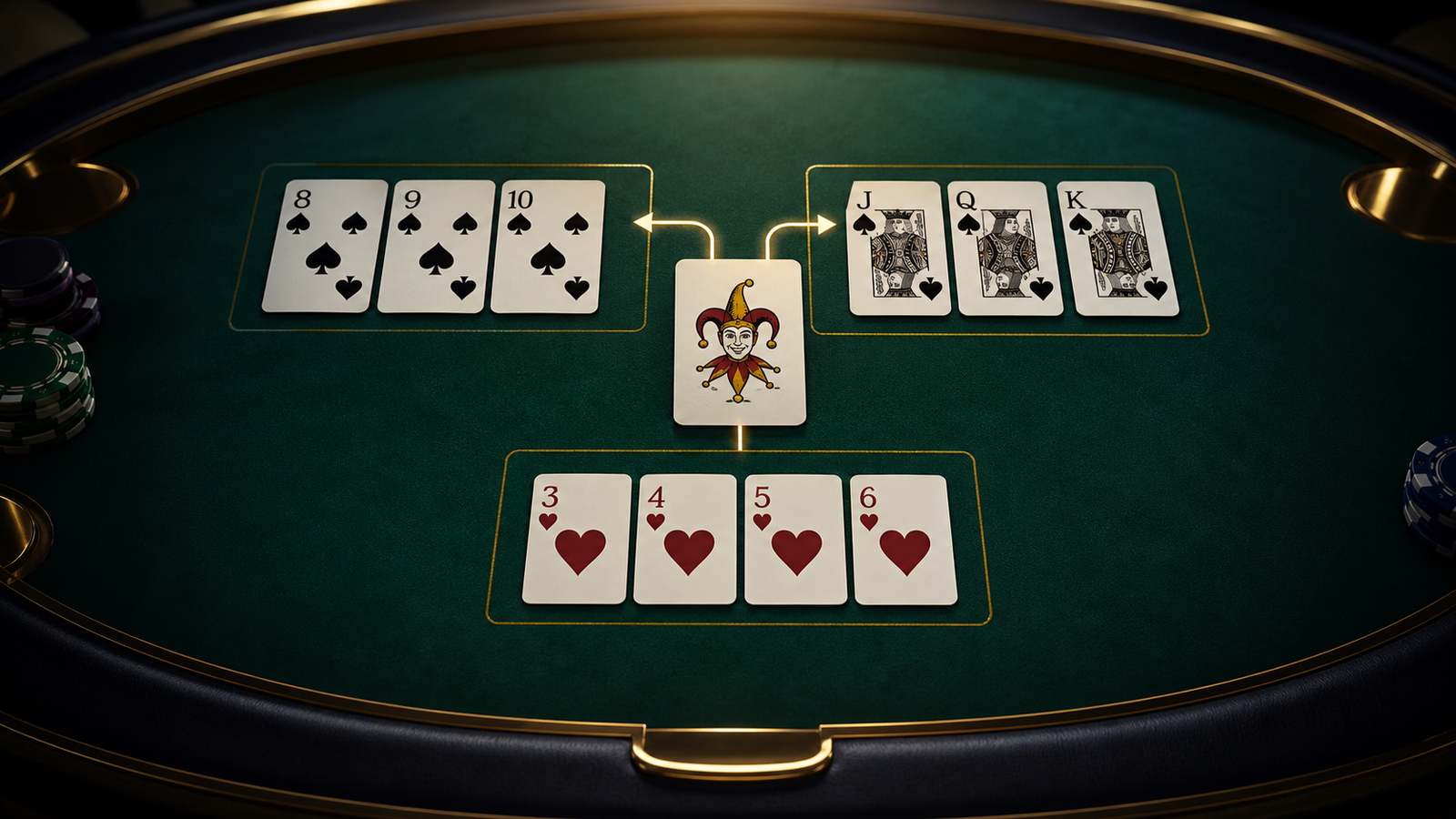
A printed Joker is the dedicated Joker card in the deck. Under common 13-card Indian Rummy rules, it can substitute for a missing card in an impure sequence and may help form a valid set when the table rules permit. It cannot turn a substituted group into the mandatory pure sequence. Wild-Joker selection, deck count, duplicate-card handling and permitted Joker combinations can differ by platform.
This is Indian Rummy guidance. Gin Rummy normally uses no Joker and relies on knocking and deadwood scoring, so its meld decisions should not be applied here.
A constraint-first Joker allocation checklist
- Sort all 13 cards by suit and protect the strongest natural pure-sequence route.
- Confirm whether the hand still needs its second sequence.
- List every candidate impure sequence or set that could use the printed Joker.
- Count the unseen natural cards that could complete each candidate without the Joker.
- Prefer the Joker where one missing card blocks a declaration-critical group and natural outs are scarce.
- Compare the points carried by cards left loose after each possible allocation.
- Recheck after every draw; Joker placement is provisional until declaration.
Example hand: solve the single-gap route
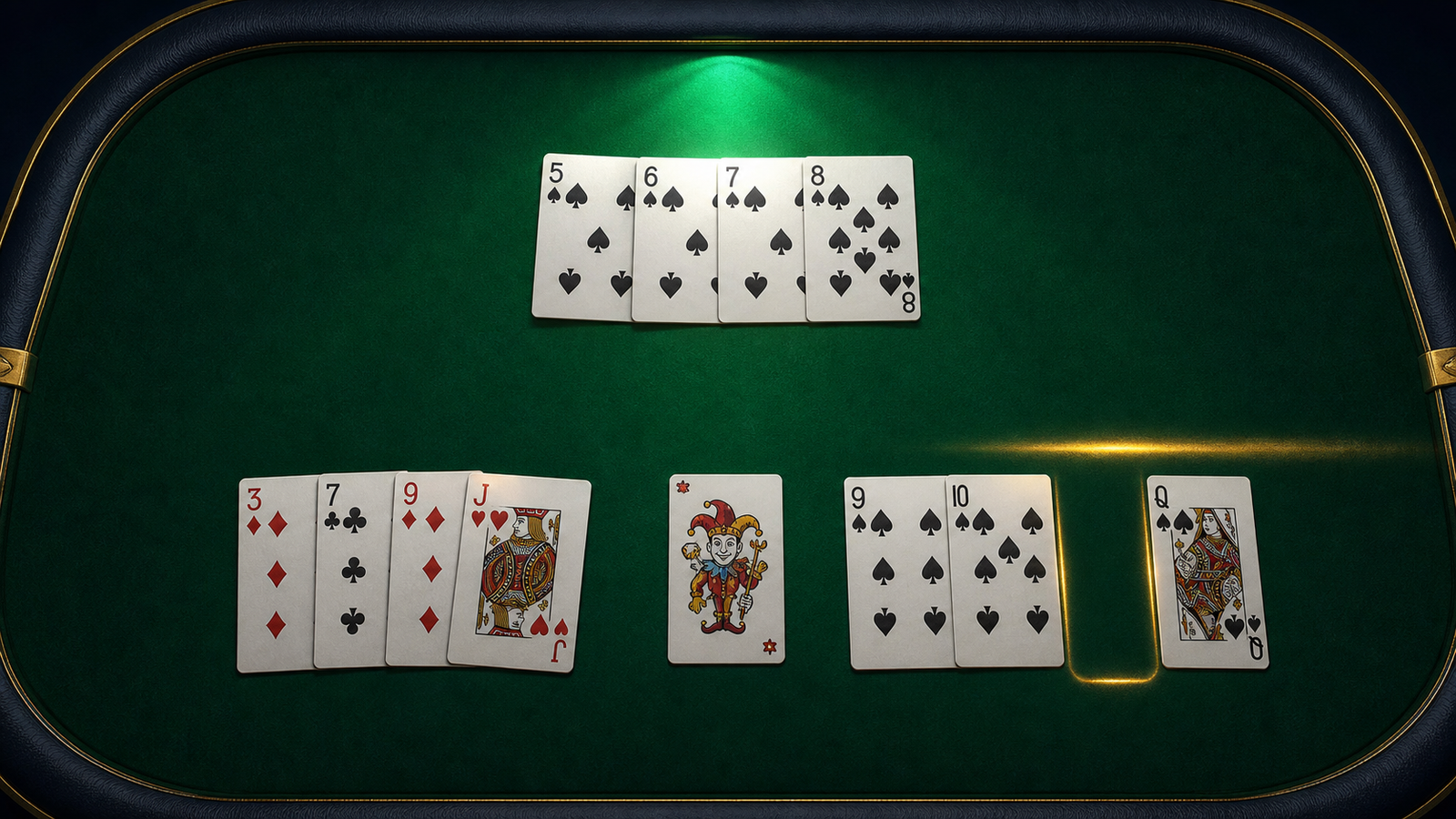
Suppose 5S-6S-7S-8S is already your pure sequence. You also hold 9H-10H-QH, 3D-7C-9D-JH and a printed Joker. The heart route needs JH to become 9H-10H-JH-QH, while the scattered cards do not yet form a realistic legal group. If JH is already elsewhere in the hand, the heart run is natural; if it is unavailable and the Joker is your only substitute, allocating the Joker as JH solves a single, declaration-useful gap. Do not break the protected spade pure sequence merely to make another group look tidy.
If a natural JH arrives later, move the Joker to the next genuine constraint. Visible discards are clues about availability, not proof of an opponent’s exact hand.
When not to spend the printed Joker
Do not automatically place a Joker beside a pair just because that creates a set. If the hand still lacks its second sequence, the set may not solve the declaration structure. Likewise, avoid locking the Joker into an open-ended route with several natural outs when another group needs one exact card. Keep arrangements flexible, reduce loose high-card exposure when practical, and use session and budget limits as part of responsible play.
FAQ
Can a printed Joker be used in a pure sequence?
No. A pure sequence uses consecutive natural cards of the same suit without Joker substitution.
Should the printed Joker complete a sequence or a set first?
After protecting the pure sequence, prioritise the group that solves the most important declaration constraint, often the required second sequence, while checking the active table rules.
Can I move a printed Joker before declaring?
Yes. Hand grouping is provisional; rearrange it when a natural draw creates a stronger legal structure, subject to the platform interface.
Does good Joker allocation guarantee a win?
No. It can reduce structural mistakes but cannot control draws, opponents or declaration timing.
Glossary
- Printed Joker: A dedicated Joker card that can substitute inside permitted impure groups under the active rules.
- Pure sequence: Three or more consecutive cards of the same suit formed without Joker substitution.
- Natural out: An unseen non-Joker card that can validly complete or extend a candidate group.
- Constraint: A missing legal group or exact card that currently prevents a valid declaration structure.
Responsible play note
Indian Rummy is a skill-based card game, but no article, checklist, or tournament routine can guarantee results. Use these guides to improve decisions, keep time and budget limits, and follow the laws and table rules that apply in your location.