
Declaration-Ready Hand Audit: A Final Indian Rummy Checklist
A declaration-ready hand should pass a short structural audit before you press the final button, especially when Jokers or similar-looking groups are involved.
Summary: Confirm one natural pure sequence, a second valid sequence, valid sets or sequences for every remaining card, correct Joker use, and the complete card count. Then inspect each suit and rank once more before declaring. A checklist reduces avoidable invalid declarations but cannot guarantee results.
Verify purity
The mandatory pure sequence must use natural consecutive cards of one suit.
Confirm sequence two
A valid set cannot replace the required second sequence.
Audit Jokers
Check every Joker against the active table rules and its assigned group.
Count every card
Make sure no unmatched or accidentally duplicated card sits outside the declared groups.
The declaration-ready decision framework
First isolate the pure sequence and verify consecutive ranks in one suit without Joker substitution. Next identify the second sequence, which may be pure or impure under common 13-card Indian Rummy rules. Finally, audit every remaining set or sequence and confirm that no loose card has been overlooked.
Final declaration checklist
- Confirm at least one natural pure sequence.
- Confirm a second valid sequence.
- Check that each set uses the same rank and permitted suits or duplicates under the table rules.
- Check every Joker placement and ensure it is not being used to label a pure sequence.
- Count all cards included in the final grouping.
- Scan suits and ranks once more for a hidden gap or mismatch.
- Read the platform confirmation screen before submitting.
- Keep responsible time and budget limits.
Example hand audit
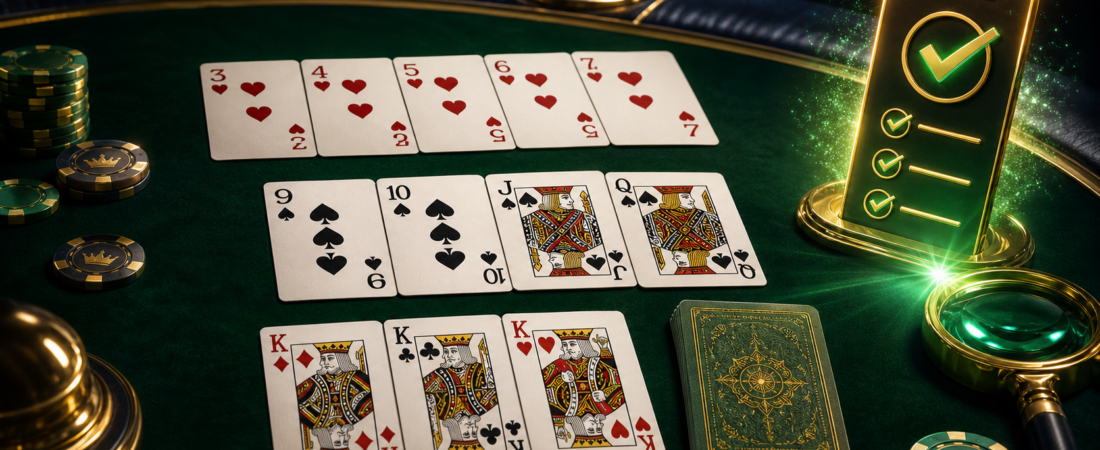
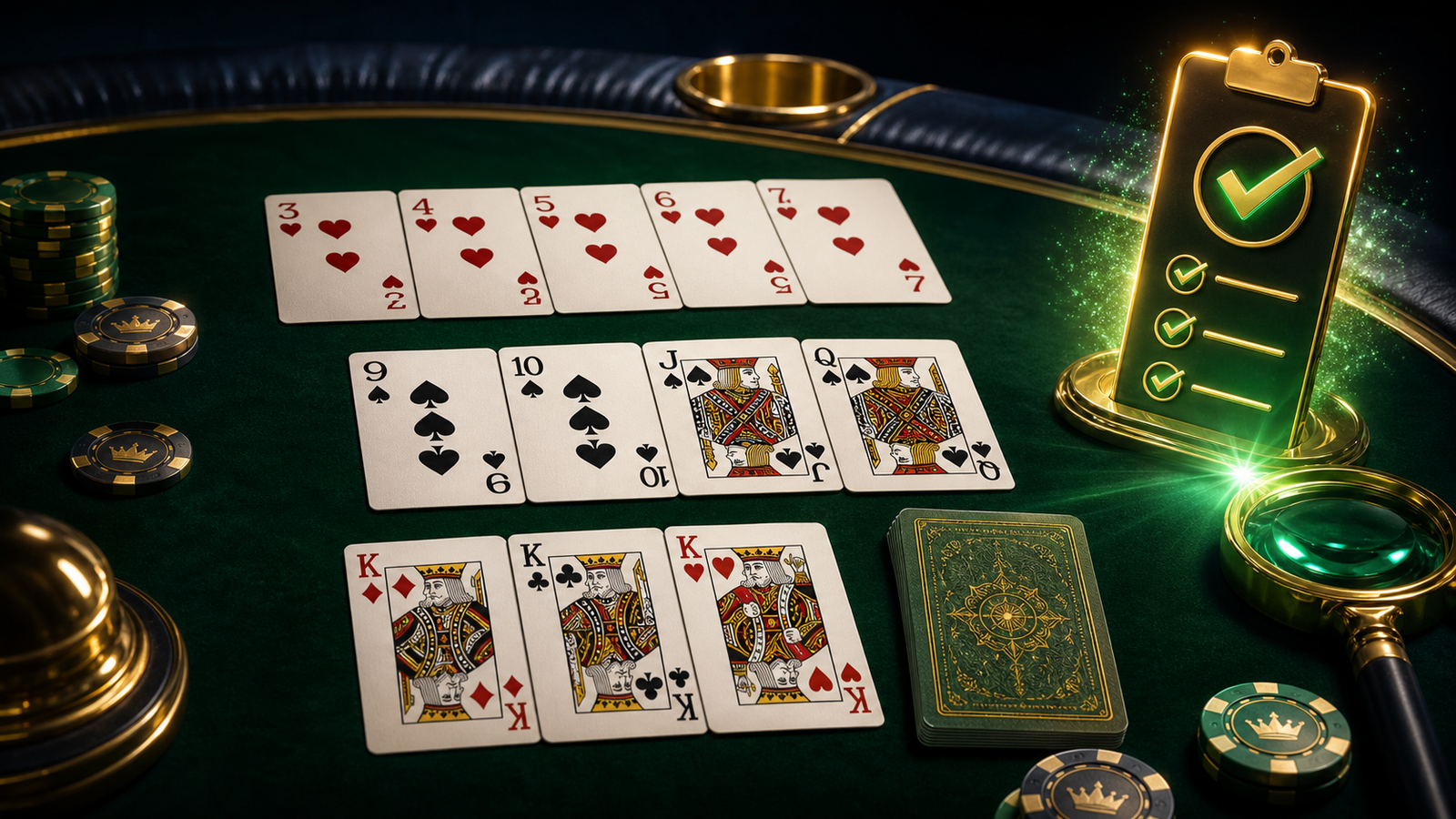
Consider 3H-4H-5H, 9S-10S-JS, 7D-7C-7H, and QC-QD plus a Joker. The hearts are a pure sequence and the spades are a second pure sequence. The sevens form a set. The Joker may complete the queen set if the active platform permits that arrangement. Before declaring, verify every card is grouped and that the interface recognises the intended Joker role.
Stable rules and platform differences
The two-sequence structure with at least one pure sequence is a stable feature of common 13-card Indian Rummy. Platforms may differ on deck count, wild and printed Jokers, duplicate cards in sets, scoring caps, and declaration interfaces. Check the active rules. Gin Rummy instead uses melds, knocking, and deadwood, so its finish procedure is different.
FAQ
What causes an invalid declaration in Indian Rummy?
Common causes include no pure sequence, no second sequence, an invalid set, incorrect Joker use, or an unmatched card.
Can a set replace the second required sequence?
No. Under common 13-card Indian Rummy rules, the hand needs at least two sequences, including one pure sequence.
Does a final checklist guarantee a valid result?
No. It reduces avoidable review errors; the active platform rules and the actual card groups still determine validity.
Glossary
- Declaration: Submitting a fully grouped hand for validation under the active table rules.
- Pure sequence: Three or more consecutive natural cards of the same suit without Joker substitution.
- Invalid declaration: A submitted grouping that fails one or more required hand-validity conditions.
Responsible play note
Indian Rummy is a skill-based card game, but no article, checklist, or tournament routine can guarantee results. Use these guides to improve decisions, keep time and budget limits, and follow the laws and table rules that apply in your location.