
Completion Distance in Indian Rummy: One Gap or a Two-Card Chase?
Completion distance asks how many useful natural cards a route still needs, helping you avoid spending too many turns on a fragile sequence chase.
Summary: Sort by suit, protect the strongest pure-sequence route, count missing cards and natural outs, then compare point exposure. A one-gap route is usually easier to complete than a route needing two exact cards, but visible discards and alternative connectors can change the choice. This framework improves decisions without guaranteeing results.
Count missing cards
Separate a one-card gap from a route that still needs two independent completions.
Count natural outs
Open-ended same-suit routes may offer more useful draws than an inside gap.
Protect purity
Give priority to the natural route most likely to form the mandatory pure sequence.
Price point risk
Release loose high cards when their completion route remains distant and narrow.
What completion distance means
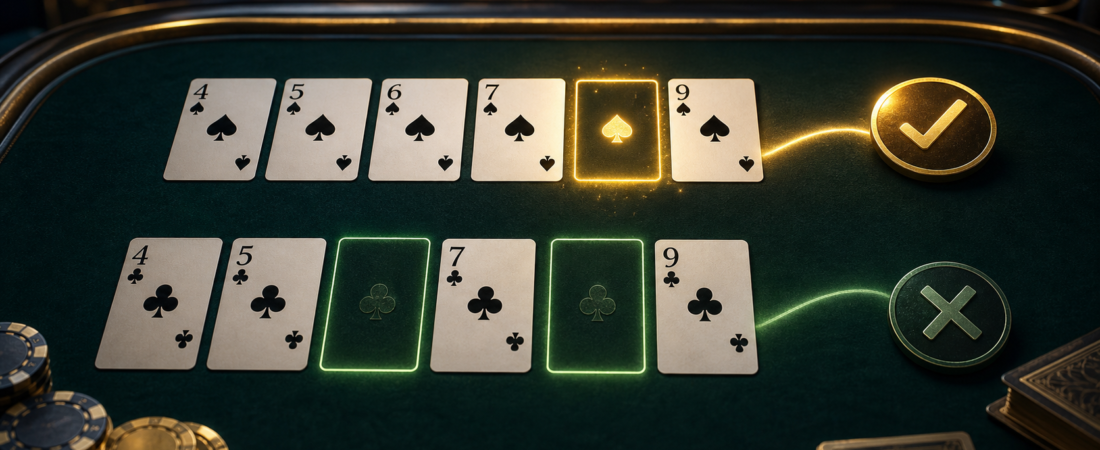
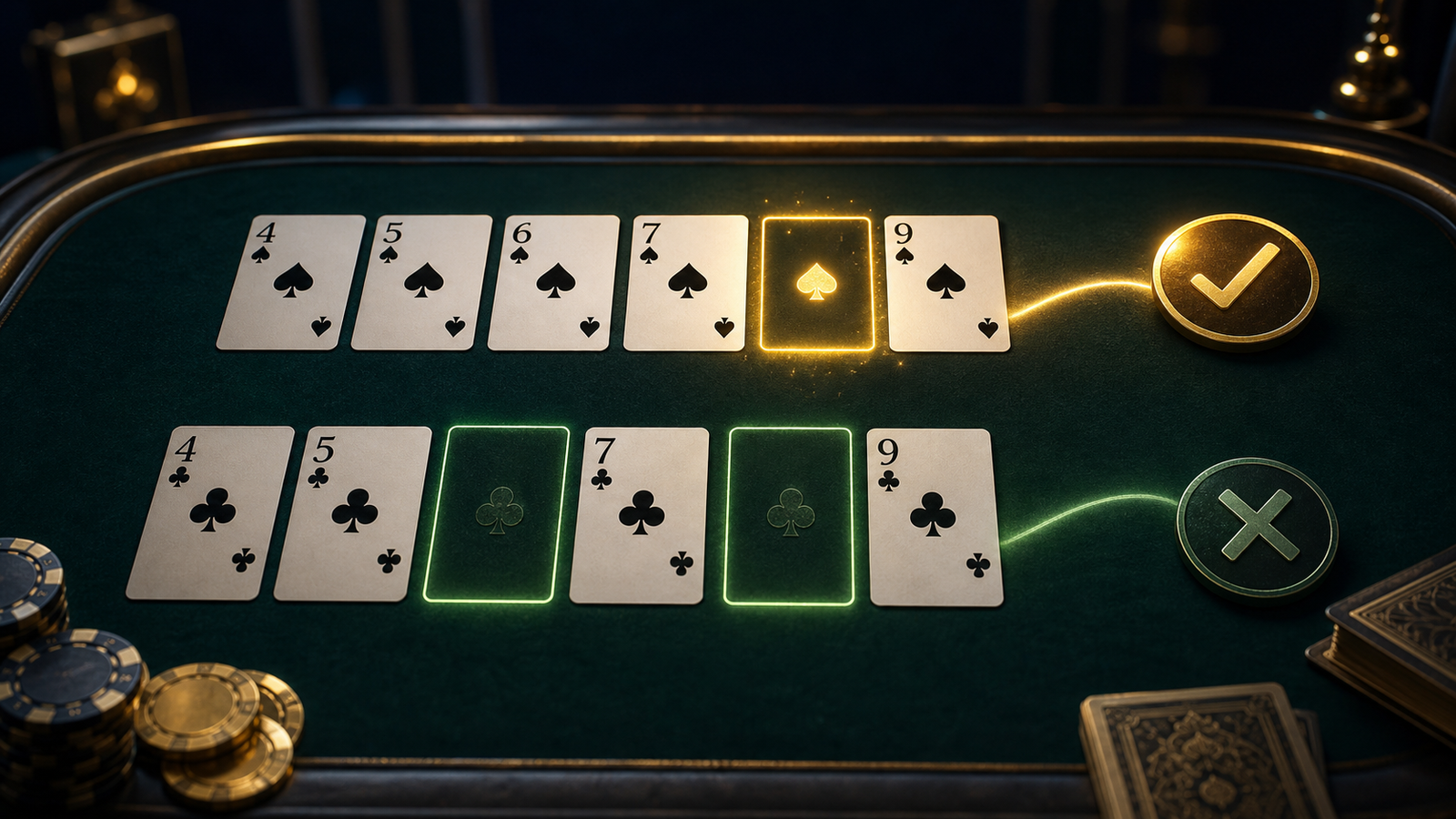
Completion distance is the number of additional cards a group needs before it becomes valid. In 13-card Indian Rummy, 5H-6H-8H has a one-card inside gap at 7H, while 5C-8C needs at least two cards to form a three-card sequence. Distance does not predict the next draw; it simply makes the unfinished work visible.
One-gap versus two-card chase checklist
- Sort the hand by suit and mark the best natural pure-sequence route.
- Count how many cards each unfinished route still needs.
- List every natural card that can validly complete or extend it.
- Check whether useful cards are already visible in the discard pile.
- Prefer the shorter route when declaration value and point risk are otherwise similar.
- Re-score after each draw instead of protecting an old plan automatically.
- Keep firm session and budget limits.
Example hand: one inside gap versus a distant pair
Suppose you hold 3D-4D-5D as a pure sequence, plus 7S-9S and 4C-7C. The spades need exactly 8S to become a second sequence. The clubs need at least two additions before they can form a valid run. Unless visible discards make 8S unrealistic or another club route gains strong connectors, the one-gap spade route has the shorter completion distance. Loose high cards should still be reviewed for point exposure.
Stable rules and platform differences
Common 13-card Indian Rummy requires at least two sequences, including at least one pure sequence; remaining cards may form valid sequences or sets. Deck count, Joker selection, duplicate-card handling, scoring caps, and declaration controls can vary by platform, so check the active table rules. Gin Rummy uses knocking and deadwood scoring and should not be mixed with Indian Rummy completion planning.
FAQ
Is a one-card gap always better than a two-card chase?
No. It is usually closer to completion, but visible discards, number of natural outs, pure-sequence value, and point exposure can change the decision.
What is an open-ended sequence route?
It is a same-suit run that can extend at either end, such as 6H-7H accepting 5H or 8H.
Can completion distance guarantee a win?
No. It is a decision aid and cannot control draws, opponents, or declaration timing.
Glossary
- Completion distance: The number of additional cards an unfinished group needs to become valid.
- Inside gap: A missing rank between two same-suit cards, such as 7H between 6H and 8H.
- Natural out: A non-Joker card that can complete or validly extend a candidate group.
Responsible play note
Indian Rummy is a skill-based card game, but no article, checklist, or tournament routine can guarantee results. Use these guides to improve decisions, keep time and budget limits, and follow the laws and table rules that apply in your location.