
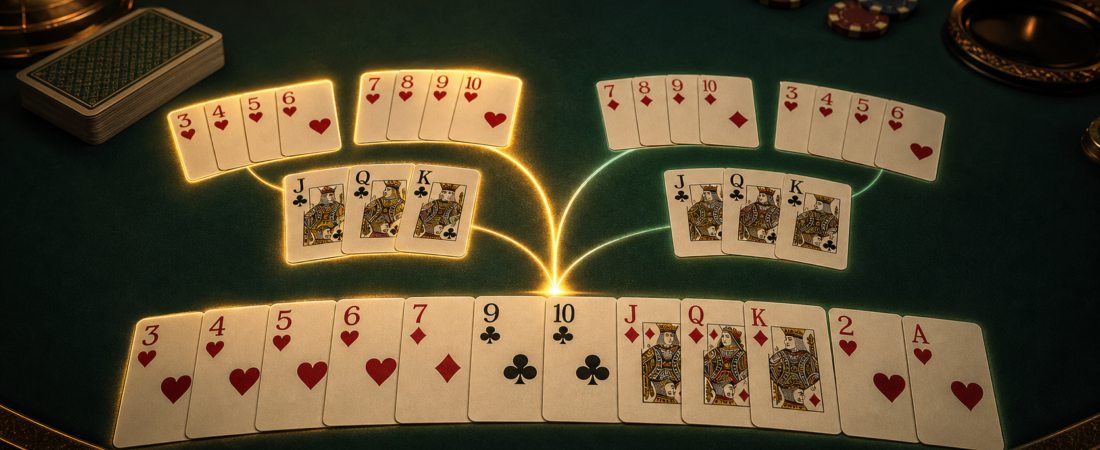
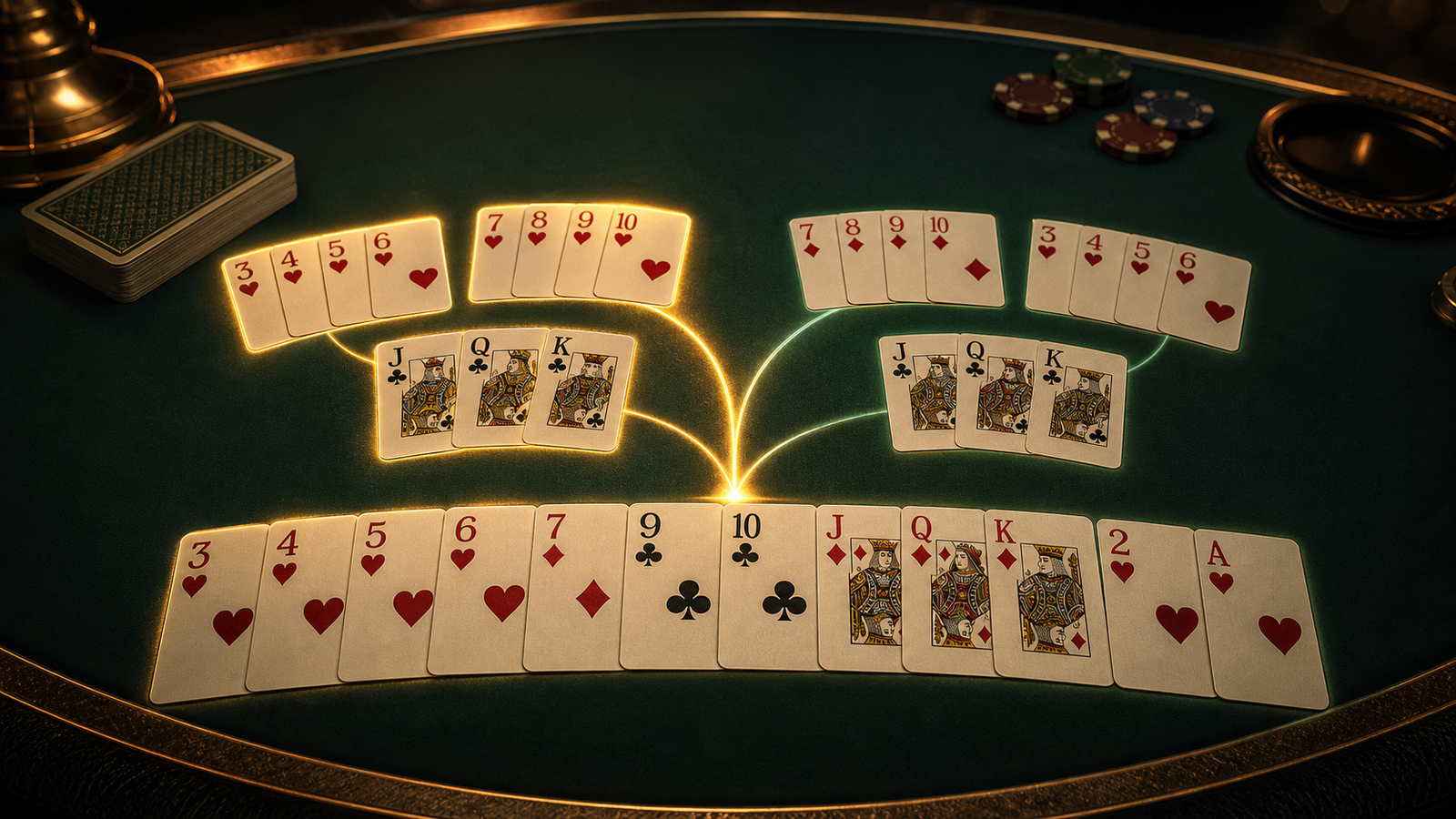
Two-Route Hand Planning for Indian Rummy Beginners
A hand with only one fragile plan can stall, while too many alternatives can fill the hand with loose cards.
Summary: Choose one primary route that best protects or completes a pure sequence, then keep one compact backup route sharing useful connectors. Re-rank both routes after every draw and release paths that stop improving. Use responsible play limits; no framework guarantees an outcome.
Primary route
Give priority to the route closest to a pure sequence or complete group.
Backup route
Keep one compact alternative with realistic connectors, not several vague ideas.
Shared cards
Middle cards can support more than one route until a draw clarifies their best use.
Exit weak paths
Release alternatives that stop gaining structure or carry excessive points.
What two-route planning means
Two-route planning means ranking one main grouping plan and one limited alternative. It does not mean keeping every possible combination. The main route should usually protect the strongest natural pure-sequence opportunity. The backup should use only a few cards and offer realistic same-suit sequence or same-rank set connections.
Primary-and-backup decision framework
- Lock any complete natural pure sequence before assigning flexible cards elsewhere.
- Rank incomplete groups by number of connectors, visible cards, and point exposure.
- Name the best route as primary and only one compact alternative as backup.
- After each draw, test whether either route completed, improved, or became less realistic.
- Move the backup to primary only when the evidence changes.
- Release weak third options and keep firm time and budget limits.
Example hand: rank two routes
Suppose you hold 4H-5H, 7H, 7C-8C and 7D. The heart route can improve with 3H or 6H and may become the primary pure-sequence plan. The club route can improve with 6C or 9C, so it is a compact backup. The three sevens also suggest a set, but 7H and 7C already serve sequence routes. Treat the set as a later reassignment, not a third plan that freezes every seven.
Stable rules and platform differences
Indian Rummy consistently centers on valid sequences and sets with at least one pure sequence. Joker selection, deck count, duplicate-card treatment, timers, scoring caps, and drop penalties can vary by platform, so route planning must respect the active table rules. Gin Rummy uses melds, knocking, and deadwood scoring and is not the same format.
FAQ
Should every Indian Rummy hand have two routes?
Use a backup only when it is compact and realistic; a nearly complete hand may need one clear finishing plan instead.
When should the backup route become primary?
Promote it when a draw completes or strongly improves it while the old primary route loses realistic connectors.
Can two-route planning guarantee a win?
No. It improves organization but cannot control draws, declarations, or opponents.
Glossary
- Pure sequence: A natural same-suit run that does not use a Joker as a replacement card.
- Primary route: The highest-priority plan for turning current cards into required valid groups.
- Backup route: One limited alternative grouping plan kept while its connectors remain realistic.
Responsible play note
Indian Rummy is a skill-based card game, but no article, checklist, or tournament routine can guarantee results. Use these guides to improve decisions, keep time and budget limits, and follow the laws and table rules that apply in your location.