

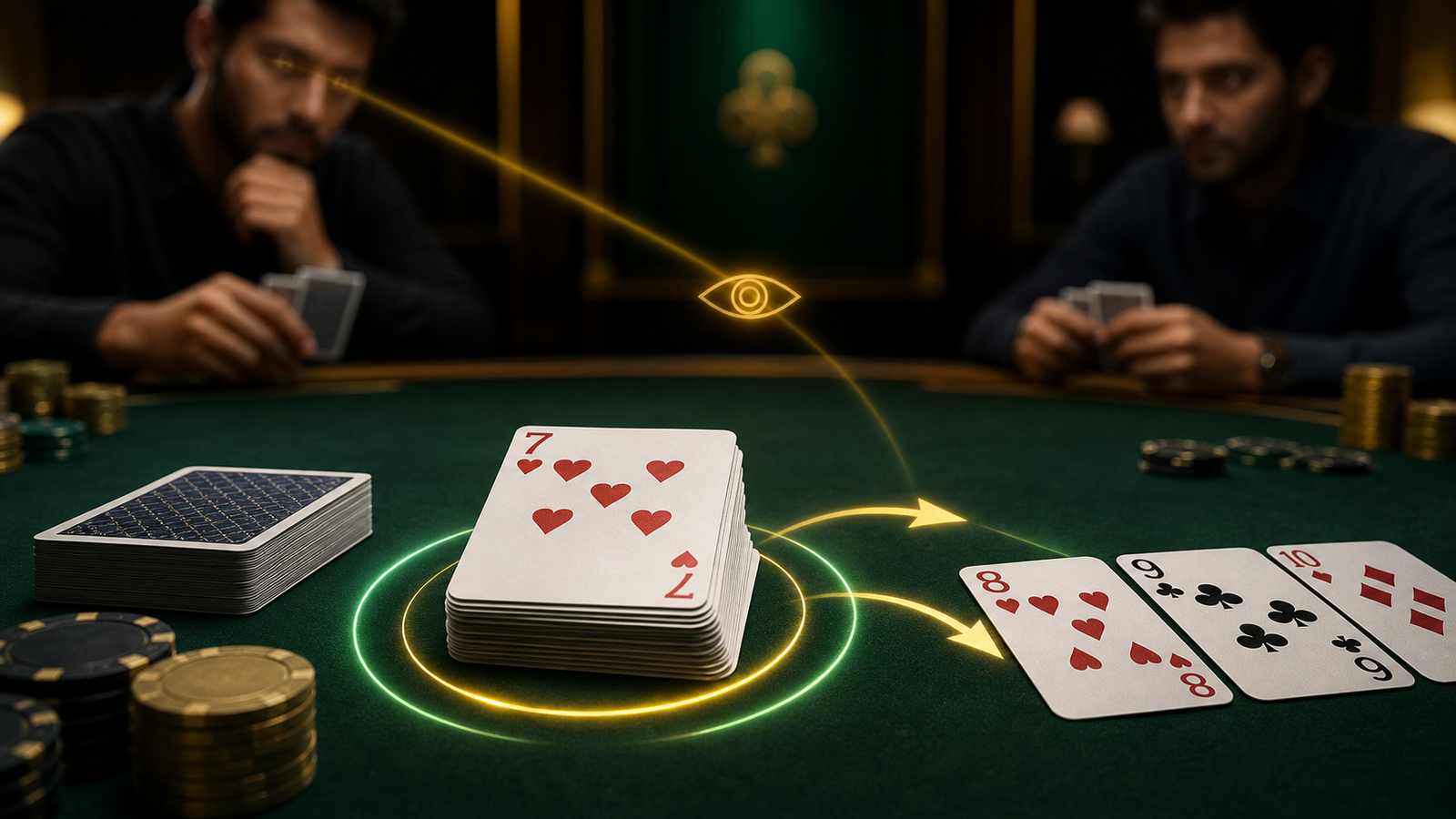
Safe Discard Signals in Indian Rummy: What to Watch Before You Throw
Discard reading is not mind-reading. It is a practical way to avoid obvious gifts, notice table patterns, and make calmer decisions under pressure.
Summary: Safe discard signals include recent open-pile pickups, nearby connector risk, repeated suit interest, and your own point exposure. Use them as responsible play guidance, not as certainty or a promise of results.
Pickup clue
A picked card can make nearby same-suit connectors more dangerous.
Suit pressure
Repeated interest in one suit may signal sequence building.
Point relief
Sometimes reducing high-card exposure is safer than waiting forever.
Uncertainty
Signals guide decisions; they do not reveal an opponent’s full hand.
What makes a discard safer?
A safer discard is a card that does less damage to your own structure and is less likely to complete an opponent’s visible plan. In Indian Rummy, this judgment starts with your pure sequence path, then considers table signals such as pickups, repeated suit interest, and high-card pressure.
Signal checklist before each discard
- Did an opponent recently pick a card from the open pile?
- Would your discard connect near that picked card by rank or suit?
- Has one suit been repeatedly picked or protected?
- Does the card break your own pure sequence or impure sequence plan?
- Is a loose high card creating more point exposure than the discard risk?
- Are you following the platform’s table rules for timing, scoring, and drop options?
Example: connector risk after a pickup
If a player picks 8♥ from the open pile, cards like 6♥, 7♥, 9♥, and 10♥ may become more sensitive because they can support nearby sequence work. That does not mean the opponent definitely needs those cards. It means you should compare the risk against your own hand: if 10♥ is loose and costly, discarding it may still be reasonable, but the choice should be deliberate.
Observation without overconfidence
Stable Indian Rummy rules define valid sequences, sets, Jokers, and declaration structure. Observation is a strategy layer, not a rule. Platform-specific values such as drop penalties and time controls can change your risk decision, and Gin Rummy deadwood logic should not be mixed into 13-card Indian Rummy unless the article is explicitly comparing formats.
FAQ
Can discard signals tell me exactly what an opponent holds?
No. They only suggest probability and risk. Use them to avoid obvious gifts, not to assume certainty.
Is it always bad to discard near a picked card?
Not always. Sometimes point control or your own hand structure matters more, but nearby connectors deserve extra caution.
What is the safest discard for beginners?
A card that does not break your pure sequence plan, does not complete an obvious visible pattern, and reduces unnecessary point exposure is usually safer.
Glossary
- Discard signal: Visible table information, such as pickups or avoided suits, that can guide safer discard choices.
- Connector risk: The chance that a discarded card helps complete a nearby sequence for another player.
- Point control: Reducing loose high-value cards so a weak hand does not become more costly.
Responsible play note
Indian Rummy is a skill-based card game, but no article, checklist, or tournament routine can guarantee results. Use these guides to improve decisions, keep time and budget limits, and follow the laws and table rules that apply in your location.