Difference Between Rummy and Gin Rummy
Rummy and Gin Rummy share the idea of building useful card groups, but the way a good hand is judged can feel very different for beginners.
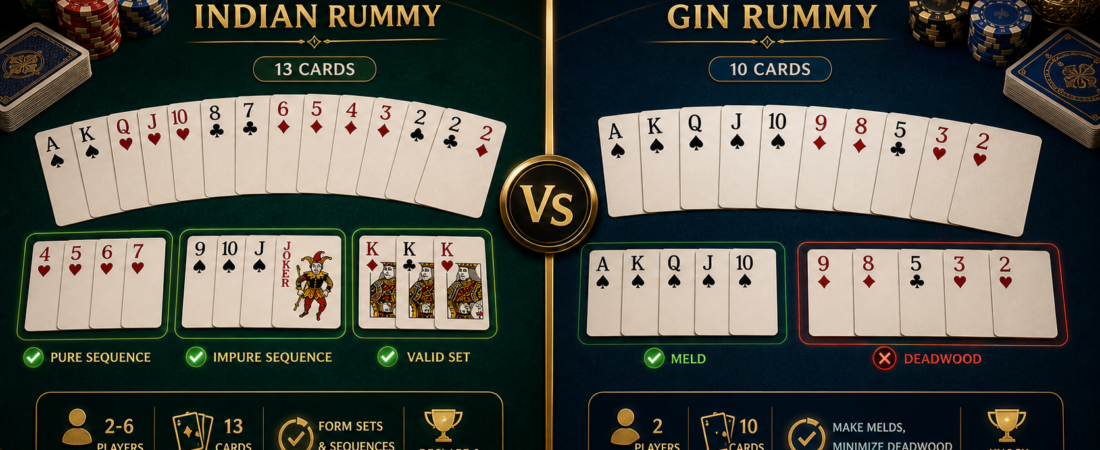
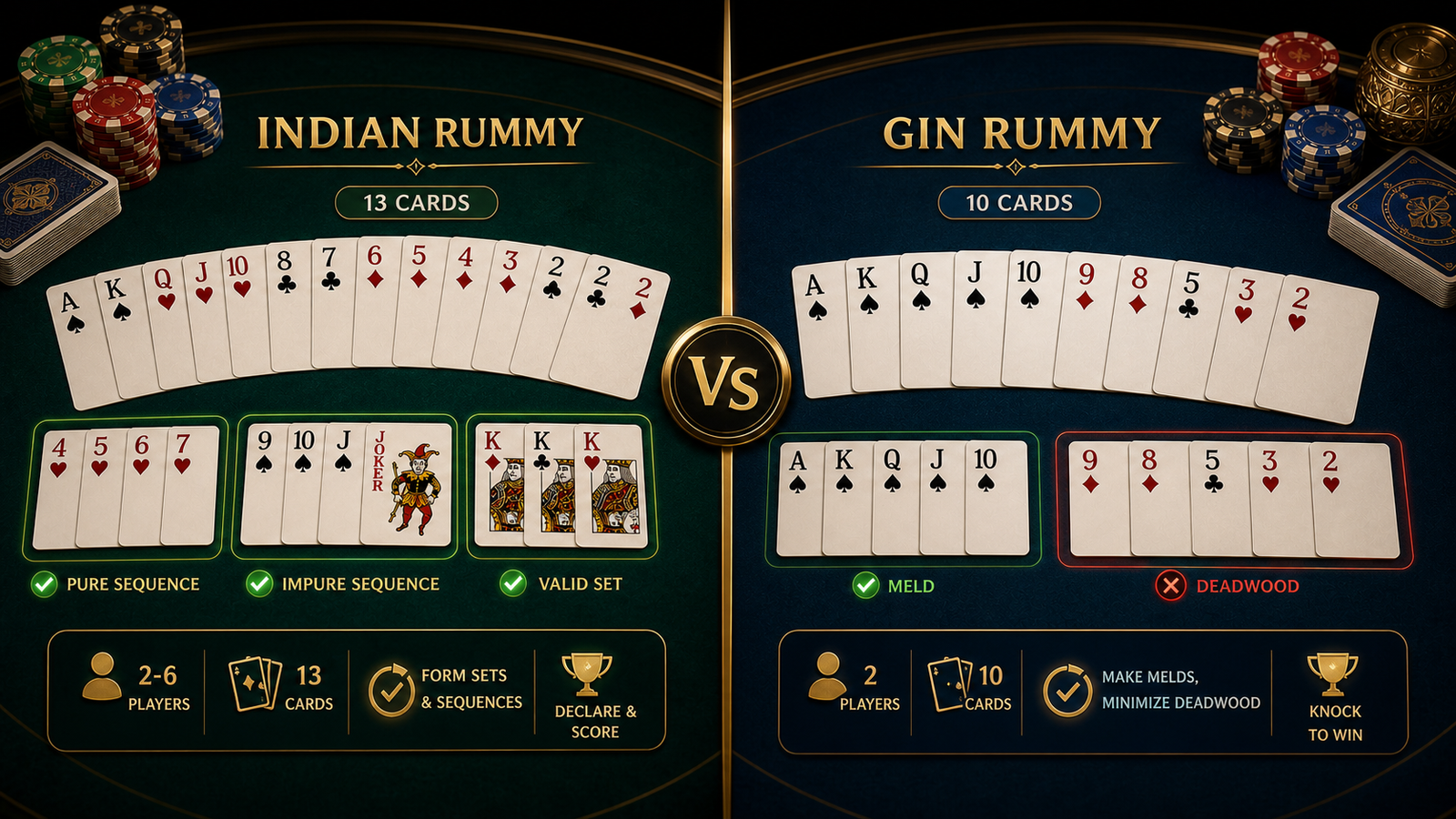
Summary: Indian Rummy usually refers to 13-card formats where a valid declaration depends on sequences and sets, including at least one pure sequence. Gin Rummy is commonly played with 10 cards, focuses on melds and deadwood, and may allow knocking depending on the rules used.
Indian Rummy hand
Often played with 13 cards, where pure sequence discipline is central to declaration quality.
Gin Rummy hand
Commonly uses 10 cards, with melds and deadwood shaping the endgame.
Joker difference
Indian Rummy tables often use printed and wild Jokers, while many Gin Rummy rules do not rely on Jokers.
Validation style
Indian Rummy checks complete grouping; Gin Rummy often measures remaining deadwood after melds.
Main gameplay difference
Indian Rummy is usually played as a 13-card game where players arrange every card into valid sequences and sets before declaring. A pure sequence, meaning a same-suit run made without a Joker, is normally required. Gin Rummy is a related but different rummy-family game where players make melds and try to keep unmatched cards, called deadwood, as low as possible.
Beginner comparison checklist
- Indian Rummy: build or protect a pure sequence first.
- Indian Rummy: use Jokers to complete weaker groups after the pure sequence is safe.
- Gin Rummy: watch deadwood value because unmatched cards affect scoring.
- Gin Rummy: learn whether the table uses knocking, gin, or undercut rules.
- Both games: confirm the exact platform or table rules before playing.
Example decision difference
In Indian Rummy, a hand with 4♥-5♥-6♥ gives you a natural pure sequence, so you can focus on grouping the remaining cards. In Gin Rummy, the same run is a meld, but the bigger question is how many points remain as deadwood after your melds. That is why a discard that looks useful in one format may be less useful in the other.
Responsible play note
Knowing the difference between games helps responsible play because you avoid applying the wrong rule set. Do not treat any strategy guide as a promise of results. Play within limits, pause when tired, and check whether your location allows the format you are choosing.
FAQ
Is Gin Rummy the same as Indian Rummy?
No. They are related rummy-family games, but Indian Rummy commonly uses 13 cards and a pure sequence requirement, while Gin Rummy commonly uses 10 cards and deadwood scoring.
What is deadwood in Gin Rummy?
Deadwood means cards that are not part of a meld. Lower deadwood is generally better, but exact scoring depends on the rules being used.
Does Gin Rummy use Jokers?
Many classic Gin Rummy rule sets do not use Jokers. Indian Rummy platforms often use printed or wild Jokers, but platform rules can differ.
Glossary
- Meld: A valid card group, such as a run or same-rank group, depending on the game rules.
- Deadwood: Unmatched cards in Gin Rummy that remain outside melds.
- Knock: A Gin Rummy endgame action allowed in some rules when deadwood is low enough.