Invalid Declaration in Rummy: A Practical Indian Rummy Checklist Before You Declare
An invalid declaration in rummy often comes from one avoidable mistake: declaring too fast without checking whether every card group satisfies Indian Rummy rules. This guide gives you a clean decision process before you commit the hand.
Summary: In 13-card Indian Rummy, a declaration is only valid when your full hand is arranged into legal sets and sequences, including at least one pure sequence. Platform scoring and penalties may differ, but the pure-sequence requirement and legal grouping check are the safest starting points.
What makes a declaration invalid in Indian Rummy?
A declaration becomes invalid when the full 13-card hand does not satisfy the grouping rules required by Indian Rummy. The most common reason is missing a pure sequence, but players also go wrong by mixing suits inside a sequence, overusing a Joker, or leaving one loose card outside a legal group.
If you search for rummy rules 13 card, remember that different platforms may apply slightly different penalty values or table formats. What stays consistent is the need to classify every card correctly before you declare.
The pure sequence rule comes first
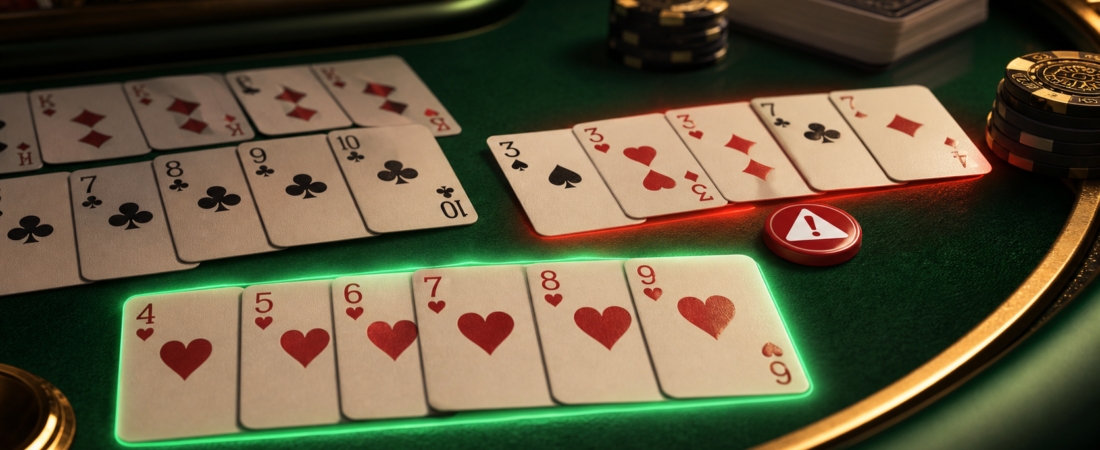
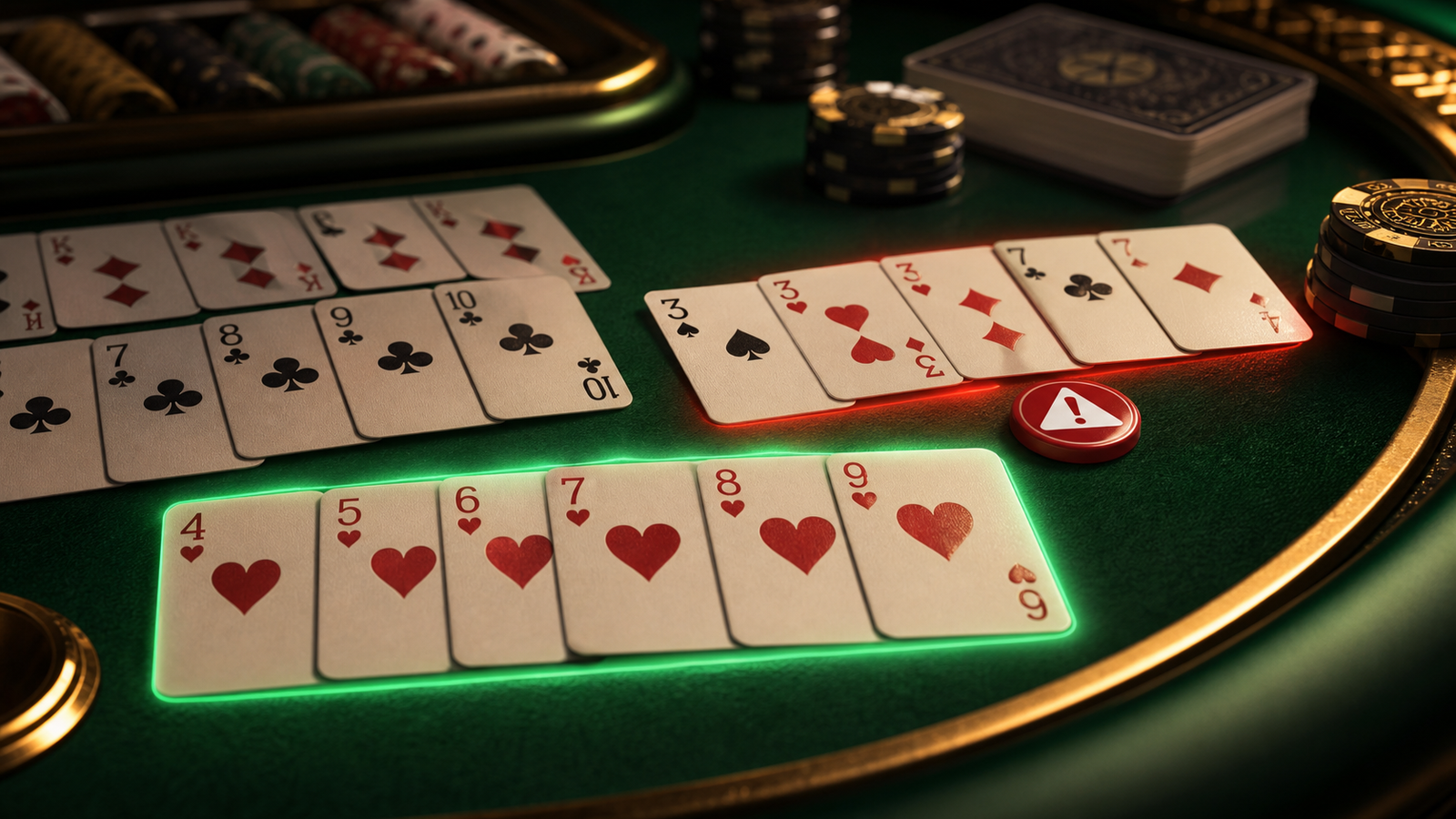
Before you check anything else, isolate your pure sequence candidate. A pure sequence is a run of consecutive cards from the same suit without using a Joker as a substitute. If this part is missing, the declaration is not ready no matter how attractive your other sets look.
This is why many players who focus only on speed run into invalid declaration problems. They see two or three completed groups and forget that the hand still fails the most important rule.
Common invalid declaration mistakes
One frequent mistake is treating a Joker-supported run like a pure sequence. A printed Joker in rummy or a wild Joker can complete an impure sequence, but it does not replace the need for one natural sequence.
Another mistake is declaring with an incomplete set structure. For example, two cards of the same rank plus one unrelated card are not a set. Players also misread same-color cards as same-suit cards, especially during fast endgames on mobile tables.
How to reduce invalid declaration risk in live play
Use a fixed hand-reading order every time. First verify the pure sequence, then the second sequence, then sets, then any Joker-supported groups, and finally any leftover card. A repeatable order reduces emotional mistakes late in the hand.
Also slow down when the declare button becomes available. A fast declaration may look sharp, but one wrong grouping turns a strong hand into an avoidable penalty.
Declaration checklist
- Confirm that at least one pure sequence exists and uses no Joker substitute.
- Check that every sequence uses consecutive cards from the same suit.
- Make sure each set uses the same rank across different suits where required.
- Verify that no card is counted in two different groups.
- Check whether the printed Joker or wild Joker is only supporting legal impure groups.
- Look for one leftover card, because a single ungrouped card still makes the declaration invalid.
- Pause for one final suit check before pressing declare.
Example hand review
Suppose your hand contains 4♥ 5♥ 6♥, 8♣ 8♦ 8♠, J♠ Q♠ printed Joker, 2♦ 3♦ 4♦, and K♣. At first glance the hand looks close, but it is still invalid because the last K♣ is not part of any legal group.
Now imagine you also treat J♠ Q♠ printed Joker as your pure sequence. That would be another error. The printed Joker can support an impure sequence, but your pure sequence is actually 4♥ 5♥ 6♥ or 2♦ 3♦ 4♦. Until every card fits, the declaration should wait.
FAQ
Is an invalid declaration always caused by a missing pure sequence?
No. Missing a pure sequence is the most common cause, but invalid declarations also happen when cards are grouped with the wrong suit, when one card is left ungrouped, or when a Joker is used in a way that breaks sequence rules.
Can a printed Joker in rummy count as part of a pure sequence?
No. A printed Joker can help complete an impure sequence or set, but a pure sequence must be formed naturally without a Joker substitute.
Do all Indian Rummy platforms use the same invalid declaration penalty?
Not always. Penalty values and table settings can vary by platform, so treat those as platform-specific details. The safest rule reference is still to validate the hand structure before declaring.
Glossary
Pure sequence: A natural run of consecutive cards from the same suit with no Joker substitute.
Invalid declaration: A declared hand that fails the required grouping rules of the table format.
Impure sequence: A sequence completed with help from a printed Joker or wild Joker.
Responsible play note
Indian Rummy is a skill-based card game, but outcomes still vary from hand to hand. Use guides like this to improve decisions, not to expect guaranteed wins. Play only if permitted in your location, keep time and budget limits, and stop if the game stops feeling controlled.