
Rummy Hand Analysis: When to Break a Set for a Pure Sequence
A strong-looking set can still be the wrong priority. This practical hand analysis shows how to decide whether breaking a set is the safer route to a valid Indian Rummy declaration.
Summary: In Indian Rummy, the pure sequence rule controls the whole hand. If a set uses the card that can complete your only realistic natural run, breaking that set may reduce long-term risk even when the set looks attractive.
The sample hand
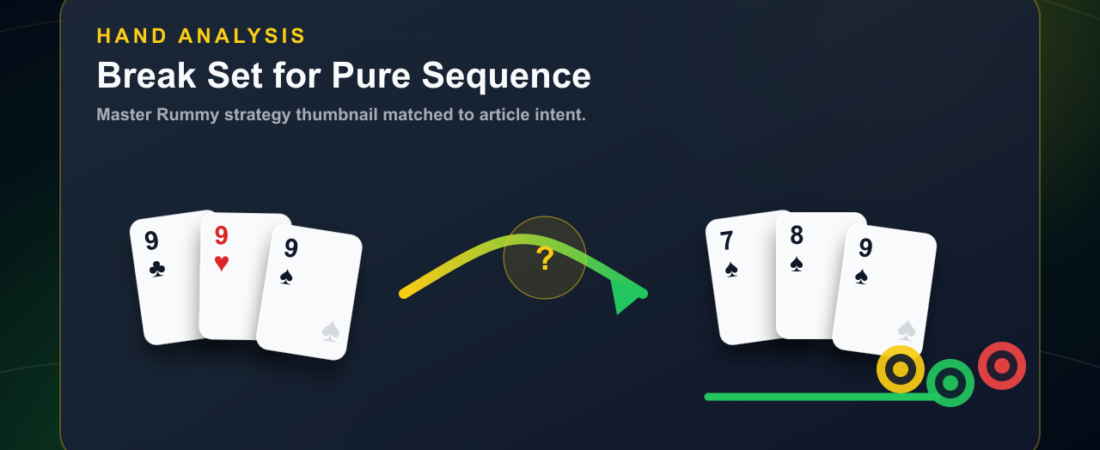
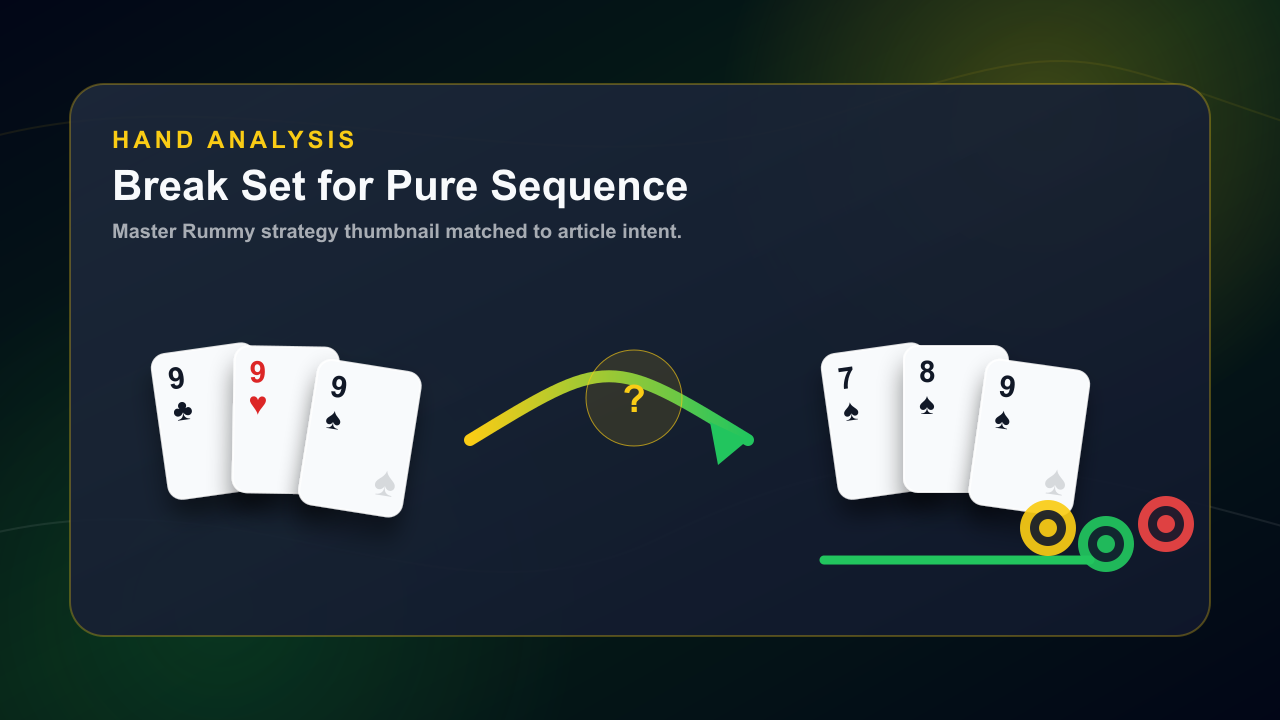
Imagine you are playing a 13-card Indian Rummy round and your hand contains 7♠, 8♠, 9♠, 9♥, 9♣, Q♦, K♦, 4♣, 5♣, 10♥, J♥, 2♠, and one Joker. At first glance, the three 9s look like a ready-made set. Many players would protect 9♠ with 9♥ and 9♣ because a completed group feels safe.
The problem is that 7♠-8♠-9♠ is also your cleanest pure sequence path. Without it, your hand depends on drawing 6♠, 10♠, or building a different natural sequence from scratch. That is a much harder route. The correct analysis begins with one question: which card protects the mandatory pure sequence?
Check Pure Sequence First
If 9♠ completes 7♠-8♠-9♠, it has higher strategic value than the set. A set can help you declare, but a pure sequence is required before any declaration can be valid.
Measure Replacement Options
A broken set can often be rebuilt with another 9, a printed Joker, or a wild Joker. A missing pure sequence has fewer replacement paths, especially if opponents are collecting the same suit.
Watch the Open Pile
If spade connectors have appeared or been picked, holding 9♠ becomes more urgent. Avoid discarding 6♠, 9♠, or 10♠ signals unless your point risk forces the move.
Rebuild After Locking
Once 7♠-8♠-9♠ is protected, treat 9♥ and 9♣ as flexible cards. They can rebuild a set later, pair with Joker support, or become safe discards if the hand changes.
Decision matrix: keep the set or break it?
Break the set when the shared card completes your only natural sequence, when you have no other pure sequence candidate, or when the replacement path for the set is easier than the replacement path for the sequence.
Keep the set when you already have a pure sequence elsewhere, when the sequence path needs too many missing cards, or when breaking the set creates several loose high-value cards that increase your penalty risk.
In the sample hand, breaking the set is usually better because 7♠-8♠-9♠ immediately satisfies the most important declaration condition. The remaining 9♥ and 9♣ are not useless; they are simply downgraded from a locked group to flexible material.
How to play the next few turns
After locking the pure sequence, your next task is to reduce confusion. Keep 7♠, 8♠, and 9♠ together as a protected zone. Do not mix the 9♠ back into set thinking unless you draw a stronger pure sequence elsewhere.
Then evaluate 9♥ and 9♣. If you draw another 9, the set can return naturally. If you draw a useful Joker, one of those 9s may support an impure sequence or set. If neither improves, release the higher-risk loose cards before the table moves into the endgame.
Also observe opponents. If someone picks 8♣ or 10♥ from the open pile, your loose cards may become dangerous discards. A good hand analysis is not static; every pickup changes the safety of your next throw.
Common mistake: protecting completed groups too early
Beginners often protect the first completed group they see. That habit feels organized, but it can hide the real problem: an invalid declaration structure. A set is valuable only after the pure sequence condition is handled. Until then, the hand is still fragile.
The better habit is to rank groups by declaration importance. Pure sequence comes first. After that, look for a second sequence, Joker-supported groups, sets, and finally deadwood reduction. This order keeps the hand legal, flexible, and easier to finish under pressure.
The final rule
Break the set when it protects your only realistic pure sequence. Keep the set when your pure sequence is already secure or the sequence path is too unlikely. This single rule prevents many attractive but invalid hands and gives you a clear structure for mid-game decisions.
Use the official Master Rummy download page for Android access and practical gameplay guides.