

Can a Four-Card Set Supply Your Missing Second Sequence?
A completed four-card set can hide a useful sequence card. Test the whole arrangement before keeping the set intact out of habit.
Summary: When the active rules permit three-card sets, a four-suit set may release one card while leaving a valid set behind. Compare the resulting groups and preserve your pure sequence.
Check what remains after the move
It is easy to leave a completed four-card set untouched. Yet one of its cards may close the second sequence your hand still needs. Treat the grouping as provisional while organising your own hand. First check that the active table accepts the remaining three-card set and the proposed sequence.
A natural set groups one rank in different suits; a sequence groups consecutive ranks in one suit. The Indian Rummy rules guide explains this distinction. The proposed move must respect both structures. Moving a card is useful only when the groups left behind also work.
Example: move the heart seven
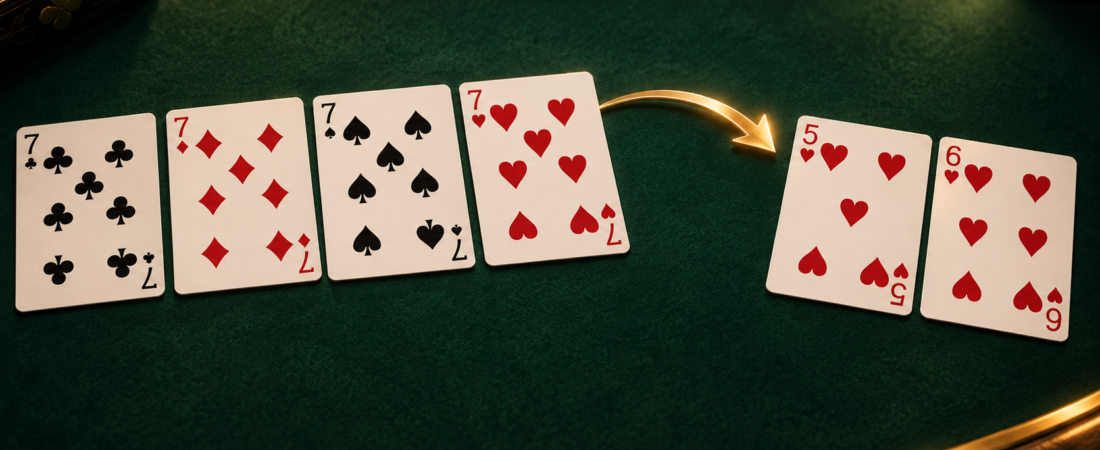
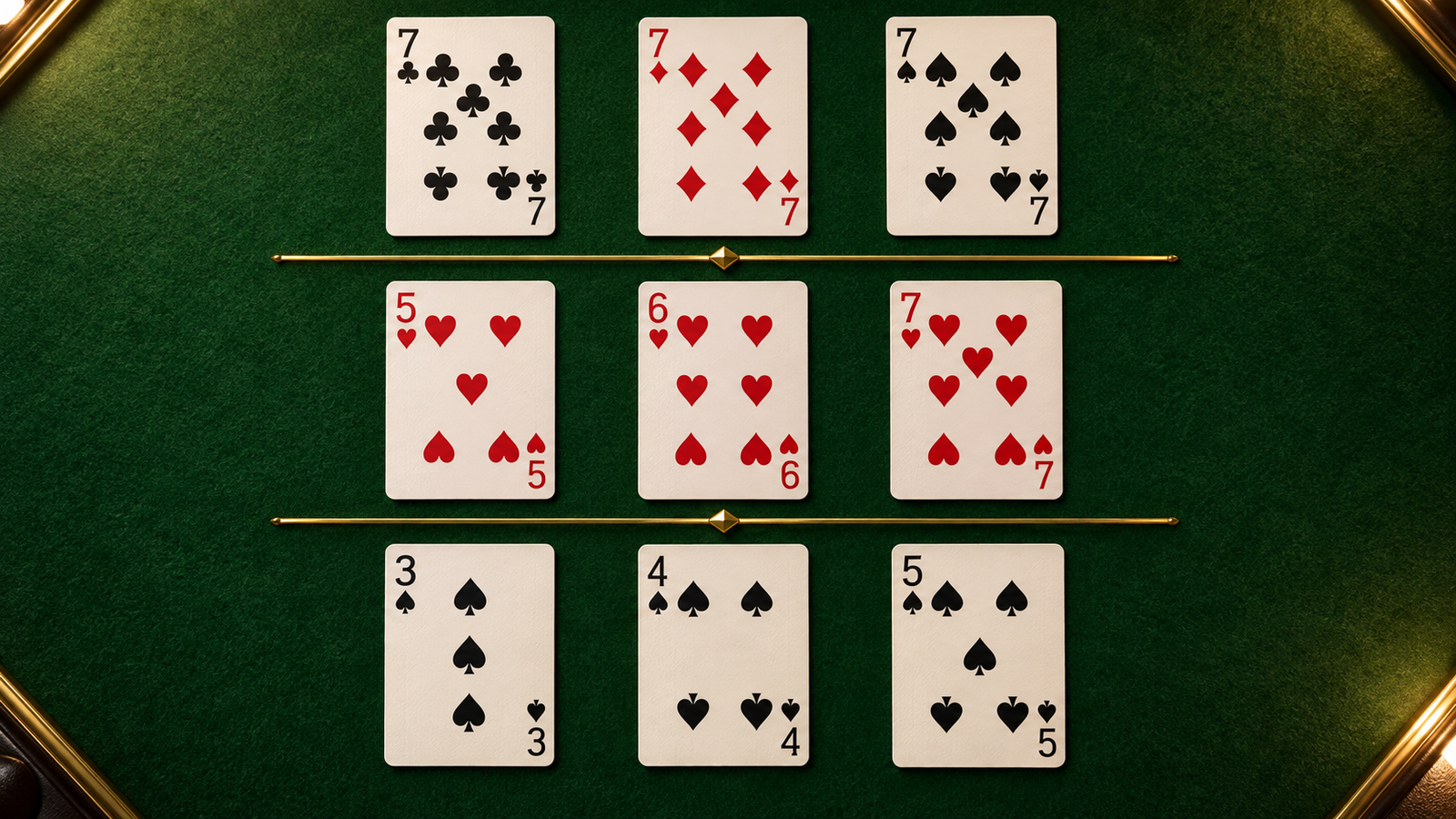
Assume common 13-card declaration requirements: at least two sequences including one pure sequence, with all cards assigned to valid groups. Assume three-card natural sets are accepted and none of the cards below is a designated wild Joker. You have 3S-4S-5S, 7C-7D-7S-7H and 5H-6H, plus four other cards. H, S, C and D mean hearts, spades, clubs and diamonds.
Move 7H from the sevens to the hearts. The result is 3S-4S-5S, 7C-7D-7S and 5H-6H-7H. The three remaining sevens use different suits, and the heart group is consecutive in one suit. The original spade pure sequence remains intact. These groups account for nine cards, so the four other cards still need checking. This partial example is not a declaration-ready hand.
Run the before-and-after checklist
- Identify the pure sequence you intend to preserve.
- Name the missing sequence and its exact gap or extension card.
- Check whether a four-card set holds that physical card.
- Remove it from the set before testing the new sequence.
- Validate the remaining set, including its suits and minimum size.
- Count every card once across the resulting groups.
- Check all remaining cards before choosing the next action.
Do not use 7H in the set and the heart run at the same time. Moving a card in a mental plan does not create a second physical copy.
Know when this move does not help
If the source set has only three cards, removing one leaves a pair under the example’s rules. If the destination cards are 5H-6D, adding 7H does not make a same-suit sequence. If the full hand still has unmatched cards, completing these groups does not finish the declaration check.
Even a valid rearrangement is not a universal discard instruction. The rest of the hand, available actions and table rules still matter. Use the declaration-ready hand audit after rearranging, and recheck any Joker treatment separately.
Practise the arrangement before using it under a timer
Lay out this partial example away from a live hand. Move the heart seven, then name the cards in each remaining group. Check the reverse move too: putting 7H back leaves the hearts unfinished. After each move, check the cards left behind, even if you had already marked that group as complete.
18+ only. Practise responsible play, set time and budget limits, take breaks and do not chase losses. A better arrangement cannot guarantee a win. Read the responsible gaming guide.
FAQ
Should I always split a four-card set?
No. Check the sequence gained, the set left behind and the full hand under the active rules. Keep the arrangement only if the resulting groups serve your hand.
Can the same seven belong to both groups?
No. Each physical card can be counted only once in a final arrangement.
Is the nine-card example ready to declare?
No. Four cards remain outside the example groups and still need validation in a 13-card hand.
Glossary
Responsible play note
Indian Rummy is a skill-based card game, but no article, checklist, or tournament routine can guarantee results. Use these guides to improve decisions, keep time and budget limits, and follow the laws and table rules that apply in your location.