


Review a Practice Rummy Hand Without Judging Only the Result
A useful practice note explains what you knew when you chose a card. The final result belongs in a separate field.
Summary: Review one decision from a completed practice hand. Record the visible information, your reason, a plausible alternative and one check to repeat next time. Do not turn a lucky draw into a rule.
Record the decision before judging the result
A result tells you how the hand ended. It does not show whether your earlier choice made sense with the information available then. Write down the cards and observations you actually remember. Mark anything missing as unknown. If you fill a gap with a card you saw later, your explanation uses information you did not have at the time.
Use a notebook after the hand has finished. Follow the platform rules on recording and assistance; this exercise does not require live tools or another player’s private information. One carefully reviewed choice is enough for a practice note.
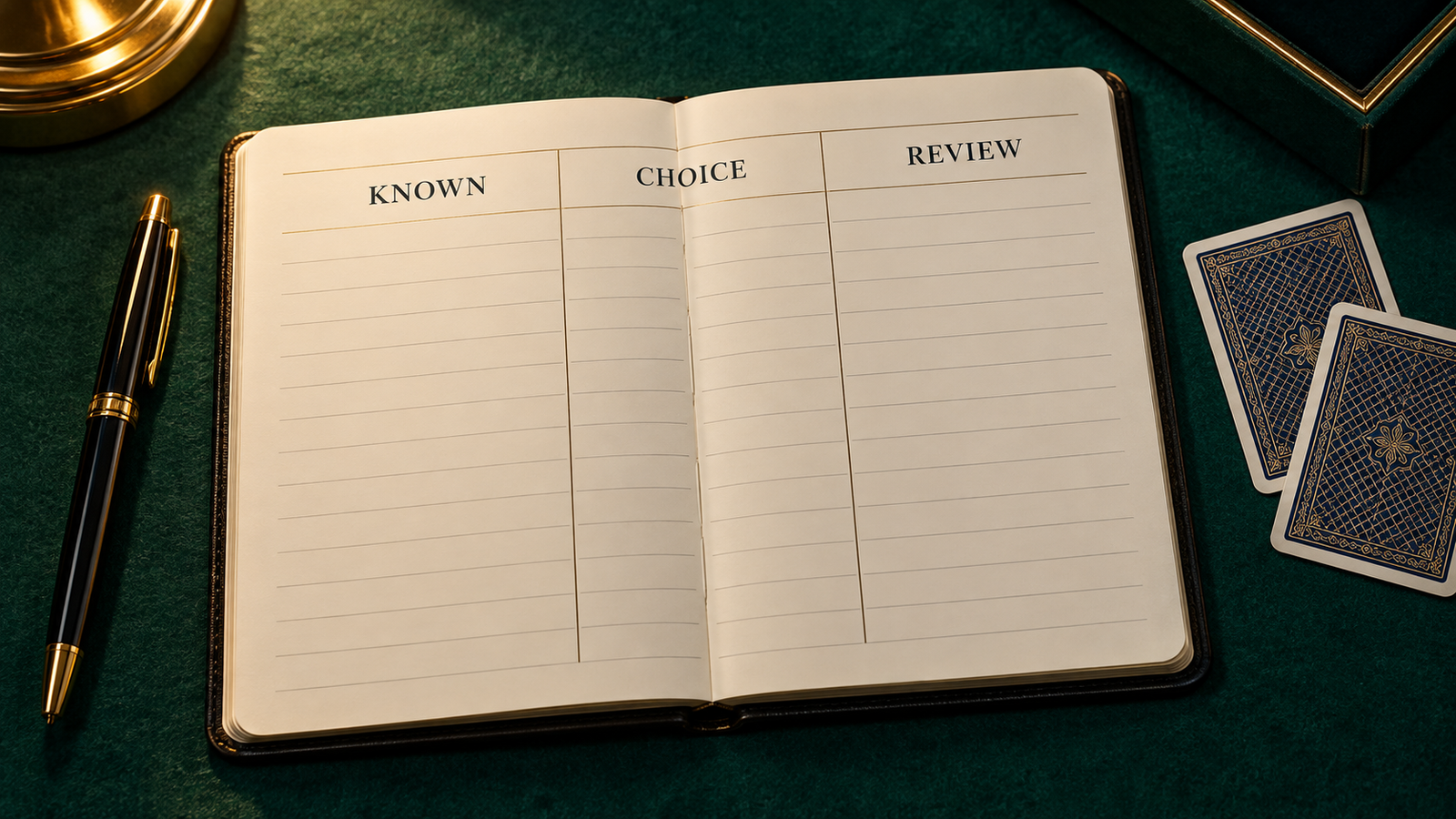
Use a small review log
- Situation: note the game variant and the decision being reviewed.
- Known information: record your relevant cards and any visible pickup or discard you genuinely remember.
- Choice: write the card you kept or discarded and your reason at that moment.
- Alternative: name one other choice and explain its tradeoff.
- Result: record what happened later without moving that information into the earlier decision.
- Next check: choose one question to ask in the next practice hand.
Keep uncertain recollections labelled as uncertain. A short, honest note is more useful than a detailed invented hand history.
Example: a sequence survives a later loss
Consider only part of a hand: 5H-6H-7H and an isolated QC, where H means hearts and C means clubs. Assume none of these cards is designated as a wild Joker. The three hearts form a natural pure sequence. If the choice is between breaking that sequence and discarding the isolated queen, preserving the sequence has a clear structural reason. The rest of the hand and table observations still matter; this is not a complete discard prescription.
Suppose the hand later loses. The review should not say that keeping 6H was a mistake just because of the loss. Record the reason it was kept, then check whether another fact available at that time would have changed the decision. Likewise, a later win does not prove every earlier discard was sound.
Check rules separately from strategic judgement
A sequence uses consecutive cards of the same suit; a set uses cards of the same rank from different suits. A pure sequence remains a declaration requirement. Review group validity against the Indian Rummy rules before debating which reasonable discard you preferred. Check the active table’s Joker and scoring rules rather than assuming every variant is identical.
For a structured validity check, use the declaration-ready hand audit. Keep a rules error separate from an uncertain strategic choice in your notes.
Finish with one repeatable check
Replace a vague note such as “play better” with a question such as “Does this discard break my only pure sequence?” Review that question in a later practice session. The log organises learning; it does not establish win probabilities or promise improved results from a small sample.
18+ only. Practise responsible play, set time and budget limits, take breaks and do not chase losses. Review can happen away from the table without extending a session or spending more.
FAQ
Should I review only losing hands?
No. A winning hand can contain a weak decision, and a losing hand can contain a defensible one. Review the information available at the time.
What if I cannot remember the other cards?
Mark them as unknown and narrow the review to facts you remember. Do not reconstruct a complete hand by guessing.
Does keeping a practice log guarantee improvement or wins?
No. It gives you a consistent way to examine decisions, without guaranteeing a result.
Glossary
Responsible play note
Indian Rummy is a skill-based card game, but no article, checklist, or tournament routine can guarantee results. Use these guides to improve decisions, keep time and budget limits, and follow the laws and table rules that apply in your location.