


Low-Point Card or Sequence Connector? Choose What to Keep in Rummy
Low points reduce the cost of an unmatched card, but they do not make that card structurally useful. A connected middle card can deserve the space when it advances a required sequence.
Summary: Judge a card on two axes: what valid group it can help form and how many points it exposes if the hand ends. Keep a connector when its natural routes serve the pure or second sequence; keep an isolated low card only when the stronger route is already secure or the connector has become unrealistic.
Start with structure
Check whether the card advances a required sequence or a valid set.
Count natural outs
List the unseen same-suit cards that can complete the route.
Price the exposure
Low ranks cost fewer points when they remain unmatched.
Use a tiebreaker
Let point value decide only after comparing realistic group value.
Point value and hand value are different
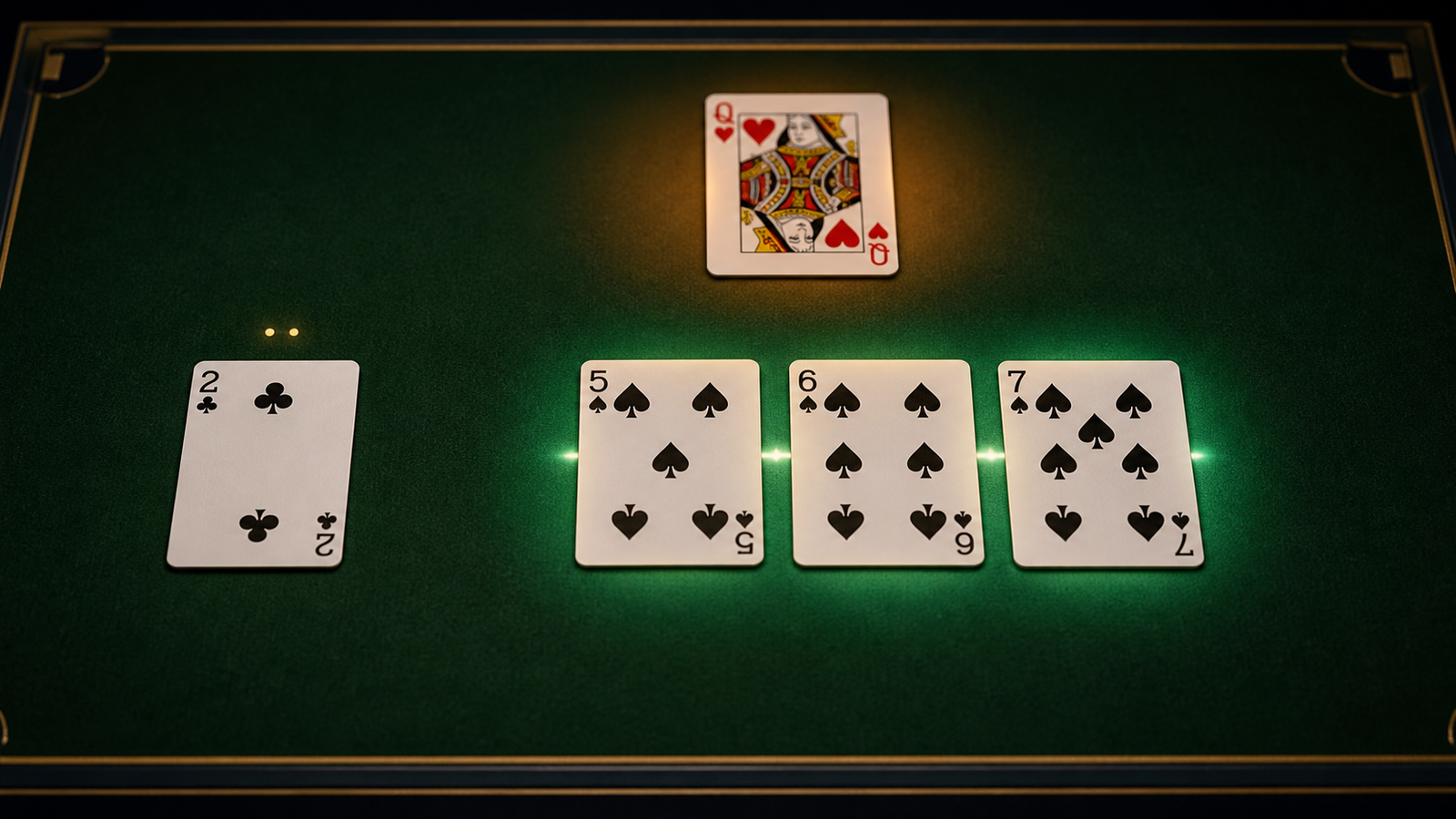
In common Indian Rummy scoring, numbered cards count at face value while aces and face cards generally count as ten points, subject to the active table rules and any cap. That makes 2C inexpensive if it stays loose. Yet a 7D beside 6D and 8D already belongs to a natural sequence and may be far more important to a valid declaration. Low point cost is a risk measure, not a complete keep-or-discard rule.
Connector-versus-low-card framework
- Confirm the best route to the mandatory pure sequence.
- Check whether the hand already has a realistic second sequence.
- Count the natural same-suit outs for each unfinished route.
- Separate cards with current group value from cards held only because they are cheap.
- Compare point exposure after the structural ranking.
- Discard a connector when its outs are visibly blocked or a stronger route replaces it.
- Review the choice after every draw and keep time and budget limits.
Example: 2C versus a middle diamond connector
Assume you hold 6D-8D with 7D, plus an isolated 2C and other cards. The three diamonds form a natural sequence immediately, so 7D has declaration value beyond its seven points. The 2C carries only two points but does not support a group. If another loose card must go, discard 2C before breaking 6D-7D-8D. The answer changes if 7D is isolated, both neighbouring diamonds are already visible in the discard history, and 2C completes a set or another valid route.
Use points as a tiebreaker, not the first filter
When two loose cards have equally weak connections, release the higher-point card first unless table observation suggests a clear feeding risk. Do not dismantle the only pure-sequence route merely to save a few points. The common declaration structure requires at least two sequences, including one pure sequence, and all other cards must form valid sequences or sets. Check platform-specific Joker, deck, scoring and drop rules. The high-card reduction guide and rules page provide the next checks.
FAQ
Is a low card always safer to keep in Indian Rummy?
No. It lowers unmatched point exposure, but a higher connected card may be more valuable if it forms a required sequence.
When should point value break a discard tie?
Use it after comparing pure-sequence need, second-sequence need, natural outs and visible feeding risk.
Can this framework guarantee a better result?
No. It organises the decision, but draws, opponent hands and later turns remain uncertain.
Glossary
- Point exposure: The points a card may add if it remains unmatched when the hand is scored.
- Sequence connector: A same-suit card that joins or extends consecutive ranks.
- Structural value: A card’s contribution to the sequences or sets needed for a valid declaration.
Responsible play note
Indian Rummy is a skill-based card game, but no article, checklist, or tournament routine can guarantee results. Use these guides to improve decisions, keep time and budget limits, and follow the laws and table rules that apply in your location.